 Social Liberty
A Day With Edmund Burke
Farm at dawn, a schoolhouse by noon, Parliament in the afternoon, a tavern table at night. A day with Edmund Burke, and "conservative" stops meaning what it means now, and institutions, their kinds and structures, become the whole question of liberty.
Click to enlarge
In 1771 Oliver Goldsmith sent a friend a short report on a sitting member of Parliament: “Burke is a farmer – en attendant a better place, but visiting about too.” The report was accurate. That autumn the member wrote to a cousin of “the most rainy and stormy season that has been known,” of wheat got into ground on “about four and twenty acres,” and at some length of bacon and hogs. Gregories, near Beaconsfield, ran to six hundred acres, bought in 1768 mostly with borrowed money, and debt on it would follow him for life.
No single day holds all of what comes next – its hours are gathered from thirty years, each one on record, and laid end to end. Burke’s life moved through the same sequence again and again: holding, school, assembly, table, desk. Each stop is an institution. Taken in order they make a measure of the man.
Morning, the holding
Weather, stock, and a steward named John Rolfe.
In November 1795, after a failed harvest and with Berkshire magistrates setting a wage scale by price of bread, that farmer wrote to the prime minister against any public schedule for grain or labor.
Market is the meeting and conference of the consumer and producer, when they mutually discover each other’s wants. A sentence like that could be Hayek – it came from someone who kept hogs.
Household stands first.
We begin our public affections in our families. No cold relation is a zealous citizen.
Famous passage on the little platoon says same from a wider angle:
To be attached to the subdivision, to love the little platoon we belong to in society, is the first principle (the germ, as it were) of public affections.
A person isn’t born into mankind. A person is born into a kitchen, then a lane, then a parish, and any larger loyalty is built by extending those, one link at a time.
Forenoon, the schools
Penn is a short distance from Beaconsfield. In spring of 1796, two years after burying his only son, Burke opened a school there for sons of French émigrés, boys whose families the Revolution had killed or scattered. Government cooperated and held the house, an abbé ran the classes, and Burke drew up the scheme and watched over it in his last year of life.
About nine months after opening, by a local account, a mob pulled down part of its wall and broke every window. School stayed open until 1820, five years past Waterloo, and in 1822 the house was sold in lots and carried away.
He knew what a school can be when law stands against it, since his own education ran through three such places. As a boy sent from Dublin to his mother’s Catholic kin, the Nagles, in the Blackwater valley, he had a village schoolmaster named O’Halloran, in a country where penal statute since 1695 had barred Catholics from keeping school.
In 1766, as his biographer James Prior collected the story, a new member of Parliament came back to look over family property, and O’Halloran walked slowly up the avenue, doubtful of his welcome from a great man. Burke, shaving at an upstairs window, ran down “his shirt collar open, his beard half shaven,” seized his old master by both hands, kept him all day and sent him off with five guineas.
O’Halloran spent his old age telling anyone in Castletown Roche that he was first to put a Latin grammar in hands of Edmund Burke. A cousin of same Nagle family, Nano Nagle, was by the 1750s opening schools for poor children of Cork in defiance of that same statute.
At twelve he went to Ballitore, in Kildare, to a boarding school kept by a Yorkshire Quaker, Abraham Shackleton, who took boys of any confession. Burke, baptized in his father’s church and raised near his mother’s, called Shackleton the teacher who shaped him most, and kept Shackleton’s son as a friend until death. At Trinity he founded a debating club in 1747. It still exists, merged into the College Historical Society. All this came before he ever held office: a schoolmaster under ban, a dissenter’s boarding school, a club of students.
His judgment of that ban comes from a tract on the Popery laws, left unfinished:
A law against the majority of the people is in substance a law against the people itself!
Those laws reached past worship to property and family, dividing Catholic estates among heirs and giving the estate to a son who converted. Burke read them as a machine for taking apart every institution a people had, one household at a time. Nobody who grew up on the wrong side of them could mistake authority for order.
Afternoon, the House
Westminster, and a bench where he spent nearly thirty years.
A kitchen, February 1780. He rises on economical reform with a list of offices that served nobody. Civil list debt keeps growing, he explains, “because the turnspit in the king’s kitchen was a member of Parliament.” Old offices had become pay for votes. Here was a defender of inherited things going through an inherited thing with a knife, and two years later part of his list was law.
A colony, March 1775. He holds the floor for hours on conciliation with America, and what he describes is a set of working institutions: congregations given to “the dissidence of dissent, and the protestantism of the Protestant religion”; a people among whom law is “so general a study” that, he has heard, they buy nearly as many copies of Blackstone as England does; colonies grown up through “a wise and salutary neglect.” Above all, distance: “Three thousand miles of ocean lie between you and them. No contrivance can prevent the effect of this distance in weakening government. Seas roll, and months pass, between the order and the execution.” A year earlier he had stood in opposition when Parliament rewrote the Massachusetts charter and forbade town meetings beyond one a year without the governor’s written leave. Massachusetts towns were never a free country, they held slaves and seized Baptist goods for church taxes, but they were bodies with their own business, and Parliament aimed at them first.
A company, December 1783. His best speech on institutions concerns a corporation. East India Company, holding a royal charter, had since 1765 held the right to collect land revenue of Bengal, and its servants arrived “wave after wave,” in an “endless, hopeless prospect of new flights of birds of prey and passage.” To defenders of its charter he answered that “every species of political dominion and every description of commercial privilege” is “in the strictest sense a trust: and it is of the very essence of every trust to be rendered accountable,—and even totally to cease, when it substantially varies from the purposes for which alone it could have a lawful existence.” Then he read an inventory of what stewardship would have left behind: “England has erected no churches, no hospitals, no palaces, no schools; England has built no bridges, made no high-roads, cut no navigations, dug out no reservoirs.”
So the man remembered for reverence toward old bodies spent his best years pulling sinecures out of one and calling another to account. Over the decade that followed, France gave him the opposite case. A plan he read cut the country into “eighty-three pieces, regularly square,” and his answer was: “No man ever was attached by a sense of pride, partiality, or real affection, to a description of square measurement. He never will glory in belonging to the chequer No. 71, or to any other badge-ticket.” In June 1791 the Le Chapelier law went further and forbade trades to form any association at all, leaving a citizen and a state with nothing between them. Robert Nisbet would write the sociology of that gap in The Quest for Community in 1953.
Three claims that pull apart
Burke’s afternoon leaves three claims side by side.
First, liberty lives inside institutions. A person alone holds no liberty that a stronger neighbor or a ministry can’t take in an afternoon. What stands in the way is a family, a congregation, a town, a court, a guild, a club.
Second, institutions go bad. Offices turn into pay, charters into dominion, a school ban into a way of life. Every body with an income learns to serve itself.
Third, nobody is wise enough to redesign them whole. Square departments are what comes of trying, and so are charter rewrites from three thousand miles off.
If liberty lives in what rots, and redesign kills what it touches, there seems no good move left. The way through lies in what was never in conflict: the second claim and the third. Rot calls for repair, and repair doesn’t call for redesign.
A state without the means of some change is without the means of its conservation. Burke’s own test was a disposition to preserve, and an ability to improve, taken together. That test can only be met where institutions are many, because with many of them one can be cut out, reformed or closed while others go on holding the people it failed. A country with one great institution has only all-or-nothing.
Evening, the table
Gerrard Street, the Turk’s Head. Since 1764 a small company has dined here: Johnson, Reynolds, Goldsmith, later Gibbon, Adam Smith, Charles James Fox. It holds no charter and collects no tax, and members argue over everything.
A body like that had a theory behind it. In 1770, defending political party when party was a dirty word, Burke wrote: “When bad men combine, the good must associate; else they will fall, one by one, an unpitied sacrifice in a contemptible struggle.” Association, for him, was how a free person acts at all.
Another guest belongs at his table for a season. In 1788 Thomas Paine was in England with a design for an iron bridge, and Burke dined with him, and went up to Masborough to see the work at Walker’s foundry. They parted over France, and Rights of Man was written against the Reflections. Paine’s Agrarian Justice appeared in 1797, the year Burke died, and it says what Burke couldn’t: rent of the earth belongs to everyone.
Here this stands with Paine against his host. Burke held “the power of perpetuating our property in our families” among the chief goods of society, without separating a family’s home and work from a ground rent nobody earned. He saw what land revenue did to Company servants in Bengal and never turned that gaze on the estates of his Whig patrons, who kept his own farm afloat with loans.
He argued against reforming Parliament’s rotten boroughs. He defended an established church, where Bill of Separations wants that wall built. His plan for slavery, a code sketched in 1780, was gradual emancipation, a steward’s plan for a thing that deserved no steward. Stewardship has no way, by itself, to say what should end at once.
And the word. Burke never called himself a conservative. Political use of the word comes after him, from Chateaubriand’s journal Le Conservateur in 1818 and an unsigned 1830 article in the Quarterly Review. His own label was Old Whig, and when Hayek wrote “Why I Am Not a Conservative” in 1960 he reached for that same label to describe his own position. Russell Kirk gave Burke to the American right with The Conservative Mind in 1953, and what that right has lately done in his name would have surprised him. In 2023 the Texas legislature passed a statute, called the Death Star by its opponents, stripping cities of power to pass ordinances across whole fields of state code, and in 2025 an appeals court threw out the cities’ challenge. Sacramento overrides its towns from the other flank. Austin’s version comes from people who call themselves conservative, and its nearest ancestor is a 1774 act about town meetings in Massachusetts, which Burke stood against.
A conservative in his sense wants the turnspit out of Parliament, the Company answerable, the Quaker’s school left alone and the town its own business. That is the conservative these essays lean toward, and no other.
Night, the desk
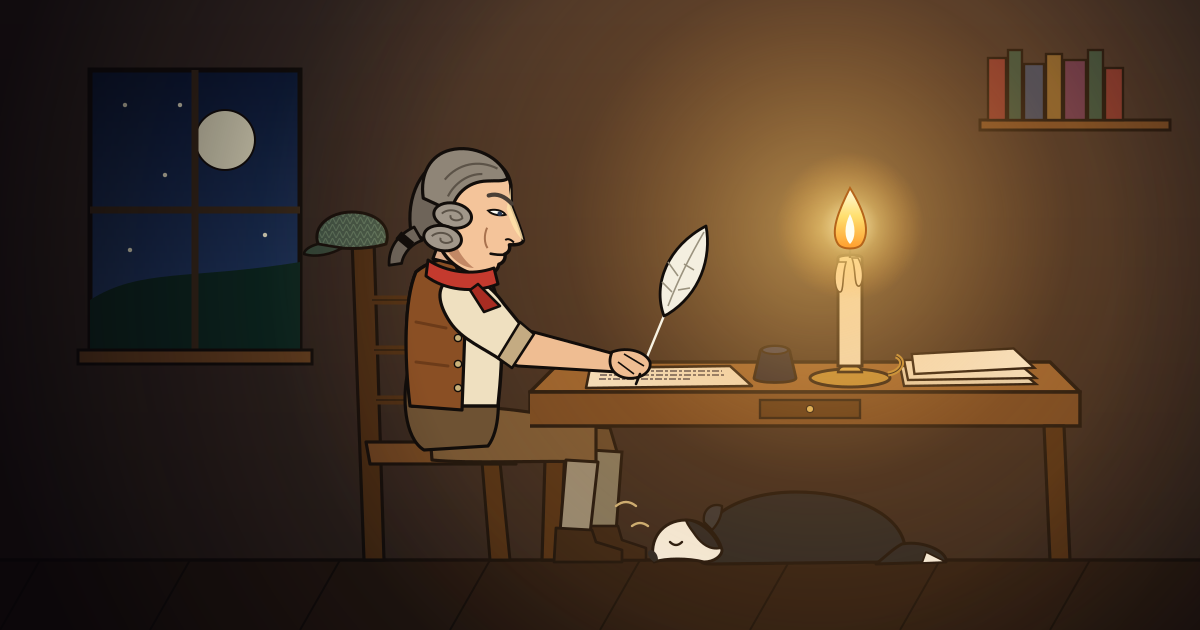
Desk is where he finally says it, in a letter of November 1789 to a young Frenchman, Charles-Jean-François Depont, who had asked him to agree that the French deserved liberty. Yes, he wrote, and went on to define it:
It is not solitary, unconnected, individual, selfish liberty, as if every man was to regulate the whole of his conduct by his own will. The liberty I mean is social freedom. It is that state of things in which liberty is secured by the equality of restraint. A constitution of things in which the liberty of no one man, and no body of men, and no number of men, can find means to trespass on the liberty of any person, or any description of persons, in the society. This kind of liberty is, indeed, but another name for justice; ascertained by wise laws, and secured by well-constructed institutions.
The italic is his. “No number of men” takes in majorities, as Liberty Before Democracy argued from other ground. “Well-constructed” says institutions are made and can be made badly, which is why a day of his can be read for their kinds and their structures.
Kinds came up through the day in an order, closest to farthest:
Holding and household, where a person first answers to someone, and where work and home give a footing no office granted. Under this collection’s view, secure in occupancy, with ground rent owed to all.
School, which has the longest reach of anything here, and which in his own life thrived under a ban. Accreditation and Liberty followed what happens when permission replaces reputation.
Congregation, dissenting and plural, supported by its own members.
Town, with its own meeting, its own revenue and its own business, the size at which people know whom they are arguing with. Cardinality of Social Groups took up why that size matters.
Company and trust, bodies with an aim and a charter, built to outlive their founders. Land trusts in Held in Trust belong here.
Table, a club, a party, a society with no standing but what members give it, and the place where any of the others can be argued over.
Structures matter as much as kinds, and Burke’s day shows those too:
Many, not one. Repair needs somewhere to stand while it goes on.
Small enough at the base, so that a member can see what the body does.
Open to exit and to entry, so a family can take a son to a Quaker’s school, and so a new school needs no leave from an old one. Guild that bars a newcomer has made itself a little East India Company.
Accountable as a trust, with named beneficiaries and a duty to account to them. Steward here means members, trustees and successors with a stake in the outcome, not a bureau: The Myth of the Public Steward covered what a bureau does with a forest.
Living by its members’ money, not on rent. Company lost its way when it stopped trading and started collecting.
Able to end. School at Penn closed after Bourbons came back to France, a clean finish, and the only one in this account.
Fostering and stewarding are separate work, and his day holds both. Fostering is O’Halloran’s Latin grammar and a school at Penn drawn up in a season: small, cheap, begun by whoever is nearby, with little to lose. Stewarding is a list of offices read out in 1780, a parish church roof, a charter called to account: slow and unglamorous work on something other people built and other people will inherit.
Nothing at that desk was abstract. Richard Burke, his only surviving son, elected to his father’s seat, died in August 1794, and the old man wrote afterward: “I live in an inverted order. They who ought to have succeeded me are gone before me. They who should have been to me as posterity are in the place of ancestors.” He had published, four years before, the sentence people now quote without its weight:
Society is a partnership not only between those who are living, but between those who are living, those who are dead, and those who are to be born. He went on with the farm and with the school.
Gregories burned in 1813 and its site is meadow. Boys’ house at Penn was carted off in lots. The Company lost India in 1858 and was wound up in 1874.
In London, a dining club begun at the Turk’s Head still keeps its list of members.
Sources
- Edmund Burke, Speech on Mr. Fox’s East India Bill (1783), Speech on Moving Resolutions for Conciliation with the Colonies (1775), Speech on American Taxation (1774), Works, vol. 2
- Edmund Burke, Reflections on the Revolution in France (1790), Works, vol. 3
- Edmund Burke, Thoughts and Details on Scarcity (1795) and A Letter to a Noble Lord (1796), Works, vol. 5
- Edmund Burke, Thoughts on the Cause of the Present Discontents (1770), Works, vol. 1
- Edmund Burke, Tracts on the Popery Laws and Sketch of a Negro Code, Works, vol. 6
- Edmund Burke, Letter to Charles-Jean-François Depont (November 1789), in Further Reflections on the Revolution in France, ed. Daniel E. Ritchie (Liberty Fund, 1992)
- James Prior, Memoir of the Life and Character of the Right Hon. Edmund Burke (1824; later editions)
- Local History and People, Penn Church
- Ballitore School and the Shackletons, Kildare Libraries
- Massachusetts Government Act, Wikipedia
- Thomas Paine’s iron bridge, World Socialist Web Site
- Allarde Decree, Wikipedia
- Conservative, Online Etymology Dictionary
- Appeals court upholds Texas “Death Star” law, Texas Tribune
- Thomas Paine, Rights of Man (1791) and Agrarian Justice (1797)
- Robert Nisbet, The Quest for Community (1953)
- Russell Kirk, The Conservative Mind (1953)
- F. A. Hayek, “Why I Am Not a Conservative,” in The Constitution of Liberty (1960)
A note on how this piece was written: the thesis and direction of this essay are mine. The historical examples, sources, and sentences were drafted with AI assistance from that direction, with quotations checked against Burke’s text, and then edited by hand. I’d rather say that plainly than have a reader guess at it.