 Social Liberty
From Time to Time
In 1787 Madison warned that requiring too much would beget a habit of doing nothing. This year California put local audits and tax credits in view, shelved a bill to show lobbyists' letters, and voters turned down an audit measure built to void a tax.
Click to enlarge
On September 14, 1787, three days before the Constitutional Convention adjourned, George Mason moved that “an Account of the public expenditures should be annually published.” Gouverneur Morris said it would be impossible in many cases. Rufus King said the word expenditures reached every minute shilling, and that any monthly statement Congress could manage would be so general it would tell nobody anything. Thomas Fitzsimons called full publication absolutely impossible. James Madison proposed striking “annually” and writing “from time to time” instead. The Articles of Confederation already required half-yearly accounts, he pointed out, and since punctual compliance was often impossible, the practice had ceased altogether. “Require too much,” he said, “and the difficulty will beget a habit of doing nothing.” The amendment passed without dissent, and Article I, Section 9 still asks only for a regular statement of receipts and expenditures, published from time to time.
The argument hasn’t changed much in two hundred and thirty-nine years. A government that spends public money is supposed to show where it went, and the people who keep the books always have reasons why showing it is harder than it sounds. California spent much of 2026 having that argument in four places at once: city and county books, money the state chose not to collect, letters lobbyists send to lawmakers, and the audits proposed for any new tax. Two of the four became law. One never got a hearing, and the voters turned the fourth one down.
The local books
Senate Bill 1126, by Sen. Steven Choi, a Republican from Irvine, and sponsored by the California Policy Center, was signed in late summer. Starting January 1, 2028, every city, county and independent special district with a website must post its audited financial statements, or its Annual Comprehensive Financial Report, within thirty days of completion, keep them free of passwords and fees, and leave them up for at least three years.
That sounds like a rule that already existed, and for many agencies it describes what they already do. Others post the audit several clicks deep under a name nobody would search for, or don’t post it, and a resident who wants to see it has to file a public records request. Some don’t finish the audit at all. In October 2024, the Policy Center counted 169 cities, counties and school districts that hadn’t submitted their 2023 financial reports. Twenty-six of them asked voters that November for a tax increase or a bond anyway.
A district can ask for a parcel tax without having a current audit to show for the last one. SB 1126 doesn’t change that. It only means that from 2028 a voter can see whether the audit exists before marking the ballot.
Pay is the part of local spending already in view. Transparent California, which the California Policy Center launched in 2014, posts salaries, overtime, benefits and pensions for some 2.7 million public employees at more than 2,500 agencies. TransparentCities.org, which we sponsor, takes the State Controller’s compensation data for 101 Bay Area cities in nine counties and charts each one’s payroll, headcount, and ten-year change in payroll and non-personnel spending. Personnel runs to roughly 70 to 80 percent of a city’s operating budget, so payroll says a good deal about what a city values.
It says much less about how the rest is chosen. A resident can look up what the Public Works director earns, and has a much harder time learning why the department repaved one street and not the next, how its capital projects were ranked, which bids came in for a storm drain or a pump station, or what a project was expected to cost against what it did cost. Those decisions live in staff reports, capital improvement plans and contract awards scattered across years of council agendas, when they’re written down at all, and much capital spending runs through bond funds and assessment districts outside the operating budget. An audited financial statement, even one posted on time, reports totals by fund, and the choices behind them stay inside the department.
Palo Alto shows what the other half could look like. TransparentCities’ page for its Community Services department charts the payroll, $13.4 million for 335 employees in 2025, and next to it the department’s non-personnel spending by activity over ten years, $19.3 million in contracts, services and supplies in 2025. Most California cities don’t allow the second chart. Palo Alto does because it publishes its own data: in July 2012 it announced an open data site at data.cityofpaloalto.org, built on the Junar platform and led by its chief information officer, Jonathan Reichental, and City Manager James Keene said the city was “excited to bring the value of Open Data to our community.” A resident can look past the total and see, activity by activity, where a department’s money goes. From the pattern of those activities a reader can make out something of the priorities of the administrative staff under the city manager, who decide how a budget is spent once the council has approved it.
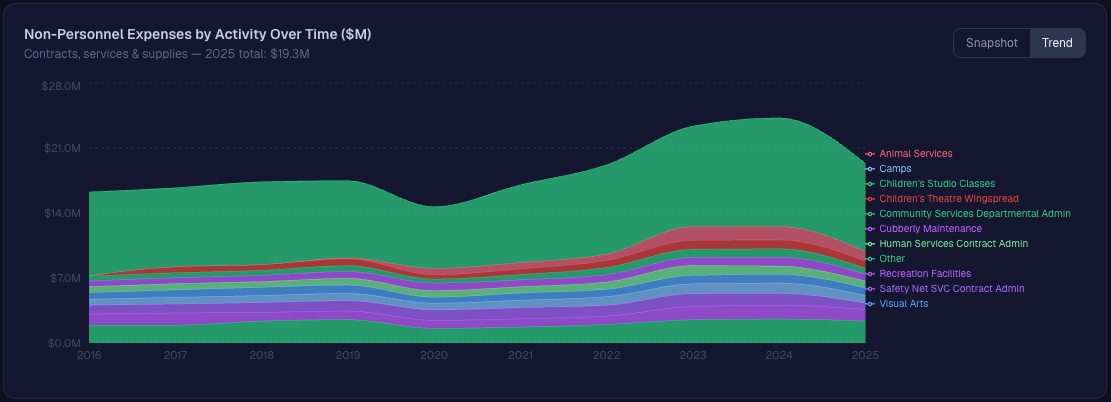
Palo Alto Community Services, non-personnel expenses by activity, 2016–2025. Source: TransparentCities.
Spending through the tax code
A tax credit is spending that never shows up as spending. When the state forgoes a dollar of revenue to reward film production or research, the effect on the budget is the same as writing a check for it, but there is no appropriation, no line in the budget, and no annual vote. California’s Department of Finance puts the total of these tax expenditures at roughly $100 billion a year, $76 billion of it in the personal income tax. Many of the older ones were never given any measure of whether they work.
Senate Bill 1349, by Sen. Lena Gonzalez, a Democrat from Long Beach, orders the Legislative Analyst’s Office to assess the state’s major tax expenditures and recommend which to change or repeal, with its report due by January 1, 2029. Newsom signed it in September. Its sponsors were SEIU and other unions, and their interest is plain enough: the corporate share of the total, about $8.2 billion, is where they hope to find revenue. Dan Walters doubted in CalMatters that it would produce much, since the largest tax expenditures, the sales-tax exemption for food and the mortgage interest deduction, are also the most popular, and since several of the lawmakers who voted for SB 1349 voted that same year to expand the film credit.
Both points can be true and the bill can still matter. A credit that has to be reviewed has to be described first, with a cost and a purpose, and once it’s on paper, it can be compared with spending that went through the budget. The Senate’s own appropriations analysis warned that the work would occupy the analyst’s office for the foreseeable future.
The letters
When a lobbyist, a union, a business group or a city wants to support or oppose a bill in Sacramento, it files a position letter through the Legislature’s online portal. Lawmakers and their staff can read every letter there. The public can’t. A reporter or a resident who wants the letters on a bill has to ask legislative staff for them one bill at a time.
Two bills this year would have opened the portal. Assembly Bill 2063, by Greg Wallis, a Republican from Rancho Mirage, and AB 2557, by Rebecca Bauer-Kahan, a Democrat from the San Ramon area, would each have required the Legislature to post the letters online, Wallis’s starting with the 2027-28 session. Common Cause supported them, and so did the California Policy Center. At least ten other legislatures, West Virginia and Hawaii among them, already post such letters.
Neither bill got a hearing. Bills in the Assembly advance only with the approval of the Rules Committee, whose chair, Blanca Pacheco, said the Legislature doesn’t need a law to publish the letters. Her spokesperson cited “technical, privacy, accessibility and cost considerations” and said staff were checking whether the portal could be safely updated. When CalMatters asked for direct access to the portal under the Legislature’s records act, it was refused. The Assembly later released the letters it had received between January 1 and February 10, by which time many of the bills they concerned had been amended, moved to the Senate, or died.
Of the four efforts, this is the one aimed at the Legislature’s own desks, and it’s the one that never came to a vote.
The audit on the ballot
The fourth arrived as Proposition 41, the Improving Transparency, Effectiveness, and Efficiency in California Government Act of 2026. It would have required the State Auditor to review the programs a proposed state special tax would fund before the measure reached the ballot, and again every four years once the tax was in force, with the auditor’s costs paid from the tax. It would also have counted any new state tax against the spending limit voters adopted in 1979, Paul Gann’s Proposition 4, so that no new tax could be built to sit outside it.
The audit was real, and so was the rest of the design. Proposition 40, on the same ballot, was SEIU-UHW’s one-time 5 percent tax on billionaires’ net worth, and Proposition 41 said that if it drew more votes than Proposition 40, the billionaire tax would be void. Its committee, Building a Better California, was founded by Sergey Brin, who gave it $102 million. Opponents of Proposition 40 spent about $378 million in all, against $33.5 million for it.
Voters rejected the billionaire tax, and they rejected Proposition 41 by a wider margin. As of November 12, with about 91 percent of ballots counted, Proposition 41 was failing 55.0 to 44.9 percent and Proposition 40 52.4 to 47.5, and Proposition 42, a ban on taxing wealth, was ahead 51.3 to 48.6. The Secretary of State certifies the final count in December. A voter could read an audit requirement on its merits, and many seem to have read it as a vehicle for something else.
Whose money
Set side by side, the four have a common shape. A think tank that opposes new local taxes wanted light on the agencies that ask for them. Unions that want corporate revenue wanted light on corporate credits. Billionaires facing a wealth tax wanted every new tax audited before the vote. Each side had good reasons to see the other side’s money, and none of them would have spent a year on transparency without that interest.
That isn’t a reason to think less of what passed. Much public disclosure has arrived this way, carried by someone who expected the light to fall on a rival, and once published, the accounts are there for everyone. A school-bond opponent will read the 2028 audits, and so will a parent deciding whether the district can be trusted with a bond. The analyst’s report on tax credits will be read by the unions, and also by anyone who thinks the state picks winners with its tax code. Neither side can choose who uses the numbers once they’re posted.
The letters bills had no such patron among the people who decided them. Lobbyists who file letters gain nothing from having them read, and the Rules Committee that held the bills is made up of the lawmakers who receive them. Wallis’s bill was written to begin with the session that opens in January. The Assembly’s staff are still checking whether the portal can be opened. Under the Confederation, the half-yearly accounts stopped the same way, one missed publication at a time.
A note on how this piece was written: every argument, source, and structural decision in this essay is ours. We chose the examples, worked out the logic connecting them, and directed what each paragraph needed to say. The sentences themselves were drafted with AI assistance from that outline and then edited by hand.
Sources: Avalon Project, Madison Debates, September 14, 1787; California Policy Center, Governor signs CPC-sponsored local government transparency bill; Transparent California, Salaries, pensions and benefits; TransparentCities, Bay Area city payroll and spending; TransparentCities, Palo Alto Community Services; Junar, Junar Helps Transform City of Palo Alto Into Pioneering Open Data Community (PR Newswire, July 31, 2012); Office of the Governor, Legislative update, September 20, 2026; Senate District 33, SB 1349 (Gonzalez) fact sheet; CalMatters, Would closing California’s corporate tax loopholes actually generate new revenue?, What are they trying to hide? California lawmakers kill lobbying transparency bills, Prop 40 billionaire tax appears headed for defeat, and Billionaires spent $378 million to kill California’s wealth tax; Digital Democracy, AB 2063; California Secretary of State, Proposition 41 official voter guide; Ballotpedia News, Two California tax initiatives qualify for the ballot; KQED, Proposition 41 results, Proposition 40 results, and Proposition 42 results; NPR, California voters defeat billionaire tax proposal.