 Social Liberty
Growing a Movement as a Design Problem
The question that decides whether a movement survives its own growth is rarely message or money. It's cardinality.
Click to enlarge
Ask someone how a political movement grows and they'll usually answer in terms of message, money, or charisma — the right slogan, enough donors, a leader people will follow. Those things matter, but they're not what actually determines whether a movement is still recognizable at ten times its founding size. That's a structural question, and it has a structural answer: how many people can any given unit of the movement actually hold before it needs to become two units instead of one, and what connects the units once there are many of them. Call it cardinality — the sizes and shapes of the groups a design allows — and treat growing a movement the way an engineer treats a bridge: not "will people show up," but "what is this structure's actual load-bearing capacity, and what happens past it."
Most movements never ask the question on purpose. They find out the hard way, at a general assembly that can no longer reach consensus, or a chapter that quietly splits into two factions that stop speaking to each other, or a national organization that discovers its "grassroots" are a mailing list. The failure isn't usually ideological. It's architectural — a structure sized for fifteen people trying to do the job of fifteen thousand, or a structure built for fifteen thousand that never earns the trust fifteen people could have given each other for free.
The number that keeps showing up
Robin Dunbar's original 1992 finding was narrow — a correlation, across primate species, between neocortex size and the largest stable social group a species could maintain — but the number it produced for humans, around 150, has turned out to be one of the more durable findings in social science, showing up independently in the size of Neolithic villages, Roman military units, Hutterite farming communities that split deliberately once they cross it, and the average number of people in a person's actual address book. Above roughly that size, a group can no longer run on personal memory and reciprocal trust alone — it needs rules, roles, and record-keeping to hold together, because no single member can track who everyone is and what they're owed.
Dunbar's own later work breaks the number into a nested series rather than one hard ceiling: a support clique of about 5, a sympathy group of about 15, a band of about 50, and the outer layer of about 150 — each roughly three times the one inside it, and each doing a different kind of social work. The 5 are who you'd call at 3 a.m. The 15 are who you'd drop everything for. The 50 are who you'd recognize on sight and trust with something real. The 150 are everyone you could still call a relationship rather than an acquaintance.
That nested structure is worth sitting with, because it's a design spec disguised as an anthropology finding. It says: don't build one ring. Build several, sized differently, each doing a job the others can't.
A related ceiling shows up one level down, in raw cognitive load rather than social bookkeeping. George Miller's classic 1956 paper, "The Magical Number Seven, Plus or Minus Two," found that working memory — how many discrete items a person can hold and actively manipulate at once, without writing anything down — tops out somewhere in the range of five to nine chunks, a limit that recurs across memory-span tasks regardless of what's being remembered. Later work has argued the true number is smaller once rehearsal tricks are controlled for, but the upper edge of Miller's range, nine, keeps showing up in practice as roughly the most live, un-chunked items a single mind can actually track at once: nine agenda items before a meeting needs written minutes instead of memory, nine open threads before one organizer needs a second person just to keep track of what everyone else is already keeping track of. It's the same shape of constraint as Dunbar's, one level down — not how many relationships a person can sustain, but how many things they can hold in their head at a given moment without a system built to hold the rest.
What happens when a design ignores it
Occupy Wall Street's General Assembly is the clean cautionary case, because the movement's organizers were unusually explicit about the structure they were choosing and unusually honest, afterward, about what it cost them. Modified consensus decision-making — every voice heard, no vote taken until dissent is resolved or set aside — works genuinely well in a room of Dunbar's inner rings, where people already know and trust each other and disagreement is rare enough to resolve by discussion. At Zuccotti Park it was run in assemblies of hundreds, sometimes low thousands, meeting outdoors, using human-microphone repetition because amplification was banned. The process that had felt liberating in an affinity group of twenty became, at scale, a multi-hour bottleneck that rewarded whoever could out-endure it, and decisions that did get made often didn't bind the encampments and solidarity actions happening under the same name elsewhere. The people who wrote the movement's own retrospectives — Occupy participants and sympathetic academics alike, in the years after — converged on roughly the same diagnosis: the assembly wasn't a bad idea, it was the right tool sized for the wrong cardinality, asked to do a 50-person job at 150-to-thousands scale with no second ring built underneath it to absorb the difference.
The opposite failure is just as common and less discussed: a structure sized correctly for coordination that never lets a real inner ring form at all. A national political party's local "chapter," in the ordinary American sense, is often a mailing list, a monthly meeting nobody's official role depends on, and a handful of people who show up because they already would have. It has cardinality in name — a roster — and none in fact, because nothing about the structure produces the 5-person and 15-person rings that turn a roster into people who'd actually show up for each other. A movement can fail by overloading its cells exactly as easily as it can fail by never letting cells form.
Cells that were built to the number on purpose
The organizations that have grown durably under real pressure tend to be the ones that treated cell size as a design constraint from the start, whether or not they'd heard of Dunbar.
Alcoholics Anonymous's Twelve Traditions make group autonomy explicit — "each group should be autonomous except in matters affecting other groups or A.A. as a whole" — and in practice, meetings that grow past the point where members can still know each other split into new meetings rather than expand indefinitely. The organization has no national membership roster, no dues, no central command that could even attempt to hold a group together past the size where trust naturally frays; the design simply lets fission happen at the point the group itself, informally, senses is right, and the movement has scaled to something on the order of two million members globally by repeating that one small unit rather than by building a bigger one.
Rodney Stark's demographic account of the early Christian church's growth, in The Rise of Christianity, makes a related argument about the mechanism behind roughly 40% per decade growth over its first three centuries: not mass persuasion events, but ordinary people bringing the new movement to their own existing social ties — family, friends, neighbors — inside house-church-sized gatherings that map remarkably well onto Dunbar's inner rings. Conversion, on Stark's account, mostly traveled through networks small enough that trust was already doing the work belief hadn't finished doing yet.
Extinction Rebellion's public organizing handbook is the most self-aware version of this design principle currently in circulation, because it was written by people who'd studied the Occupy-era failures directly. It specifies autonomous "affinity groups" of roughly 5 to 15 people as the basic unit — sized, explicitly, in the range Dunbar's inner two rings occupy — federated upward through regional and thematic "circles" using a delegate-based structure, rather than trying to run direct consensus at the scale of a national mobilization. Each cell can act without waiting for the whole network to agree, and the network learns what the cells are doing without having to referee it in real time. It's the nested-ring structure again, arrived at independently by people optimizing for the same constraint: how much trust can actually travel through a room, and what has to happen once you need more people than that.
The unit a movement is handed, versus the unit it needs
There's a second cardinality question underneath the first, and it isn't about people — it's about geography, and it's mostly invisible because, like the reified categories The Rule of the Unquestioned describes, it arrived looking like a fact of nature rather than a design choice. American ballot access law is written and administered state by state, so "build a state chapter in each of the fifty states" is the frame every third-party effort inherits before it has decided anything else about its own structure. It's rarely questioned, for the same reason the school-subject roster went a century without being questioned: the boundary predates anyone currently organizing inside it, and doing politics at all, in the U.S., means accepting the state as the unit political infrastructure comes in.
But the fifty-state grid is itself just an administrative solution to a mostly unrelated problem — apportioning federal representation and running elections — dressed up, by long habit, as the natural shape a political movement should take. It's a poor match for where people actually live economically and socially integrated lives, which cut across state lines far more than they respect them: the commuting and labor-market region anchored on Boston–New York–Washington doesn't stop being one functional place because it also happens to cross a dozen state boundaries. Ballot access itself is a stark illustration of how arbitrary the fifty-unit grid is even on its own terms — signature requirements to get a new party on a statewide ballot range, depending on the state and office, from a few hundred signatures to well over one hundred thousand, with wildly different filing deadlines and petition rules, so the "same" fifty-state strategy is actually fifty separate design problems wearing one name.
The country already used a different number
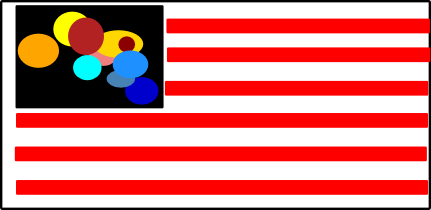
The original was the more beautiful design: red and white stripes, and a field of white stars, one for each colony, circling on a blue sky. Thirteen distinct lights, plainly counted, sharing one field — not because a committee decided thirteen was a tidy number, but because that was the actual count of the thing being represented.
The fifty-unit frame is also, on inspection, not even the country's original design — and the original one is worth taking seriously precisely because it wasn't invented by a modern planner, it emerged from what the political and economic geography of 1776 actually was. The United States began as thirteen colonies, and the Continental Congress that declared independence, the Articles of Confederation that first bound them, and the Constitution that replaced the Articles all treated those thirteen as real, distinct units of political community, not administrative subdivisions of a larger whole waiting to be drawn. Each had grown its own charter, its own government, and its own economy well before 1776: Massachusetts Bay's town-meeting Puritan congregationalism was not Virginia's Anglican, tobacco-planter gentry; Pennsylvania's Quaker-founded religious pluralism was not South Carolina's rice-and-indigo plantation economy built on the largest enslaved population of any colony. The Constitution's equal-Senate-representation-per-state, its state-weighted Electoral College, its requirement of three-fourths of the states to amend anything at all — these aren't arbitrary design flourishes. They're what you build when the units you're federating are genuinely large, genuinely distinct peer communities, and you need a structure that can coordinate a dozen or so of them without any one dissolving into the others.
That's the same design question the first half of this essay asked about friendships, just answered at an entirely different scale: not how many people can know each other well enough to trust each other, but how many large, self-governing communities a federal structure can hold together as real peers before the layer stops meaning anything. Thirteen, in 1787, was an answer arrived at the same way Dunbar's rings were — not chosen in advance, but discovered as the number of units that had actually developed into something coherent enough to be worth representing as a unit.
What happened next was subdivision, not the discovery of thirty-seven more coherent political communities. Territories were carved into states largely along survey lines, river boundaries, and congressional horse-trading — pairs of states admitted together to balance Senate votes, boundaries drawn by the Public Land Survey System's grid rather than by anything resembling Virginia's or Massachusetts's organic colonial development — until the count reached forty-eight by 1912 and fifty with Alaska and Hawaii in 1959. Somewhere in that process, the unit that had once meant "a genuinely distinct political-economic community, large enough to be a real peer of the others" quietly came to mean "whatever the federal government drew a line around and admitted," and the fifty-state grid inherited the founders' constitutional deference to "the state" as a unit without inheriting the reason that deference had made sense in 1787.
Planners using entirely different tools have been rediscovering something close to the original number. The Regional Plan Association's America 2050 initiative, led by Robert Yaro and Petra Todorovich starting in the mid-2000s, mapped American commuting patterns, freight flows, and metropolitan economic integration and identified roughly ten to eleven "megaregions" — large-scale networks of metropolitan areas bound together by shared labor markets and infrastructure, from the Northeast Corridor to Cascadia to the Texas Triangle — as the scale at which American economic and social life actually functions today. A later, widely shared popularization rounds that count to an even thirteen.
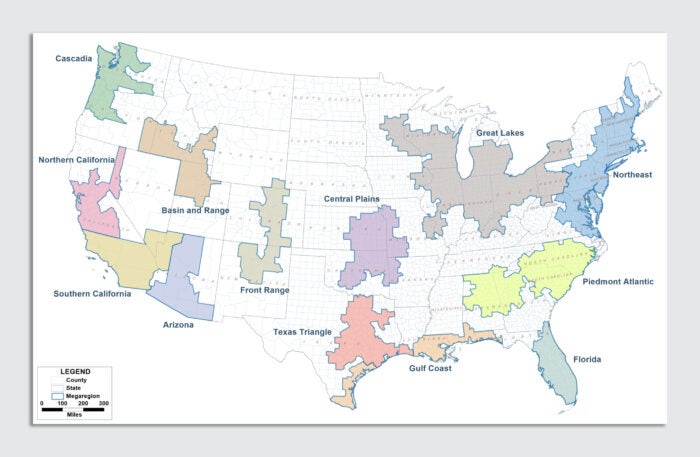
Whether the right modern count is ten, eleven, or thirteen is a methodology argument, and not the point worth resting weight on. The point is that two entirely independent processes — a set of colonies developing distinct political identities over a century and a half before 1776, and a set of economists and planners measuring commuting sheds and freight corridors more than two hundred years later — both looked at the actual shape of American life and landed on a dozen-or-so large regions, not fifty small ones. That convergence is a signal, not a coincidence to wave away: fifty was probably never the natural cardinality of American political community. It's the cardinality of an admissions process that kept running long after the thing it was originally measuring stopped being the thing it was counting.
None of this is really an argument about the number thirteen, or ten, or fifty — the exact count was never the point, and a reader who takes away "refile as thirteen state parties" has missed it. What the number gestures at is real, though: America's regions aren't interchangeable administrative units standing in for each other, they're places with distinct economies, industries, and civic cultures, and a movement organized around social liberty runs into that difference the moment it does anything more concrete than restate first principles. What social liberty implies for a legislature weighing water rights and land use in the Basin and Range is not what it implies for a legislature weighing e-bike regulation in a Northeast Corridor city, or occupational licensing in the Gulf Coast, or property-tax assessment in a Great Lakes statehouse trying to hold a shrinking tax base together — the underlying commitments are the same, but the legislative terrain, the coalition available in the room, and the opening argument worth making are not. A movement that insists on saying the identical thing to every regional legislature, in the name of message discipline, is optimizing for consistency over the actual diversity of the thing it's trying to represent. The regional cell isn't only a better-sized unit for holding trust — it's also the right unit for doing the harder, more honest work of developing the region-specific reading of social liberty that each region's own legislative agenda actually calls for, region by region, bill by bill, rather than one national talking point handed down and repeated everywhere it doesn't quite fit.
This isn't a call to ignore state law — a movement still has to win ballot access one state at a time, whatever else it does, because that's the legal reality regardless of the underlying economic geography. It's a call to stop mistaking the legal unit for the organizing unit. A movement can file by state while building its actual cells — the trust-sized, Dunbar-scaled groups described above — around the region a person's life is actually lived in, and let that regional layer, not the state layer, be where affinity groups federate into something bigger than fifteen people, much the way the original thirteen states, not their internal counties, were the real unit the founders federated. Who Pays? made a parallel argument about funding a public ledger: the honest design question is never "what's the traditional unit," it's "what unit does the actual mechanism operate at," and then building the legal and financial structure to match rather than the other way around.
Designing on purpose
None of this produces a single correct blueprint, and it shouldn't — the whole point of taking cardinality seriously is that the right group size depends on what the group needs to do, and a design that fits a mutual-aid network won't fit a legislative campaign. But it does produce a discipline: before asking what a movement should say, ask what size its rooms are built to hold, whether the people in them can actually reach the trust the structure is asking them to run on, and whether the geography it's organizing around is the one its members actually live in or just the one the paperwork happens to require. A movement that gets the message right and the cardinality wrong will feel, for a while, like it's growing. It's actually just getting heavier, in a structure that was never sized to carry the weight — and the collapse, when it comes, will look like an argument about ideas, when the real cause was an argument about architecture that nobody thought to have.
Sources: Dunbar, R.I.M., "Neocortex size as a constraint on group size in primates," Journal of Human Evolution (1992); Dunbar, "Do online social media cut through the constraints that limit the size of offline social networks?" Royal Society Open Science (2016) (the nested 5/15/50/150 layers); Miller, George A., "The Magical Number Seven, Plus or Minus Two: Some Limits on Our Capacity for Processing Information," Psychological Review (1956); Cowan, Nelson, "The Magical Number 4 in Short-term Memory: A Reconsideration of Mental Storage Capacity," Behavioral and Brain Sciences (2001); Alcoholics Anonymous World Services, "The Twelve Traditions"; Rodney Stark, The Rise of Christianity: How the Obscure, Marginal Jesus Movement Became the Dominant Religious Force in the Western World in a Few Centuries (1996); Extinction Rebellion, "This Is Not a Drill" organizing handbook and public affinity-group/circle structure documentation; retrospective accounts of Occupy Wall Street's General Assembly process, including David Graeber's The Democracy Project (2013) and post-Occupy academic case studies of consensus decision-making at scale; U.S. National Archives, Articles of Confederation (1781) and the Constitution's Article I/Article V state-apportionment provisions; standard colonial-economic-history accounts of the thirteen colonies' distinct charters and economies (New England town/church governance, Chesapeake tobacco planter society, Pennsylvania's Quaker settlement, Lower South rice/indigo plantation economy); admission-of-states history from the Northwest Ordinance and Public Land Survey System through the Alaska (1959) and Hawaii (1959) admissions; Regional Plan Association / America 2050, megaregions research led by Robert Yaro and Petra Todorovich; Richard Winger, Ballot Access News, on the range of state-by-state ballot access signature and filing requirements.