 Social Liberty
Ordering the Separations
The separation of church and state wasn't won in one stroke. It took fifty years, state by state, and it fell last where the establishment's own beneficiaries began to fear who would hold the machinery next.
Click to enlarge
In the autumn of 1818 the parish of Dedham, Massachusetts, chose a new minister. The parish was every taxpayer in town, and the taxpayers wanted Alvan Lamson, a young Harvard man of the liberal, Unitarian kind. The church was the smaller body of communicants, orthodox Congregationalists, and they wanted nothing to do with him. Outvoted, the church members walked out of the meetinghouse and took with them what they thought was theirs: the records, the deeds, and the communion silver. The parish sued. In Baker v. Fales (1820) the state's highest court ruled that the parish, not the church, owned all of it, and the orthodox deacons were ordered to hand over the silver.
Across Massachusetts the same thing happened in parish after parish, and by the end of the decade the orthodox had lost scores of meetinghouses to the liberals, built with their grandparents' money and maintained by a tax the state still collected on behalf of whichever minister the town elected. The establishment they had defended for two centuries had become a machine for taking their churches away. In 1833 Massachusetts, the last state with an established church, voted to end it, and a good share of the votes came from the very people the establishment had been built to serve.
Bill of Separations set out twelve domains the state ought to leave altogether, from church and speech to property, education, medicine, and technology. Twelve walls can't all go up at once. Each needs its own coalition, its own cases, its own decade of argument, and a movement that presses on all of them equally ends up pressing hard on none. The question this essay takes up is order: which separations come first, which wait, and what the history of the one separation already won says about how the others get built.
Fifty years, three states, three different wins
The First Amendment is often remembered as the moment church and state were separated in America. It wasn't. It bound Congress alone, and when it was ratified in 1791 several states still collected religious taxes and would for decades. The Supreme Court didn't apply the Establishment Clause to the states until Everson v. Board of Education in 1947. The separation everyone now treats as settled was won state by state, and each state won it a different way.
Virginia came first. In 1784 Patrick Henry proposed a general assessment, a tax for the support of Christian teachers, with each taxpayer allowed to name the denomination that got his share. It was a moderate bill, a tolerant establishment, and it looked certain to pass. James Madison got the vote postponed a year and spent it organizing petitions. His Memorial and Remonstrance is the one history remembers, but it gathered fewer signatures than a petition circulated by evangelical dissenters, Baptists and Presbyterians who had no interest in Madison's Enlightenment arguments and a great deal of interest in never paying for anyone else's minister. Henry's bill died, and in its place the legislature passed Jefferson's Statute for Religious Freedom in January 1786.
Connecticut came next, in 1818, and the win there came from an odd ticket. The Toleration Party joined Baptists and Methodists, who objected to establishment on principle, with Episcopalians, who mostly objected to not being the established church, and with Jeffersonian Republicans, who objected to the Federalist clergy campaigning against them from the pulpit. These groups agreed on nothing else. They agreed that the Standing Order should stop collecting taxes, and that was enough to carry a governor and then a new constitution.
Massachusetts came last, after Dedham, when the people the establishment served no longer trusted it to serve them.
Before any of these wins came a long stage of partial exit. From the 1720s Massachusetts let Baptists and Quakers escape the ministerial tax if they filed a certificate, signed by their own ministers, proving they belonged to a dissenting congregation. The certificates were grudging, often refused by local assessors, and Isaac Backus, the Baptist minister who led the fight against them, came to see that filing one conceded the state's right to decide who was exempt. In 1774 he traveled to Philadelphia to put the Baptists' case to the Massachusetts delegates at the Continental Congress. John Adams told him, by Backus's account, that they might as well expect a change in the solar system as expect Massachusetts to give up its establishment. It took fifty-nine years.
Four measures of readiness
Those three wins suggest a way to rank the other eleven separations. None of the measures below is enough alone, and a separation that scores well on one and badly on the rest is a separation for later.
Dependency. Some separations hold up others. Property is the clearest case: a family can't keep a curriculum office away from its children, or an artist keep a mural standing, without something durable enough to stand on, and a state that can take a house by civil forfeiture holds a lever over every other domain that house shelters. Currency is another, though it sits outside the original twelve and got its own essay in Separation of Currency and State: the power to issue money is the power to fund entanglement in every other domain without asking anyone to pay for it openly. Conscience sits under all of them, in the sense that it names the general principle, but a general principle is a poor first campaign, because it gives no single case to win.
Existing exit. Virginia's dissenters already worshipped in their own churches, Backus's Baptists already paid their own ministers, and the certificate system, for all its humiliations, had kept the habit of independent support alive for fifty years. The wall went up around something already built. A separation is ripe where a working alternative already exists outside the state and needs only the state to stop taxing or regulating it twice. Homeschooling families and education savings accounts, direct primary care practices that take no insurance, reader-funded journalism, and self-custodied money all count. Where no alternative exists yet, a demand for separation reads as a demand to abolish something with nothing in its place, and it loses.
Incumbent fear. Dedham is the case for this measure. An entanglement survives as long as the people who benefit from it trust themselves to hold the controls. It becomes vulnerable the moment they imagine their rivals holding them. Several separations on the list are in exactly that condition now. Both parties have watched the other use federal pressure on social media platforms, research grants, curriculum standards, and public broadcasting funds against them, and each party currently wants the machinery out of the other's hands. That fear is unstable, because the natural move is to seize the machinery back rather than dismantle it, and the Toleration Party's Episcopalians would have happily become the established church had that been on offer. But it is the window in which an odd coalition can form.
Durability. A separation won as a structural fact holds better than one won as a policy. Virginia's statute has never been repealed. A separation won as a funding preference, or as an exemption at an agency's discretion, lasts until the next administration. A campaign that can win only the weak form of a separation is sometimes better postponed than spent.
Three stages of a separation
The disestablishment fights also show that a separation passes through stages, and that each stage calls for different work.
The first is the certificate: a carved-out exemption, granted at the state's discretion, that lets some people leave on paper. Homeschool exemptions, religious exemptions from vaccine mandates, and opt-outs from data collection are certificates in this sense. They matter, because they keep the alternative alive and keep a population in practice at living outside the state's arrangement. Their weakness is the one Backus saw: they concede the state's authority to grant them, and an assessor can refuse.
The second is the parallel: the alternative grows large enough that it no longer looks like an exception. Arizona's universal education savings accounts, passed in 2022, moved education there from the first stage toward the second, by attaching funds to the child rather than the building. The committees of correspondence and provincial congresses of the 1770s were parallels of the same kind in government, working institutions that existed before independence was declared.
The third is the wall: the domain leaves the state's jurisdiction as a matter of structure, in statute or constitution. Virginia in 1786, Connecticut in 1818, Massachusetts in 1833.
Each article in the Bill of Separations sits at some stage now, and the work on each depends on which. Pressing for a wall where the parallel hasn't been built is the Virginia dissenters petitioning before they had churches. Settling for certificates where a parallel already exists is Backus's mistake before he saw it.
Placing the twelve
Run the measures and stages across the list, and the twelve sort roughly into four groups.
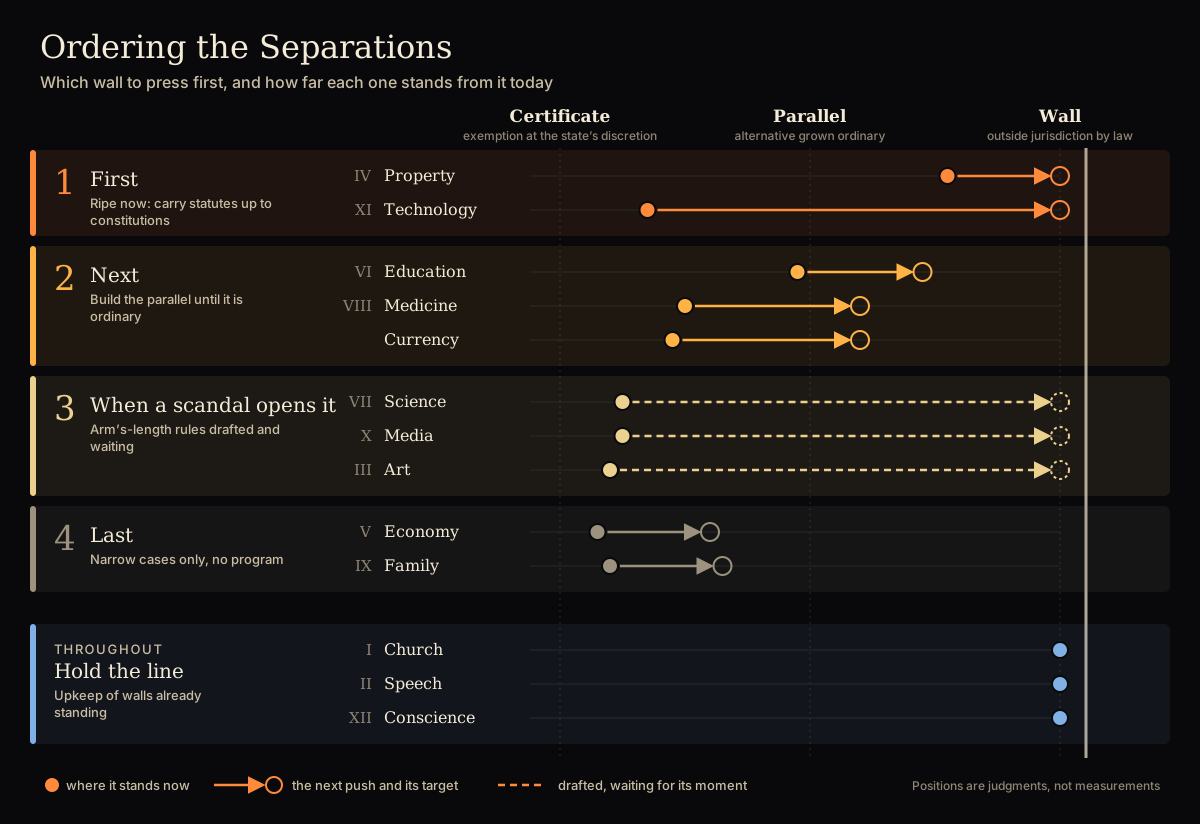
First: property and technology. Civil asset forfeiture scores on every measure. It underpins other domains, it draws a coalition from left and right that agrees on little else, and it is being won state by state already. New Mexico abolished civil forfeiture in 2015 with no recorded opposition in either chamber, and Nebraska and Maine followed. That is Connecticut's pattern, and the next step is the same one Connecticut's took: from statute to state constitution. Technology fits the incumbent-fear measure better than any other domain. In Murthy v. Missouri (2024) the Supreme Court dismissed a challenge to federal pressure on platforms for lack of standing, leaving the underlying question open, and each party now has reason to want it closed before the other holds the executive branch. A statute barring officials from requesting the removal of lawful speech by a private platform is narrow, enforceable, and the kind of thing a party in opposition supports.
Second: education, medicine, and currency, where the parallel comes first. Each has a working alternative that is growing, and each would lose a direct fight for a wall today. The work here is the second stage: widening the parallel until it is ordinary, moving exemptions from discretionary to automatic, and converting certificates into funds that follow the person. Government Schooling Is Unacceptable made the full case for education. Medicine follows the same path through direct care and right-to-try laws, and currency through self-custody and the slow work traced in Tallies and Tokens.
Third: science, media, and art, which wait for the funding fights. These are domains where the state funds rather than administers, and the separation they need is narrower: the funding decision kept upstream of the content decision. They become winnable each time a grant is revoked or a broadcaster defunded for its content, because each such case shows the lever plainly. The work in the meantime is drafting: precise arm's-length rules, ready for the moment a scandal makes them wanted, so the moment isn't spent arguing over wording.
Fourth: church, speech, conscience, and the defensive line. These three are the strongest walls already standing, and the work on them is upkeep, not construction. Their value to the rest of the program is as precedent. Every argument for a newer separation borrows from them, and a breach in one would weaken the case for all.
That leaves economy and family, and both belong late. Separation of economy and state is the broadest article on the list, and pressed early it reads as a whole program rather than a single wall, which invites a referendum on everything at once. Its parts arrive anyway through property, currency, and the narrow cases that the ballot measures discussed in these essays keep raising. Separation of family and state is the easiest of all to caricature and the most painful to lose, and its first campaigns are narrow ones already drawing unusual coalitions, such as laws in several states separating poverty from neglect in child welfare cases, so that a family isn't broken up because it can't afford childcare.
Coalition of the unlike
The Toleration Party is the model worth keeping in view. Its Episcopalians wanted their own establishment, and its Baptists wanted none, and neither hid it. What made the coalition work was that the single demand on the ticket, stop collecting the tax, served both, and that each member could explain its vote to its own people in its own terms. Madison's petition and the evangelical petition against Henry's bill said different things for different reasons, and the bill lost to their sum.
A civil forfeiture campaign that joins a public defender and a gun-shop owner works the same way, as does a platform-pressure bill backed by people who fear each other's censorship. The coalition needs no shared philosophy and is weakened by an attempt to impose one. It needs one demand narrow enough that everyone in it can want it for a different reason.
The disestablishment fights also suggest where to fight. Every one of them was won in a state legislature or a state convention, not in Congress, and the national rule came a century and a half later, as a summary of what the states had already done. A movement working on these separations has fifty places to win the first one, and a win in New Mexico is evidence a legislator in Maine can point to.
Dedham's church members, for their part, kept meeting. They built a new meetinghouse a few streets away, paid for it themselves, and bought new communion silver. Fifteen years later, when the town no longer collected a tax for anyone's minister, theirs was simply one church among several in town, with its own building and its own deeds.
A note on how this piece was written: the ordering of the separations and the measures used to rank them are ours, as is the direction of the argument. The sentences were drafted with AI assistance from that direction, then edited by hand.