 Social Liberty
Shakeup On the Arabian Peninsula
A war on many dimensions. Control of gulf passage is only a tool. The real shakeup is that every power on the peninsula has turned out to be rich and weak at the same time, and the war is finding out which kind of weakness breaks first.
Click to enlarge
Bab al-Mandab at night. On the Arabian shore, oil works burn in tall ragged sheets of flame, storage tanks and a pipeline standing black against the glow, a smaller fire further down the coast where a pumping station has been hit. Out in the strait a tanker burns amidships, her hull outlined in orange by her own fire, burning oil spreading across the water beside her. Perim sits as a dark hump in the channel, and past it the low line of the African coast. The sky over all of it has gone deep crimson at the horizon. Missile trails arc in from the southwest, their heads still glowing, while smoke rolls off the fires, lit orange from underneath, and embers climb into the dark. Every flame breaks into ripples on the water below.
That picture is a composite for what has happened somewhere in this war in the last three months: tankers attacked in the strait, fires at Saudi oil facilities, pumping stations struck along the pipeline that runs to the Red Sea, missiles crossing the sky toward Saudi cities.
What happened
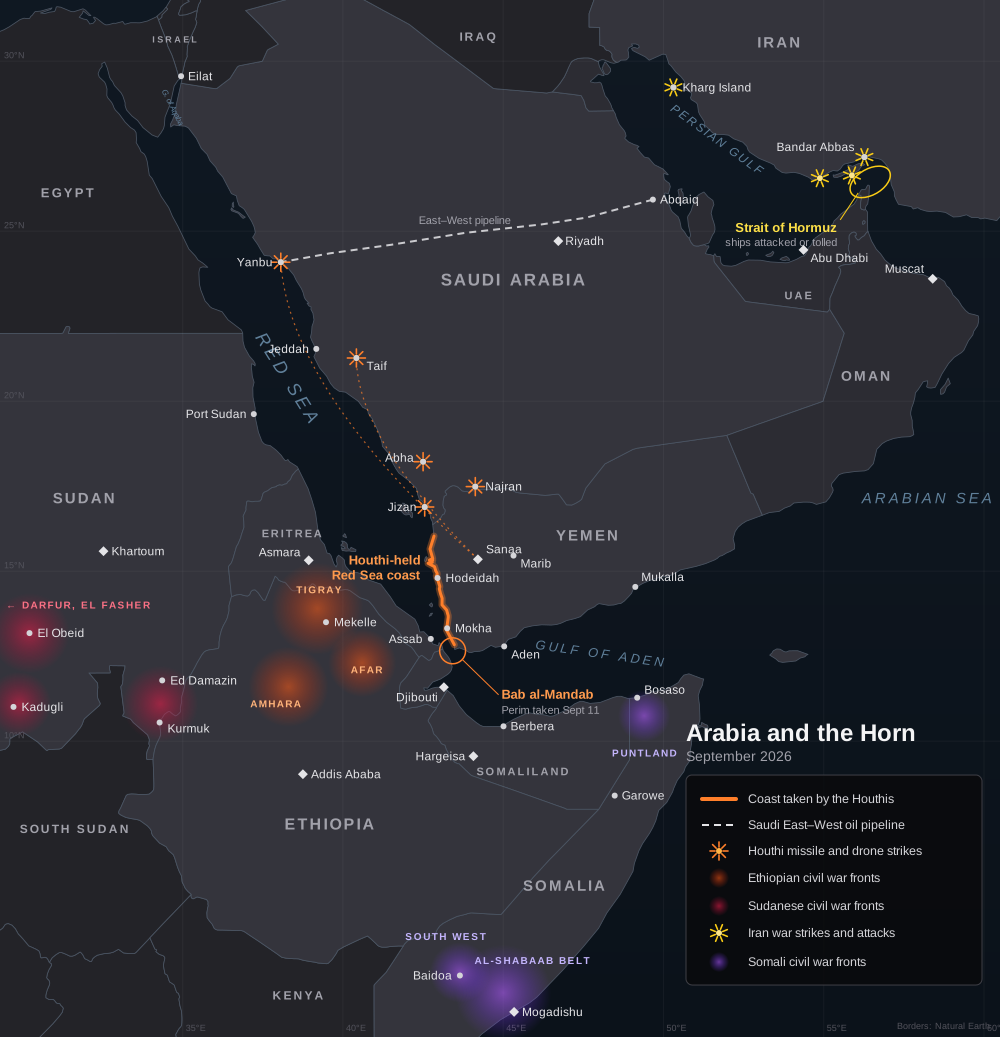
The Houthis ended their truce with Saudi Arabia on July 13, after Saudi-backed forces struck Sanaa airport to stop an Iranian military transport from landing. A week later they declared a naval blockade of the kingdom and began attacking Saudi tankers. On September 3 they opened a ground offensive in Taiz. By September 25 they held almost the entire Red Sea coast of Yemen, from Hodeidah past Mokha to Dhubab, along with the Hanish Islands and Perim, the island in the mouth of the Bab al-Mandab. Missiles and drones have hit Saudi cities from Najran to Taif. Drones struck two pumping stations on the East-West pipeline, the route built so Saudi oil wouldn't depend on the Strait of Hormuz, and it was shut for more than a week. Oil went back above $100. More than a hundred thousand Yemenis have been displaced.
Meanwhile, all of this sits inside a larger war. The United States and Israel struck Iran on February 28. A ceasefire and an American naval blockade followed, then a signed memorandum in Islamabad, and then collapse on July 8, when Iran began attacking shipping in Hormuz. The US reimposed its blockade on July 14, the day after the Houthis ended their truce.
The strait is a tool
Most of the coverage stops here and settles on the strait. It's an easy story to tell. A tenth of the world's seaborne oil goes through the Bab al-Mandab, and a movement from the mountains of northern Yemen now holds both the island in its mouth and the shore facing it. Put that next to Iran's pressure on Hormuz, and the two doors out of the Gulf are closing at once.
But a chokepoint doesn't explain anything by itself. The Bab al-Mandab was just as narrow a year ago, and ten years ago, and in 1967. What changed isn't the geography. What changed is that the powers who were supposed to keep that strait open, or at least to make closing it too expensive, turned out not to be able to. The strait is the lever the Houthis picked up. The interesting question is why nobody on the peninsula could take it out of their hands.
The answer is that every one of the current players is rich, and every one of them is weak, and this war is where those two facts finally met.
Rich and weak
Saudi Arabia has one of the largest military budgets in the world and the most modern equipment money can buy. It has also never won a war. It fought the Houthis along its southern border in 2009 and struggled. It led a coalition into Yemen in 2015, spent seven years and many tens of billions of dollars, and ended up negotiating a truce with the movement it set out to defeat. This month, with missiles landing on its cities, the kingdom's first move was to call Washington. Crown Prince Mohammed bin Salman reportedly asked President Trump twice for American strikes, and was refused. Its second move was to accept Israeli targeting intelligence, passed through US Central Command. Its third was to watch France send soldiers and air defenses to guard its own oil terminal at Yanbu. The alliance it signed in August, the Mecca Pact with Turkey and Pakistan, loosely modeled on NATO, produced nothing. A state that can buy anything has had to ask for everything.
The United Arab Emirates was supposed to be the exception, the Gulf state with a real army, sometimes called "Little Sparta" in Washington. For a decade it built its own project in southern Yemen: the Southern Transitional Council and a string of coastal forces that answered to Abu Dhabi. In a few days last winter that project came apart. Saudi Arabia struck a UAE weapons shipment at Mukalla on December 30. Saudi-backed forces took Mukalla, Seiyun, and then Aden by January 7. The STC dissolved itself, its leader fled to Abu Dhabi, and the Emirates withdrew from Yemen. The positions that fell to the Houthis in September include the same coast the UAE once held. Its condemnations of the Houthi attacks have been strongly worded, and it has sent no one.
Iran sits on some of the largest oil and gas reserves on earth. It has spent twenty years and a great deal of money building the Axis of Resistance, and the Houthis are that project's most successful product. But Iran itself has been bombed since February, blockaded at sea since April with one brief pause, and cut off from most of the income its reserves ought to bring. Its answer at Hormuz has been to let some ships through for a fee, a toll on the strait collected from passing tankers. It can supply missiles to Yemen. It can't protect its own ports.
The Houthis look like the one strong player. They are disciplined, battle-hardened, cheap to supply, and winning. Their movement collects an estimated $2.5 billion a year from customs, fuel, levies, and "war contributions," and now holds the most valuable piece of geography on the peninsula. Yet they govern a population in which more than 22 million people need humanitarian aid. Public employees in their territory have gone unpaid for years. They can close a strait, but they can't export anything through it, feed the people behind them, or fight a long war without Iranian parts. Their power is real, and it's the power of a toll gate, not a state.
The outside powers fit the same pattern. The United States could end the Houthi coastal campaign in weeks and has chosen not to, because the Houthis signaled they didn't want a fight with America and Washington has another war to manage. Turkey and Pakistan signed a defense pact they have not honored. France will guard a terminal but, in President Macron's words, "not to engage in any conflicts." There is no shortage of money or hardware around the peninsula. There is a severe shortage of anyone willing to spend it here.
Why wealth doesn't become strength
There's a name for the kind of state that dominates the peninsula. In 1987 the economists Hazem Beblawi and Giacomo Luciani called it the rentier state: a government whose income comes mostly from selling a natural resource abroad, rather than from taxing the work of its own people.
A rentier state doesn't need its citizens' consent, because it doesn't need their money. It pays them instead, in subsidies, public jobs, and cheap fuel, and in exchange it asks for quiet. The old rule, no taxation without representation, runs backwards: no taxation, so no representation. It works well in peacetime. But it produces governments that have never had to ask their people for anything, and so have no practice asking when it matters. It's easy to buy fighter jets. It's much harder to buy the willingness of your own young men to fight on a mountain border for a government they've never had a say in. Through the last Yemen war, the Saudi-led coalition relied heavily on hired and borrowed soldiers, including thousands of Sudanese fighters. Money bought the army. It couldn't buy the reason to fight.
Oil is also, in the most literal sense, rent from land. Nobody made it; whoever holds the ground above it collects. Rights and Property argued that land is the one kind of property whose value the holder didn't create, and that rent collected on it is income without effort. The Gulf is that argument at the scale of nations. The royal families of the peninsula hold a claim on value they didn't produce, and the state they've built around that claim is strong exactly as long as nobody tests it by force.
The Houthis are testing it. And the irony is that they are turning into rentiers themselves. A chokepoint is land rent too, collected from ships instead of wells. The movement that began as a revival among poor mountain farmers now lives off customs posts, fuel levies, and the threat to close a strait, while its own public servants go unpaid. It's acquiring the same weakness it's exploiting.
Sunni and Shia
Sectarianism is the cheapest substitute for consent, which is why every player on the peninsula reaches for it.
The war is usually described as Sunni Saudi Arabia against Shia Iran and its Shia allies in Yemen, and that's true as far as it goes. But the Houthis are Zaydis, a branch of Shia Islam quite distinct from Iran's Twelver Shiism and often called the Shiism closest to Sunnism. For centuries Zaydi and Shafi'i Sunni Yemenis prayed in each other's mosques. A Zaydi imamate ruled north Yemen for about a thousand years, until a republican revolution in 1962.
When that revolution came, Saudi Arabia backed the Zaydi imam. For most of the 1960s it armed the royalist Zaydi tribes against Egyptian-backed republicans, because the threat Riyadh feared then was Nasser, not Shiism. The sectarian line that now seems permanent was drawn later, and both patrons helped draw it. From the 1980s, Saudi-funded Salafi schools spread into the Zaydi heartland, most famously at Dammaj in Saada province, near the Houthi family's home ground. The Houthi movement grew partly as a Zaydi revival against that pressure, and in 2014 it expelled the Salafis from Dammaj. Iran, for its part, has spent twenty years pulling Houthi rhetoric and symbolism toward its own revolutionary Twelver model. On the government side, the Islah party, Yemen's Muslim Brotherhood, anchors much of the resistance in Marib and Taiz and has its own Sunni politics.
Seen through the rentier lens, this makes sense. A government that can't offer its people a say can still offer them a side. Sect mobilizes people without requiring anyone to share power. It's why the Mecca Pact was sold as a Sunni alliance and why Tehran calls its network an axis of resistance rather than an Iranian sphere. And it's why the pact failed its first test: a shared sect turned out to be a cheaper promise to make than to keep.
The war economy
For an ordinary Yemeni, the shakeup looks different. Formal jobs have mostly disappeared. Three-quarters or more of the population works in the informal economy: day labor, motorcycle taxis, subsistence farming, and qat, the stimulant leaf that remains the country's most reliable cash crop and a heavy drain on its scarce water. Remittances from relatives working in Saudi Arabia and the Gulf keep millions of households alive, so many Yemeni families depend on wages earned in the country their side is firing missiles at. And the one employer on every side that reliably pays is an armed group.
This is the rentier pattern at the bottom of the ladder. Where a state can't or won't employ people, the militia does, paid for by rents and tolls rather than production. A war that is also the main source of steady wages doesn't end when its strategic reasons run out. It ends when something else pays better.
Across the water: the Horn
The advanced course in this war starts on the other side of the strait. From Perim, the Houthis can see Africa. The coast they're looking at belongs to Djibouti and Eritrea, and behind them lie three countries fighting civil wars at once. Sudan has been at war since 2023. Somalia has been, in one form or another, since 1991. And this week Ethiopia joined them again.
Ethiopia, poor and strong
Ethiopia is the peninsula turned inside out. The Gulf monarchies are rich in money and short on people willing to fight for them. Ethiopia, with some 130 million people, is poor in money and long on people, with one of the largest armies in Africa and a terrible recent record of using it: the Tigray war of 2020 to 2022 killed on the order of 600,000 people. What the Gulf has in excess, Ethiopia lacks, and the other way around. Most of all it lacks the sea. It has had no coastline since Eritrea became independent in 1993, and nearly all its trade runs through a single corridor to the port of Djibouti, which now sits a few miles across the water from Houthi guns.
Prime Minister Abiy Ahmed has called sea access a matter of survival, and the port he means is Eritrea's Assab. In January 2024 he signed a memorandum with the breakaway region of Somaliland for a fifty-year lease on about 20 kilometers of its coast. A year ago he called the loss of Assab a "mistake" that it was only a matter of time to reverse. In February an army parade in Addis Ababa carried a banner implying the port should be annexed.
Ethiopia's war inside
Abiy's other project since taking power in 2018 has been pulling authority back to the center from the ethnic regions that run Ethiopia's federation. It has made enemies in nearly all of them at once. The Tigray People's Liberation Front, which ruled the whole country until 2018, fought him to a truce in 2022, then in March 2025 pushed aside the federal-backed interim administration in Tigray and took the region back. In Amhara, the Fano militias that fought alongside the federal army against Tigray turned on it in 2023 and have been waging an insurgency since; last winter they took towns on the main highways while federal troops were redeployed north. In Oromia, the country's largest region, the Oromo Liberation Army operates across the center, south, and west, at times close to Addis Ababa itself. In June, Abiy's Prosperity Party won about 90 percent of the seats in a national election that the main opposition boycotted.
On September 20, those enemies joined up. The TPLF, the Amhara Fano National Movement, the OLA, and armed movements from Afar, Benishangul, and Gumuz announced the Ethiopian People's Forces Alliance for Survival, with the stated aim of overthrowing Abiy and installing a transitional government. On September 22, federal drones and aircraft struck Tigray; two drones hit schools in Alamata and killed at least 14 civilians. The next morning the Tigray Defense Forces seized the airports at Axum, Shire, and Mekelle, and fighting opened along the Tigray–Afar border and deep into Amhara. Fano says it has captured senior federal commanders. Phone and internet service in Tigray is cut. The last round of this war was, by some estimates, the deadliest conflict of the century so far, and this one begins with more fronts than that one ended with.
Sudan, the war next door
Sudan's war began in April 2023, when the army under General Abdel Fattah al-Burhan and the Rapid Support Forces under Mohamed Hamdan Dagalo, known as Hemedti, turned on each other after sharing power. The RSF grew out of the Janjaweed militias of Darfur, and part of its experience was earned in Yemen. When Saudi Arabia and the UAE needed ground troops there after 2015, thousands of the Sudanese fighters they hired came from Hemedti's forces. The rich hired the poor to fight, and the poor came home with money, weapons, and an army of their own.
The army retook Khartoum in 2025 and moved its government back there in January from its wartime base at Port Sudan. The RSF took El Fasher, the army's last stronghold in Darfur, in October 2025, in a massacre that Amnesty International has since called crimes against humanity and ethnic cleansing. It now runs a rival government from Nyala, which in May set up its own central bank. Sudan is splitting in two, roughly between Darfur in the west and the Nile valley in the east.
This summer's fighting is in the country between them. The RSF has besieged El Obeid, the capital of North Kordofan, with drone strikes on its power and fuel stations, while the army pushes back along the highways. In South Kordofan the army has broken the siege of Kadugli three times this year, and it keeps closing again. In Blue Nile state, on Ethiopia's border, the RSF and a rebel ally took the town of Kurmuk in March, and it has changed hands twice since. The army says Ethiopia has trained RSF fighters on its side of the border, and in May it shot down what it said was an Ethiopian drone near Ed Damazin. A UN fact-finding mission warned this month that external support networks are fueling the war. The UAE is widely reported to back the RSF, which it denies; Egypt and Turkey are reported to back the army. By UN counts, Sudan is the largest displacement crisis in the world.
Somalia, the state that isn't
Somalia's central government collapsed in 1991, and the state that has been slowly rebuilt since is now coming apart at the top. President Hassan Sheikh Mohamud's term ran out on May 15. His government says a 2024 constitutional amendment extended it to 2027; the opposition says it didn't. Puntland stopped recognizing the federal government in 2024, Jubaland did the same at the end of that year, and South West state followed in March, after which Mogadishu sent troops into two of its towns. In June, fighting broke out in Mogadishu itself when opposition leaders planning a protest said they were attacked by forces loyal to the president. At least 13 people were killed.
Meanwhile al-Shabaab has taken back more than 60 towns and villages across the south in the past year, reversing most of what a government offensive won in 2022, and it operates within reach of the capital. In the far north, Puntland's forces are fighting an Islamic State affiliate in the Cal Miskaad mountains. The African Union mission, some 11,000 troops from Uganda, Kenya, Ethiopia, and Djibouti, loses its American logistical support after December. And al-Shabaab has been deepening its ties with the Houthis across the Gulf of Aden, one more thread tying the two shores together.
Somaliland, in the northwest, has run its own affairs since 1991 and is the one piece of the old Somalia that has been reasonably stable. It's also the piece everyone wants: Ethiopia for a port, the UAE, whose DP World runs the port at Berbera, and Israel, the first state to recognize it. Mogadishu, backed above all by Turkey, calls all of that an attack on its sovereignty.
Everyone's proxies
This is where the peninsula's rich-and-weak powers come back in, because they've chosen sides in all three wars. The UAE, shut out of Yemen, has built its deepest military partnership in Africa with Abiy's government, is widely reported to back the RSF in Sudan, and has its port in Somaliland, alongside Israel, which recognized Somaliland in December 2025. Saudi Arabia and Egypt have lined up with Eritrea. Egypt, at odds with Ethiopia for years over the great dam on the Blue Nile, signed a deal in December to upgrade Assab with berths for warships. Eritrea's troops crossed into Ethiopia at Zalambesa in August, and Asmara is now in coalition with the same TPLF it helped Abiy fight three years ago. Egypt, Eritrea, and Sudan's army are all alleged to be backing Ethiopia's new rebel alliance. Turkey stands behind the governments in Mogadishu and Khartoum.
The wars also shelter each other's rebels. Ethiopia has helped the RSF, including a training camp near the border in Benishangul-Gumuz. Sudan's army has given the TPLF bases in eastern Sudan, and last November it hosted a meeting of Eritrean, Fano, OLA, and TPLF officials. Ethiopian troops help guard Mogadishu in the African Union force while Addis Ababa courts the breakaway Somaliland that Mogadishu claims. Every side in each of these wars is sheltering someone else's rebels, and the Gulf rivalry runs underneath all of them.
The Saudi–UAE split that emptied Yemen of Emirati troops didn't end, then. It moved across the water and found better soldiers. And the sectarian map explains nothing here. Ethiopia is majority Christian with a very large Muslim population, and Eritrea is split between the two. Sudan's army and the RSF are both Sunni; so is nearly all of Somalia, al-Shabaab and its enemies alike. The Sunni kingdom and the Sunni emirate sit on opposite sides, and neither choice has anything to do with sect. On this shore the alliances follow money, ports, and whoever has an army to rent.
That's what makes the Horn the key to the larger picture. The rich powers of the peninsula can't field armies that win. The Horn can field armies, Ethiopia's and Eritrea's, Sudan's two, Somalia's many, and can't pay for them. The two have been finding each other since Gulf money hired Sudanese fighters for Yemen. If the Houthis choke the Djibouti corridor while Ethiopia's federal army is fighting on four fronts at home, the most populous landlocked country in the world loses its main outlet at the worst possible moment, and whoever holds Addis Ababa at the end of this war will have every reason to take a coast by force. The strait isn't only a lever on Saudi oil. It's a lever on a whole coast of poor, armed, divided states, and three of them are already on fire.
Context or cause
There's an old question about whether a thing comes into a context or creates the context it enters. This war makes the question practical, because the answer changes which facts look like causes.
Most coverage in the West reads the peninsula through Israel. In that reading the Houthis are a front in Israel's war with Iran. They entered it by firing missiles at Tel Aviv in March, and their Red Sea blockade began as a ban on Israeli shipping. The headline of September is Saudi Arabia accepting Israeli intelligence, and Somaliland matters because Israel recognized it. The whole region becomes a ring drawn around one country, and every event is sorted by whether it moves toward or away from Jerusalem.
Read from the peninsula outward, the same events sort differently. The Saudi–UAE split broke open over southern Yemen in December, with no Israeli role in it. The Houthis ended their truce with Riyadh over a Saudi-backed strike on Sanaa airport, a quarrel between Saudi Arabia and Iran. The Zaydi–Salafi line in Saada was drawn by Riyadh and Tehran over forty years. Ethiopia's civil war is about federalism, ethnic regions, and a coastline lost in 1993. The rentier bargain that leaves the Gulf rich and weak goes back to the first oil concessions. None of these began with Israel, and none would end if Israel vanished from the map tomorrow.
Israel is trying to create the context, and it's trying hard. The Iran war that American and Israeli strikes opened in February gave the Houthis their cause and their reason to end a truce that had held since 2022. Since then Israel has recognized Somaliland, deepened its partnerships with the UAE and Ethiopia, and opened an intelligence line to Riyadh. Each move is an attempt to redraw the region's alliances around itself, and a Saudi kingdom that has never recognized Israel, taking Israeli targeting data to fight a Shia militia, shows the attempt isn't empty.
But its powers are limited by nature, not by will. Israel is a country of about ten million people with no strategic depth, already fighting on its own borders, and a thousand miles and more from Aden or Assab. What it has are the tools of a small state with a superb intelligence service and air force: strikes, surveillance, recognition, and arms sales. Those tools act on the surface of a context. They can find a missile launcher in Marib, but they can't take and hold a coastline. They can recognize Somaliland, but they can't make anyone else follow; the United States still hasn't. They can hand Riyadh a target list, but not an army that wins, a Gulf coalition that holds together, or a reason for Ethiopians to stop fighting each other. Israeli airstrikes on Hodeidah in past years didn't stop the Houthis, and its reach into the Horn runs almost entirely through the Emirates, which just lost its own war in Yemen.
So Israel tries to create the context, and the context it enters mostly decides what its efforts amount to. It walks into a region of rentier states, sectarian lines drawn by others, a Saudi–Emirati rivalry, and an Ethiopian state coming apart, none of which it made and none of which it can remake from the air. An account that starts from Israel sees a war about Israel with some local color. An account that starts from the peninsula sees a region shaking apart on its own fault lines, with Israel as one ambitious and capable force pressing on them, and reaching the limits of what a small country far away can press. The second picture explains more of what happened this summer.
What the shakeup is
For fifty years the order on the Arabian Peninsula rested on two things: oil money at home and borrowed protection from abroad. The money bought quiet from citizens, and the protection, mostly American, meant no one had to find out whether the quiet would hold under fire. This summer both supports were tested at once. The protector declined to protect. The money turned out to buy hardware and hired soldiers, but not an army that wins or allies that show up.
What's being shaken is not a strait. It's the idea that wealth drawn from the ground, without the consent of the people living on it, can be turned into lasting power. Every player in this war on the peninsula is rich. None of them has found out how to be strong on the terms they've chosen. Across the water sit the opposite cases, Ethiopia, Sudan, and Somalia, poor and populous and armed and at war with themselves, and the rich powers are paying for the fighting on every side. Whoever finds out first, whether by building an army citizens will actually fight in, or by striking a bargain that pays better than war, will decide what the peninsula looks like after the fires go out. The one thing this summer settled is that it won't be decided by whoever has the most money.
Sources
- 2026 Yemen offensives, Wikipedia
- Houthis in the 2026 Iran war, Wikipedia
- 2026 Iran war ceasefire, Wikipedia
- September 2026 Houthi strikes on Saudi Arabia, Wikipedia
- Saudi Arabia shuts critical oil pipeline after drone attack, Al Jazeera
- Inside the Houthis' expanding war economy in Yemen, Al Jazeera
- Will the Bab el-Mandeb blockade impact oil and shipping prices?, Northeastern Global News
- Saudi Arabia, Israel in talks through CENTCOM over Houthi threat, Israel Hayom
- Saudi Arabia turns to Israel as Houthi attacks expose limits of the Mecca Pact, Jerusalem Post
- Saudi Arabia reports fresh Houthi attacks as France offers military support to protect Yanbu, Euronews
- Yemen in 2026: Southern Transitional Council's fall and intensifying Houthi conflict, House of Commons Library
- How the UAE's decade-long project in Yemen ended in 48 hours, Drop Site News
- Saudi Arabia's Houthi crisis is partly of its own making, analysts say, Jewish Insider
- UAE strongly condemns attacks by Houthi group on Saudi civilian and economic facilities, UAE Ministry of Foreign Affairs
- The impacts of the Houthis' advance could extend well beyond Saudi Arabia, Carnegie Endowment
- Renewed tensions between Ethiopia and Tigray threaten to draw in the wider region, The Soufan Center
- Ethiopia and Eritrea are on the brink of war again, Atlantic Council
- Eritrea-Ethiopia port dispute heats up, Africa Defense Forum
- Egypt and Saudi Arabia focus on Eritrea as UAE bolsters ties to Ethiopia, Middle East Eye
- 2026 Ethiopian offensive, Wikipedia
- Ethiopia returns to civil war, Foreign Policy
- Ethiopia prepares for war: Africa File special edition, Critical Threats
- Africa's Red Sea states face growing risks as Houthi rebels expand their reach, The Conversation
- Timeline of the Sudanese civil war (2026), Wikipedia
- 2026 Blue Nile campaign, Wikipedia
- Sudan, September 2026 monthly forecast, Security Council Report
- Sudan: external support networks are fuelling conflict and civilian harm, UN Fact-Finding Mission warns, OHCHR
- Constitutional crisis in Somalia, Wikipedia
- Somalia's election crisis amid federal-regional rifts, ACLED
- Conflict with al-Shabaab in Somalia, Council on Foreign Relations
- 2026 Strait of Hormuz crisis, Wikipedia
- The Strait of Hormuz: security developments and impacts, Congressional Research Service
- Hazem Beblawi and Giacomo Luciani, eds., The Rentier State (1987)
A note on how this piece was written: every argument, source, and structural decision in this essay is mine. I chose the examples, worked out the logic connecting them, and directed what each paragraph needed to say. The sentences themselves were drafted with AI assistance from that outline and then edited by hand. I'd rather say that plainly than have a reader guess at it.