 Social Liberty
The Game Is The Thing
Professional tennis pays almost nobody a living wage and almost everybody keeps playing anyway — because the brutal, top-heavy payout curve is what makes the tournament worth entering in the first place.
Click to enlarge
Every game with a prize attached is, underneath the rules everyone actually watches, a payout structure — and that structure is never neutral. How the money gets divided among winners, losers, and everyone finishing in between is not a detail bolted on after the real design work is done; it's a lever that shapes what the players inside the game are actually trying to do, which in turn shapes what the game itself ends up measuring.
A flat payout, split evenly regardless of outcome, optimizes for participation — it rewards showing up and nothing more, because showing up is the only thing separated from not showing up.
A winner-take-all payout optimizes for a single outcome at the extreme, at the cost of making every non-winning performance worthless in the same way.
Somewhere between those two extremes sits every other shape a designer could choose — steep or shallow, concentrated at the top or spread through the middle — and each one is a bet on a different dynamic: risk-taking versus caution, depth of field versus concentration of talent, participation versus intensity. Nobody who sets a payout curve is being neutral about which of those dynamics they want more of. They are choosing, whether they say so or not, and the curve itself is the clearest record of that choice. Professional tennis's curve is a particularly stark example of this, worth looking at closely because the shape it chose — and what that shape is optimized to produce — turns out to explain almost everything else about how the sport actually works.
Here is the shape of professional tennis's money, in one look:
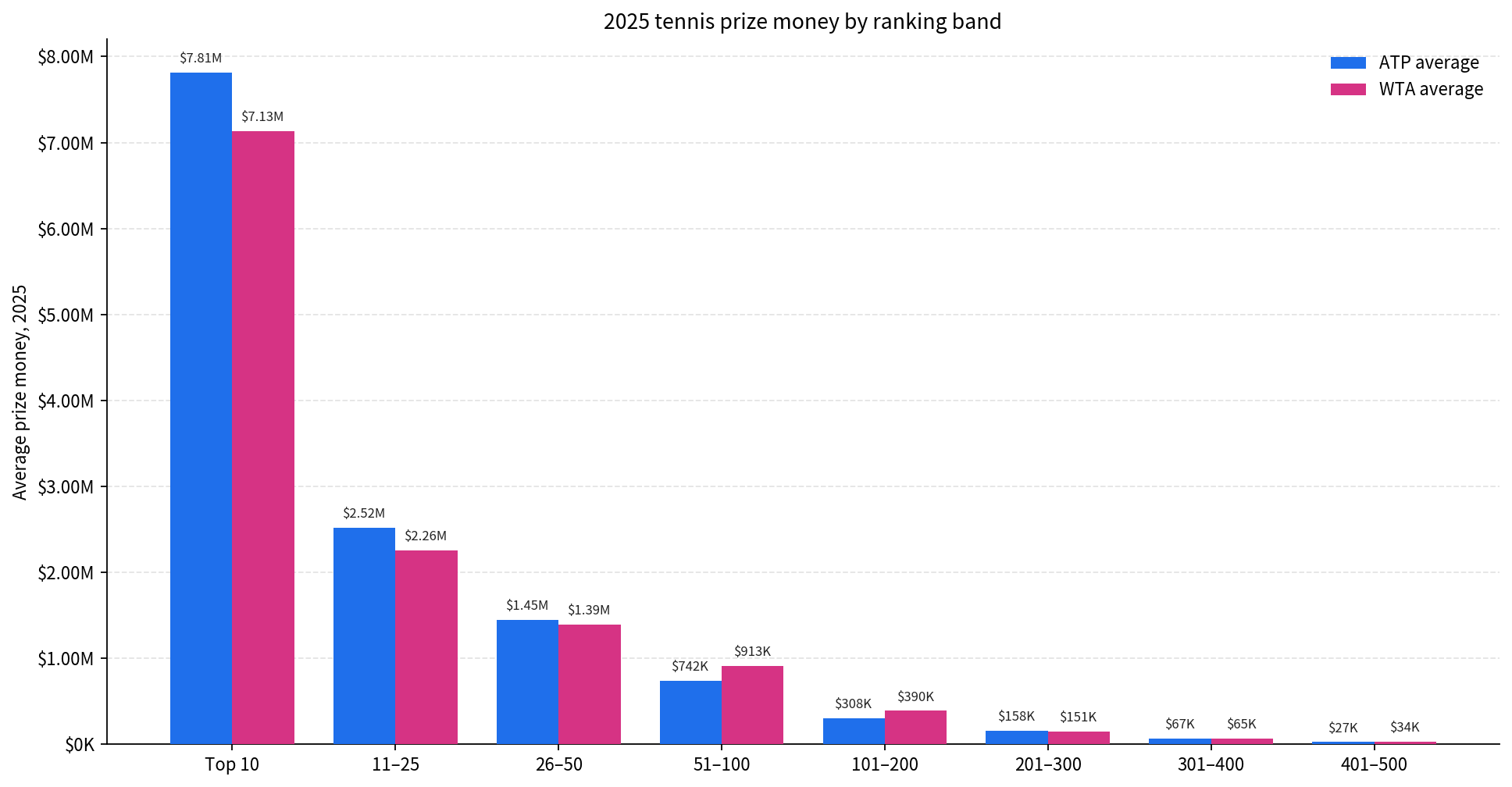
A player ranked in the Top 10 in 2025 took home an average of $7.81M on the ATP tour, $7.13M on the WTA. Drop one band, to 11–25, and the number is a third of that. Drop again, to 26–50, and it's cut in half once more. By the time you reach the 101–200 band — several hundred of the most technically excellent tennis players on Earth, good enough to be ranked ahead of tens of thousands of hopefuls who never got this far — average earnings are $308K on the men's side and $390K on the women's, before coaching, travel, stringing, physio, and the entry fees for the tournaments that produced that income in the first place. Net a good chunk of those players are subsidizing their own careers. By 400–500, prize money averages $27K to $34K a year, for professionals who train full-time and are, in absolute terms, some of the best athletes alive at what they do.
The instinct this chart produces in almost everyone who first sees it is that it looks unfair, or at least badly designed — an industry that pays its median full-time worker enough to lose money, propping up a tiny stratum at the very top. If you designed a compensation scheme from scratch and it came out looking like this, most people would call it broken. But tennis's money didn't come out looking like this by accident, and it isn't a bug the sport tolerates despite itself. It's the mechanism that makes the sport work at all.
Why the curve has to be steep
Start with what a tournament actually is: a single-elimination filter that spends several days and a lot of court time to answer one question — who, of this field, is best right now. Every round eliminates half the remaining players and produces exactly one champion. The prize structure that pays for this filter has to reward finishing near the top disproportionately, for a reason that has nothing to do with sentiment and everything to do with what the payout is actually purchasing: not effort, and not participation, but the outcome of the filter itself. A flatter curve — pay the round-of-64 loser almost what the champion gets — buys you a tournament nobody has any reason to try hard in, because trying hard and losing in the final costs the same as losing in the first round. The steepness is what makes the semifinal worth playing to win instead of playing out the string.
This is the same logic that governs venture capital, oil exploration, drug development, and any other domain where most attempts fail by design and the entire point of the enterprise is finding the rare one that doesn't. Nobody looks at a venture fund's return distribution — a handful of outsized winners subsidizing a portfolio of write-offs — and calls it unfair to the failed startups. The concentration is what the search process is for. A fund that paid every portfolio company the average return regardless of outcome wouldn't just perform worse; it would stop being a mechanism for finding winners and become a mechanism for funding whoever asked. Tennis's ranking bands are the same distribution wearing a different uniform: the entire 500-deep field exists so that the process of elimination can locate, with real confidence, who the very best currently is — and the money has to be concentrated at the outcome the process was built to find, or the process stops meaning anything.
What the variance is actually buying
The second half of the picture is where the steep average gets more interesting, not less:
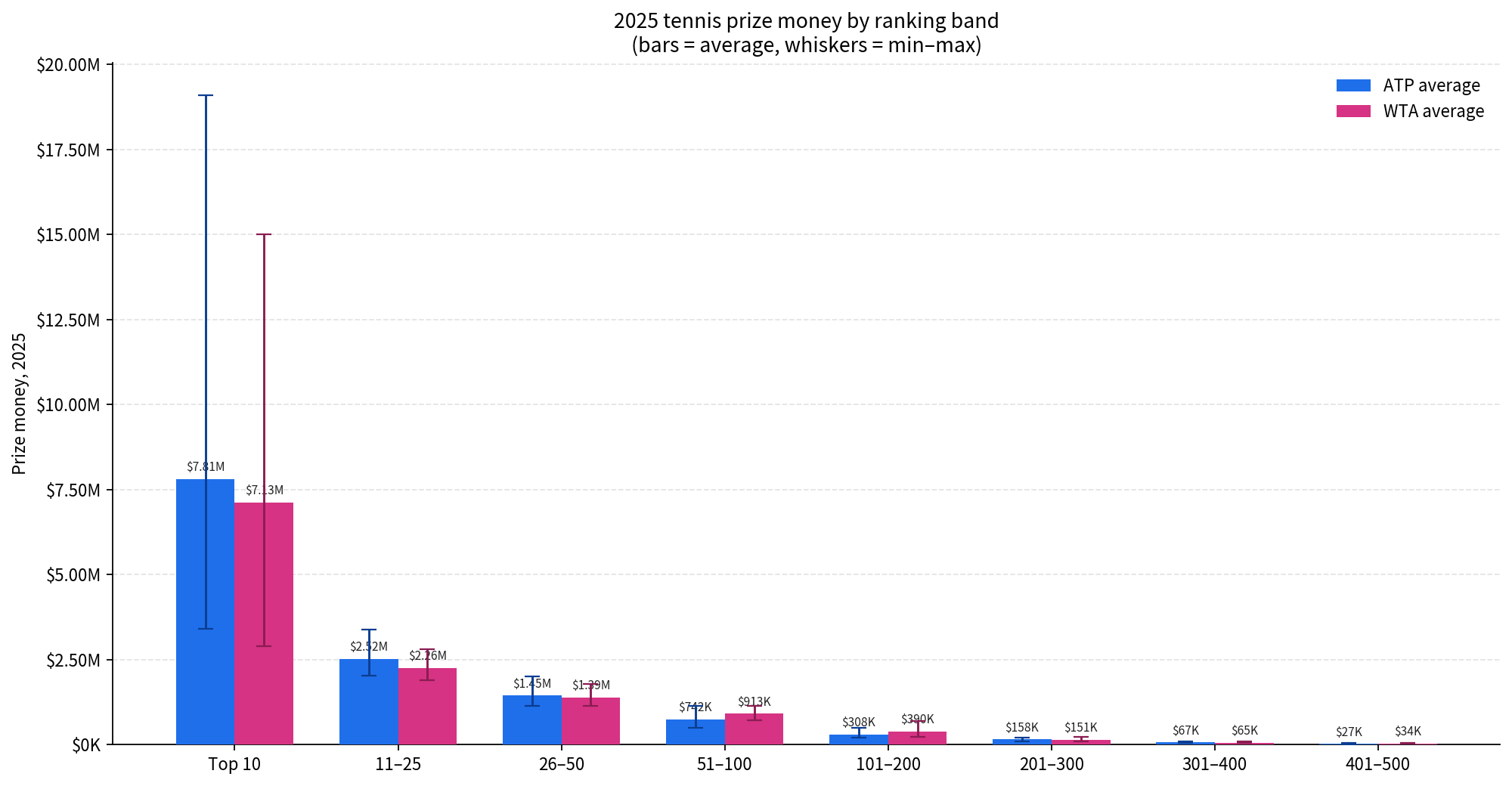
The Top 10 average of $7.81M sits inside a whisker that stretches from roughly $3.4M to $19M on the ATP side, and a comparably wide range on the WTA side. That's not noise around a stable mean — it's the tour's best players earning wildly different livings from each other despite occupying what looks, from a ranking-list distance, like the same tier. Meanwhile the 401–500 band, earning next to nothing on average, also has next to no variance: everyone down there is clustered near the bottom, because there's no further room to differentiate once you're already earning almost nothing.
That pattern — variance expanding exactly where the stakes are highest, and compressing exactly where they're lowest — is the tournament structure doing its second job. The ranking bands sort players into rough tiers of ability, but within the Top 10 the money is still being allocated by something finer-grained than the ranking number: who actually wins the majors, who close out the tour finals, who has the run of form in a given year. A Wimbledon champion and a player ranked ten spots behind them are, on ability, close to indistinguishable — the gap that separates a top-20 player from a top-5 player is a matter of a few percentage points of first-serve conversion, break-point conversion, a handful of matches that could plausibly have gone either way. But the prize structure doesn't pay for ability in the abstract; it pays for who converted that ability into wins, in a given tournament, on a given day. The wide whiskers at the top are the sport refusing to smooth over that difference even among players who are, by any coarser measure, peers. Lower down the ranking, where nobody's converting anything into a title, there's nothing left to differentiate, and the payouts compress into the same shared floor for the same reason a lottery's non-winning tickets are all worth exactly zero regardless of how close the numbers came.
What a flatter curve would actually cost
It's worth taking the counterfactual seriously rather than waving it off, because the instinct to flatten the curve is a reasonable one and the sport has, at various points, faced real pressure to do it — guarantee a living wage down to the 100 mark, say, or pay challenger-level events closer to what a tour event pays. The honest answer is that it would work, in the narrow sense that more people could stay on tour longer without going broke. It would also change what the tour is measuring.
Flatten the payout curve enough and the marginal round stops being worth winning for its own sake. A player already guaranteed a comfortable income at the 150 ranking has less reason to gut out a five-set qualifier against someone ranked 400 spots below them — the financial gap between winning and losing that match shrinks, and with it the pressure that currently keeps a ranking list an honest read of who's actually better right now. Every sport that has tried to soften its own tournament structure runs into a version of this: guarantee too much for participation and the event starts measuring who showed up instead of who won. The steep curve isn't just unkind to the middle of the field — it's the reason the ranking list at the top can be trusted at all.
What it would change downstream, though, is the shape of the sport beneath the tour, and there the trade looks more favorable. A flatter curve, or a wider one — more prize money at the 100–300 bands specifically, funded by trimming some of the top-heaviness rather than adding to the pot — would let more of the players just below tour level treat competitive tennis as a sustainable middle-class career instead of a young person's gamble cashed out by the mid-twenties. That's the population that becomes club pros, academy coaches, and regional circuit organizers once the ranking-list ambition runs out, and right now a large share of them are forced out of the sport entirely by the economics rather than choosing to leave it — taking their game, and their ability to teach it, with them. A structure that let more of that tier stay financially afloat a few years longer wouldn't dilute the search for who's best at the very top; it would just thicken the layer of serious, tournament-tested players who end up teaching club members, running junior programs, and stocking the USTA-league and ladder-tournament scene that most amateur players actually touch. The steep curve concentrates talent at the summit efficiently; a slightly less brutal one down at 150–400 would concentrate talent in the clubs more efficiently than it currently does, and club tennis is arguably where the sport's long-run health — new players, retained players, the whole base of the pyramid the tour sits on top of — actually gets made or lost.
The part that doesn't fit the cynical read
It would be easy to stop here and conclude that tennis's money structure is simply extractive — a sport that lets a handful of stars capture almost everything while the rest subsidize the spectacle with their unpaid labor. That reading gets the direction of causation backwards. Nobody is forced into the 300–500 ranking bands; every player there chose to enter a filter with a payout curve that was fully visible before they entered it, competing for the chance to reach the tier where the real money is, the same way every one of those failed startups took venture money knowing exactly how the fund's return distribution worked. The players ranked 400th aren't unpaid labor propping up the Top 10 — they're option-holders, buying a shot at the outcome the steep curve is designed to reward, at a price (their own unsubsidized training and travel costs) they set for themselves by choosing to keep playing.
And the return on that option isn't purely financial while it's outstanding. A ranking of 350 in the world at a sport with a global talent pool numbering in the tens of millions is a genuinely rare achievement, sellable in the form of coaching income, sponsorship at a regional level, or simply the standing of being demonstrably one of the best in the world at something extraordinarily hard — none of which shows up in the ATP or WTA prize money column at all. The chart above is measuring one output of the tournament system, not the whole of what the system produces or what it's worth to the people inside it.
What the two charts together actually show is a payout structure doing exactly what it's built to do: concentrate reward at the outcome the whole apparatus exists to find, differentiate finely among the players close enough to that outcome to matter, and stop bothering to differentiate once the field has been reduced to people who, this year, didn't get there. It looks unfair only if you mistake the ranking list for a job ladder, where seniority is supposed to buy a smoothly rising wage. It isn't one. It's a search process, and the steep curve is the cost of running a search process that still means something when it's done.