 Social Liberty
Transitioning to Private Pickleball
The Municipal Trilemma found a boundary problem no siting distance could solve. Four exterior boundaries and a membership fee solve the part zoning never could.
Click to enlarge
The Municipal Trilemma worked through pickleball as the cleanest small-stakes instance of the boundary problem this site keeps finding at every scale: a court's value to the players and its cost to the neighbors are both real, both large, and generated by the same fixed piece of land at the same time of day, with no siting distance inside a normal town's footprint that clears a residential lot line while staying close enough to be the kind of accessible amenity that made the sport worth building courts for in the first place.
That essay's conclusion was that a lot of towns aren't actually solving the fight. They're capping new public courts and calling the cap a policy, which forfeits the good the courts would have done rather than finding the site that lets it be done without cost to anyone standing nearby.
There's an answer sitting in plain sight that a zoning map was never going to produce, because it isn't a zoning answer. It's a market one, and — the same way Land as Road found for private streets — it isn't a proposal waiting for someone to try it. It's already running, under a name that doesn't advertise itself as a rebuttal to anyone: the private pickleball facility, membership-funded and privately owned, built specifically to solve the one problem no public court sited anywhere in a residential neighborhood was ever going to solve on its own — sometimes by moving the court indoors, and just as often by moving it to a stretch of commercial land where the boundary problem was never actually present, and bundling in whatever else the same foot traffic will pay for along the way.
Part of why a zoning map keeps losing this race is that pickleball itself is still a moving target. It's a sport still figuring out its own best practices in real time — court surfacing, paddle and ball regulation, acoustic mitigation, even the ratio of courts to parking and clubhouse space a given facility actually needs — none of it settled the way tennis or basketball's requirements settled decades ago. A rule or a facility standard that made sense for the sport eighteen months ago can already be outdated by the time a public parks department finishes the capital planning cycle to build around it.
This kind of fast-moving, still-experimental environment needs a provider that is motivated to adjust practice week to week, not a public process built to move on a budget and public-review cycle. A free market does exactly that by default — a facility owner who guesses wrong about a court dimension or a soundproofing spec eats the cost immediately and fixes it on the next build, where a public agency's mistake gets locked in for a decade because building it again isn't in next year's budget either. Responsiveness isn't a side benefit of letting the private sector run ahead of government here. It's the actual advantage being exercised, in a sport that specifically punishes whoever can't keep up with it.
The part a wall solves that a setback can't
The Municipal Trilemma named the acoustic mechanism precisely: the sound isn't loud so much as it's impulsive, a sharp paddle-on-ball pop repeated roughly twice a second, in the exact frequency range human hearing is worst at tuning out. Distance attenuates that signal gradually and imperfectly — cutting it in half takes roughly four times the distance, which is exactly why no setback that still leaves a court walkable from a neighborhood also leaves it inaudible from one. A standard commercial building envelope doesn't attenuate gradually. It blocks categorically, the way any wall separating a noisy interior use from the exterior does for a bowling alley, a shooting range, or a nightclub — none of which get built in the middle of a residential block expecting distance alone to handle the noise, because nobody would accept that as an adequate plan. Pickleball courts sited outdoors have mostly been trying to solve an indoor-shaped problem with an outdoor-shaped tool, which is a design mismatch dressed up as a siting dispute.
Indoor facilities have been absorbing exactly the demand that mismatch was creating. The Picklr, founded in 2021, has franchised indoor pickleball complexes into markets across dozens of states on the standard gym-franchise model — a fixed monthly build-out cost, a membership or court-rental fee structure, and a building envelope that makes the noise question simply not come up, because the noise never leaves the building. Chicken N Pickle built its own version around a restaurant-and-courts hybrid, expanding out of Kansas City into multiple states on the same logic. Life Time, already running athletic country clubs on a membership model for decades, has added indoor courts to existing facilities rather than treating pickleball as a problem requiring a new civic asset at all.
None of this required anyone to win a zoning fight. It required a facility owner to notice that a sport growing faster than any other in the country, per the Sports & Fitness Industry Association's own participation data for several years running, was generating demand a public parks budget was structurally unable to site without a fight — and to build the thing that demand could actually pay for directly.
Outdoors still works, just not everywhere a town needs it to
None of this is actually an argument that pickleball has to move indoors. Indoor construction is the answer for the specific case The Municipal Trilemma was diagnosing — a residential neighborhood where no outdoor distance clears the lot line — but a private developer isn't stuck solving that case everywhere the way a parks department, chasing walkable equity of access, effectively is.
A private outdoor facility sited on land that was never residential to begin with — a business park, a strip along an arterial road already zoned commercial, the acreage next to a big-box retail pad — doesn't need four walls and an HVAC system to solve the boundary problem, because there was no residential boundary there to begin with.
The same twice-a-second pop that reads as intolerable through a bedroom window is background noise against a commercial corridor already running forklifts, delivery trucks, and drive-through speakers. The market's actual answer isn't "indoors, always." It's siting: a public parks department has to fight for whatever land inside a walkable neighborhood it can get, while a private developer is free to go looking for the parcel where the externality was never going to be a cost to anyone, and outdoor construction is cheap enough that a lot of them have taken exactly that option instead of building indoors at all.
The synergies a parks department never had a reason to chase

A public court, once built, does one thing: it hosts pickleball. A private facility, whether indoor or sited on a commercial outdoor lot, has every incentive a public one lacks to bundle in whatever else the same foot traffic will pay for, and the market has been doing that bundling aggressively rather than treating the court as the whole product. Chicken N Pickle's entire model is the court as the draw and the restaurant, bar, and event space as where the actual margin lives — a family plays for an hour and stays for dinner, which a standalone public court structurally can't capture because a town's parks budget has no mechanism for taxing the burger sold two blocks away as a result.
Indoor operators have leaned the same direction toward fitness and health: pickleball's injury profile — sudden lateral movement and repetitive overhead motion producing a real, well-documented wave of ankle sprains, rotator cuff strain, and the tendinitis players have started calling "pickleball elbow" — has made physical therapy and sports-medicine tie-ins a natural adjacent tenant rather than a coincidence, the same way a ski resort's clinic sits at the bottom of the lift instead of across town.
Taproom and brewery co-location shows up in the same facilities for the same reason a bowling alley has always sold beer: a captive, socially inclined crowd already paying to be there is exactly the customer an adjacent business doesn't have to advertise to find.
None of that bundling needed to be invented from a theory. Land as Road made the general version of this case already: a private owner who benefits from a use's spillover has every incentive to capture that spillover directly, through co-location and shared leases, instead of leaving it to accrue somewhere the original investment never gets credit for it.
A vacant big-box retail box — the kind of dead department-store anchor space that's been sitting empty in strip malls across the country since the last decade's retail contraction — is exactly the real estate this logic has been finding: cheap per square foot precisely because nobody wanted it for retail anymore, structurally suited to subdividing into courts plus a bar plus a fitness studio plus a therapy clinic under one lease, and profitable in a way the same square footage sitting empty as failed retail never was.
A public parks department solving "where do we put courts" was never going to solve "and what should share a roof with them" at the same time, because that second question isn't a land-use question at all. It's a leasing question, and leasing is the one part of this that was never going to be a municipality's job to begin with.
A free court is a price, not an absence of one
There's a version of this argument that stops at "the town should build more courts, better sited," and it's worth explaining why that version doesn't actually rescue the public option, rather than just asserting a private one is better.
A municipality that offers even a small, capped, badly sited number of free public courts isn't a neutral non-participant in the market a private facility is trying to enter next door. It's a competitor operating at a price of zero, and zero is a price like any other — it just happens to be one no private operator can profitably match, regardless of how well they've solved the siting and noise problems the town never could.
That's the mechanism worth naming plainly: a free public option, even a bad one, functions as a price ceiling on the whole local market, the same distortion rent control produces in housing.
A resident deciding whether a $20-an-hour private court membership is worth it isn't comparing it against the true cost of building and running a court — they're comparing it against a sticker price of zero at the town's own courts, and the comparison makes the private option look like an unnecessary luxury rather than what it actually is, a facility pricing in the land, the acoustic engineering, and the siting flexibility the free option was never able to deliver.
The town's free courts are almost never actually free in the way that comparison implies — they're rationed by waitlist, lottery app, or a hard cap on new construction, which means the real cost of the "free" option is a queue rather than a fee. But a queue doesn't show up in the number a resident mentally weighs against a membership price, which is exactly why an undersupplied public option can suppress private investment even while failing, by its own design, to meet the demand it's nominally serving. We end up with the worst of worlds.
This is the sense in which a well-intentioned municipal provider ends up functioning as a limiter rather than a provider at all. It isn't capable of building enough courts to clear demand — The Municipal Trilemma already established why, structurally, it can't — and at the same time its below-cost price anchors the market in a way that makes it harder for anyone who could clear that demand to justify the capital.
The town isn't failing to solve the shortage and otherwise staying out of the way. It's failing to solve the shortage while actively holding down the price signal that would otherwise tell a private developer this specific shortage is worth building into. A parks department doesn't need to intend that outcome for it to be the one its free court produces.
Free isn't a price point. It's a different category entirely.
Naming the distortion isn't the same as making it easy to undo, and an honest version of this argument has to say so rather than assume the crowding-out mechanism reverses itself the moment someone points it out.
The behavioral economics here is sharper than ordinary price sensitivity: Dan Ariely's own experiments found that dropping a price from one cent to zero shifts demand far more than an equivalent one-cent drop anywhere else on the price curve — in his best-known version, cutting a premium chocolate's price by a cent barely moved anyone, but cutting a cheap chocolate's price by that same cent, down to free, sent nearly everyone toward it even though the relative price gap between the two options hadn't changed at all.
Free isn't the bottom of a price scale a resident is weighing rationally against a membership fee. It's a different category of decision, one loss aversion makes sticky in its own right — giving up a free good registers as a loss the way spending new money doesn't, even when the paid alternative is worth strictly more.
That means a town can't simply announce that its courts are closing and its citizens should go find a membership, and expect the market to absorb the transition cleanly, even in cases where the private option is unambiguously better on cost, siting, and quality. A population that's spent years treating court access as a free amenity will experience its withdrawal as a loss regardless of what replaces it, and a private operator entering that market cold, against an entrenched zero-price expectation, is fighting a behavioral headwind no pricing model alone accounts for.
Transitioning to LVT already made the general version of this case for a much larger reform: the steady-state economics of a policy can be completely sound while the crossing itself is where the whole thing actually dies, and the fix isn't to argue harder for the destination, it's to design the transition as seriously as the policy.
The same discipline applies here at a much smaller scale. A town phasing out free courts has better options than an abrupt closure — an announced sunset date years out, giving both residents time to adjust their expectations and private operators a known demand curve to build capital against, rather than an uncertain one they have to guess at.
A gradual fee introduction on the existing public courts, rather than a jump from free to market rate, softens the loss-aversion cliff the same way a phased LVT assessment correction softens capitalization shock. A town doesn't even need to run that fee schedule itself — leasing the courts' administration, fee collection, and day-to-day maintenance out to a private operator under a management contract gets the phase-in built and billed by someone whose whole job is running exactly this kind of facility, while the town keeps the underlying asset and simply collects a concession fee instead of a parks department learning court-management logistics from scratch.
And private operators have their own tool that doesn't require the town's cooperation at all: free or steeply discounted trial periods, the same zero-price psychology working in the opposite direction, letting a new member experience the better product before the fee registers as a cost at all rather than asking them to trust a sales pitch against a free incumbent.
None of this changes the underlying case that a free public court is a limiter rather than a provider. It changes what a serious version of the argument owes to the people currently standing on the other side of that free court, which is a plan for getting them across, not just a diagnosis of where they currently are.
What a membership fee is actually pricing
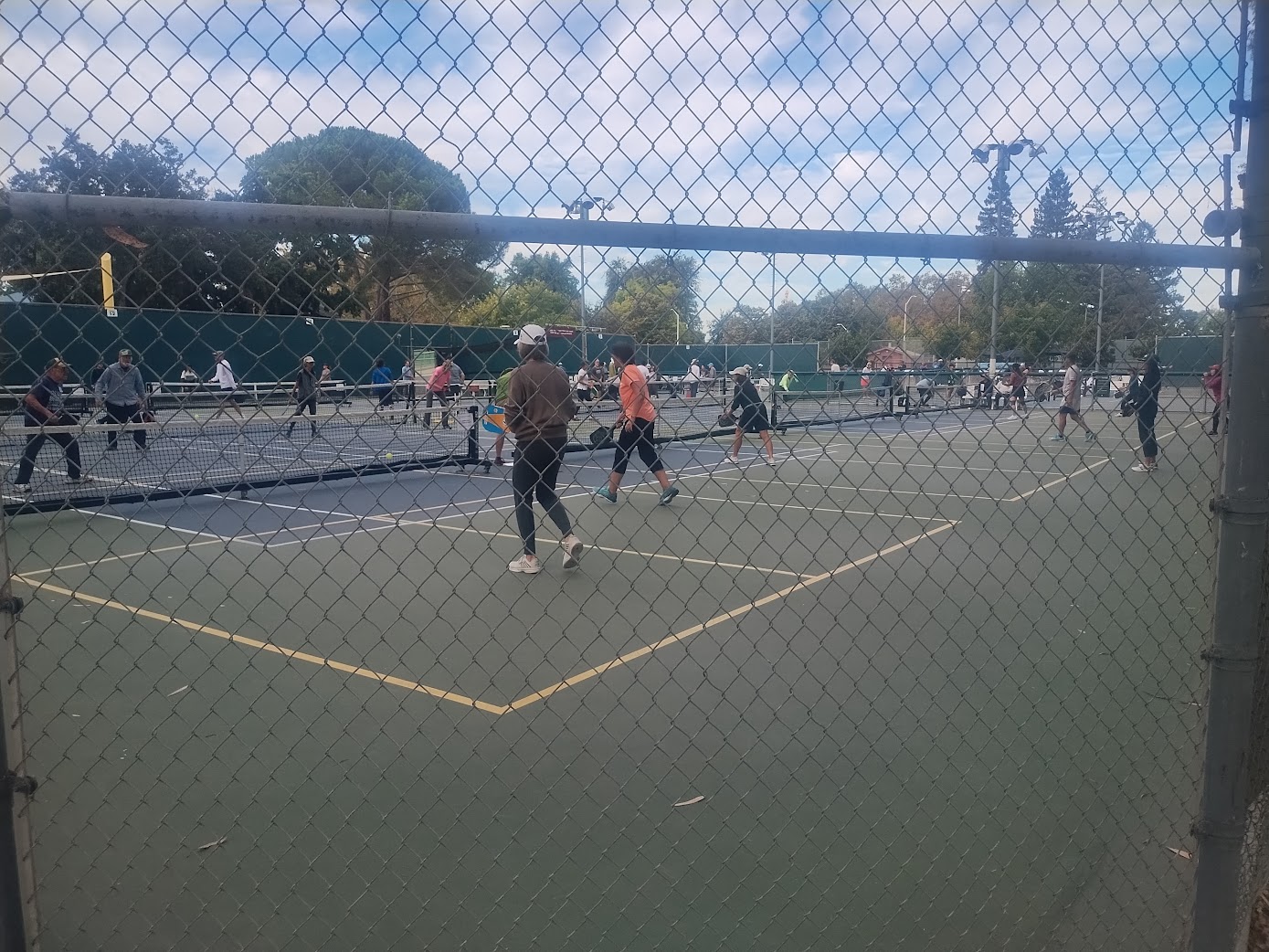
The cost of a pickleball court was never zero. A public court's apparent lack of a price tag doesn't mean the cost disappeared — The Municipal Trilemma already made this case for curb space and it applies just as directly here: an unpriced amenity doesn't stop costing something, it just moves the bill onto whoever's standing closest without a vote in the matter, which in pickleball's case is the neighbor whose porch stops being usable most mornings the courts are booked. A membership fee at a private facility prices the actual inputs — the land, the building, the acoustic engineering that makes the noise a non-issue — onto the party actually receiving the benefit, instead of externalizing the one cost that was never going to clear a setback onto somebody who gets nothing from the arrangement at all.
The land itself is the largest of those inputs, and it's also the one a public court's budget almost never actually counts. A town that already owns the parcel a court sits on doesn't write a check for it, which makes the site read as free in every budget conversation that follows — but the town still owns a piece of land with a real market value, foregoing whatever else that land could be earning or being used for the entire time four courts occupy a sixth of an acre serving a handful of players an hour.
That foregone value doesn't disappear just because no invoice for it ever gets cut. A private facility has no such blind spot, because the land shows up on a balance sheet whether the owner wants to look at it or not — rent, a mortgage, or the opportunity cost of not selling the parcel to someone who'd pay more for it, all real numbers a membership fee has to actually clear before the facility is worth operating at all.
A public court's land cost is just as real. It's only invisible because nobody's ever had to write it down.
That's a real tradeoff, not a free win, and it's worth naming rather than waving off the way a weaker version of this argument would. A fee excludes a player a free public court wouldn't have. But the comparison isn't between a private court that costs something and a public court that costs nothing — it's between a private court that costs something to the player who uses it and a public court that, in practice, has been rationing itself by capped hours, lottery sign-ups, and the quiet decision so many towns have already made to just stop building more, while still imposing a real, unpriced cost on the neighbor next door.
Both systems ration. Only one of them prices the rationing onto the party the amenity is actually for.
The land underneath it doesn't get a free ride either
Land as Road made a point of not letting private road ownership quietly reproduce the same unpriced land the public system left unpriced, and the same discipline applies here without needing a new argument built from scratch.
An indoor pickleball facility sited in a dense, walkable neighborhood is valuable specifically because the neighborhood around it is valuable — the same land-value logic Transitioning to LVT and Single Tax for the Living World apply everywhere else on this site. A land value tax assessed on the site a private facility occupies, the same way it would be on any adjacent parcel, keeps the arrangement honest in exactly the way a membership fee alone doesn't: the facility owner captures real value from the neighborhood's density and foot traffic, and owes rent on that value regardless of what's built on top of it, the same as every other landholder nearby.
Privatizing the court solves the boundary problem. LVT underneath it is what stops that solution from becoming an unpriced windfall in its place.
The cap, revisited
Go back to the town that solved its pickleball fight by simply refusing to build more courts. That refusal reads as caution, but it's actually just a forfeited good sitting next to a working alternative nobody at the council meeting was looking at, because the alternative doesn't show up on a zoning map at all — it shows up as a membership fee, a building permit for ordinary commercial space, and a wall doing the one job a hundred-yard buffer was never going to manage. The market didn't wait for the town to solve its own boundary problem. It just built the thing that didn't have one.
Featured in Municipal Social Liberty