 Social Liberty
Authenticity and Nature -- Becoming What Is
Land, sky, weather, position, and culture. A people becomes itself through the things it never chose and cannot control. Freedom is not escape from them, and the worst a distant government can do is pretend they are not there.
Click to enlarge
In 1976 a double-hulled canoe named Hōkūleʻa sailed from Maui to Tahiti, about 2,500 miles, without a compass, a chart, or a sextant. Its navigator was Mau Piailug, from Satawal, a coral island in Micronesia about a mile long with a few hundred people on it. Hawaiians had lost the old way of finding islands across open ocean generations earlier. Piailug still had it. He read the rising and setting points of stars on a compass held in memory, the long swells that keep their direction for days, the color of the water, and the birds that fly out from land in the morning and back at night. After about a month at sea the canoe reached Tahiti.
None of what Piailug knew was chosen by anyone. It came from a sky, an ocean, and an island too small to feed its people without voyaging. Generations on Satawal had answered those facts, and the answers had become a body of knowledge, a set of customs, and a kind of person. That is what this essay means by authenticity. A people is authentic to the degree that it has been shaped by the things it did not choose and cannot control, and has answered them in its own way.
Then Piailug did something that matters as much as the voyage. Breaking with the custom that kept navigation inside particular families, he taught it to outsiders, Hawaiians who wanted their own sky back. One of them, Nainoa Thompson, went on to navigate the canoe himself and to train a new generation. Authenticity, it turned out, could be learned by anyone willing to submit to the same stars and swells. That point will matter later.
Authentic, from the Greek
The word comes from the Greek authentēs, someone who acts on their own authority, with their own hand. An authentic thing is self-authored rather than copied or imposed. Toward an Authentic Santa Clara Valley used the word this way about politics and infrastructure development: an authentic movement grows out of the body politic and its lived experience, while an inauthentic one is draped over it from outside.
There seems to be a paradox in applying the word to a people. If authentic means self-authored, how can it come from things nobody chose? The answer is that a people authors its response, not its circumstances. Nobody on Satawal chose the Pacific. What they chose, over centuries, was how to live with it. Remove the given and there is nothing to respond to. Remove the response and there is only weather. Authenticity needs both, and it fails in two ways: when a people's response is replaced by someone else's, and when the given itself is hidden from them. They become detached, disembodied, and isolated.
Five kinds of given do most of the work.
Land
The ground a people lives on decides what can be grown, built, and defended, and often how people must cooperate to survive on it.
Much of the western Netherlands lies below sea level. Nobody chose that. What the people living there chose, starting in the Middle Ages, was to organize. Landowners along the same stretch of dikes and drains formed water boards to maintain them, raised money from the people who benefited, and elected their own officers. The Hoogheemraadschap van Rijnland received its charter in 1255 and still exists. The water boards are often called the oldest democratic institutions in the country, older than the Dutch state, and they were built by people who had no choice about the water but every choice about how to hold it back. When one landowner neglected a dike, the neighbors flooded too. The land made the cooperation necessary and made it local, because each polder had its own levels and leaks that only the people living on it understood.
The Dutch habit of settling disputes by long negotiation among parties who cannot afford to walk away is still called the polder model. The phrase names a political culture after a piece of land.
Sky
The sky tells a people what time it is, where they are, and when to begin. For the Carolinian navigators it was a map. For the Māori, the new year begins when the star cluster Matariki, the Pleiades, rises before dawn in midwinter. New Zealand made Matariki a public holiday in 2022, the first in the country based on a Māori calendar, and one that falls on a different date every year because it follows the stars rather than the government's calendar.
A sky can be lost without anyone deciding to lose it. Most people in cities now see a few dozen stars where their great-grandparents saw thousands, and the loss happened one streetlight and one parking lot at a time. Flagstaff, Arizona, home of the Lowell Observatory, decided early that it would not lose its sky. In 1958 the city banned advertising searchlights, and over the following decades it wrote lighting rules that shield fixtures and limit glare. In 2001 it became the first International Dark Sky City. No higher government required this. It was a town deciding that a given it could not create was worth keeping, and keeping it through its own rules.
Weather
Weather sets a people's calendar, its architecture, its crops, and often its temperament. It also sets when people can gather to govern themselves.
The Icelandic Althing, founded in 930, met in the open air at Þingvellir for two weeks each June. It met in midsummer because that was the only time farmers from across the island could travel over the highlands and the rivers were passable. The lawspeaker recited a third of the law each year from a rock above the plain, so that over three years the whole of it was heard by everyone present. Iceland's self-government had the shape of its weather: brief, seasonal, outdoors, and dependent on everyone making the journey. The Swiss Landsgemeinden that still meet in spring follow a similar logic.
Weather also builds. The thick adobe walls of the Pueblo peoples hold the night's cold into the day and the day's heat into the night, which is what a high desert with huge daily temperature swings requires. The steep roofs of alpine villages shed snow. The deep porches of the American South were shade before they were a style. Buildings that answer their weather look like they belong somewhere, because they do.
Position
Position is where a people stands in relation to others: on a coast or inland, upriver or down, on a crossroads or at the end of a road, between two powers or under one.
Around 1230 someone built a bridge across the Schöllenen gorge in the Swiss Alps, opening the shortest route over the Gotthard pass between Germany and Italy. Overnight, the mountain valley of Uri sat astride one of the most valuable trade routes in Europe. Its position made it worth courting. In 1231 Uri received a charter making it answerable directly to the emperor, with no lord in between, and sixty years later it joined Schwyz and Unterwalden in the alliance that became Switzerland. The people of Uri did not choose the pass. They chose what to do once the pass made them important.
Andorra is a smaller case of the same thing. Wedged in the Pyrenees between two larger powers, it has had two co-princes since 1278, one French and one Spanish, and its independence has rested for most of that time on the fact that neither neighbor would let the other have it.
Position is also the given that economists know how to price. Henry George's argument in Progress and Poverty (1879) was that the rent of land is mostly the value of its position: its nearness to people, routes, water, and work, none of which the owner created. That is why this collection of essays keeps returning to the land value tax. It is the one tax that falls on a given rather than on effort. A people that collects the rent of its position is recognizing what its place is worth, and the value comes back to the community whose presence created it.
Culture
Culture looks like the odd one out on this list. People make it, so how can it be a given?
It is a given because nobody controls it. Every person is born into a language they did not choose, a set of manners, a way of settling disputes, a set of stories about who their people are. Culture Part 1 described culture as the place a society keeps its answers, and the answers on Satawal, in the polders, and at Þingvellir were responses to the four givens above, accumulated over generations until they became a fifth. Culture is the given that remembers the others.
Culture also changes, and nobody controls that either. Culture Part 2 traced how it moves through small signals too slight to resist. A people can tend its culture, teach it, and argue over it, but it cannot design it, any more than it can design the weather. Attempts to design one usually produce something recognizably fake.
The counterfeit
In 1976, the same year Hōkūleʻa sailed, the geographer Edward Relph published Place and Placelessness. He described a spreading condition in which places lose their particular identity and become interchangeable: the same highway strip, the same subdivision, the same mall, whether the land under it is desert or marsh. Relph called the attitude behind it inauthentic. It treats places as sites for standard products and ignores what is already there.
Placelessness is usually blamed on markets, and markets do produce some of it. But much of it is required by law. A uniform building code, a single zoning template, and a statewide standard for street widths will produce the same suburb in the fog belt and the desert, because they were written to ignore the difference. The Municipal Trilemma found that cities often have less control than they appear to over what gets built inside them. When the rules come from far away, the buildings answer to the rules and not to the land, sky, and weather.
California's recent housing laws show how this happens. Most of them were written with the state's largest cities in mind, above all San Francisco, whose state senator Scott Wiener has carried many of them. SB 79, signed in 2025, allows mid-rise apartment buildings by right within about half a mile of qualifying rail and bus stops in the state's urban counties. In San Francisco, a dense city that grew up around streetcars, that extends what the city already is. The same rule applies to a small town whose one commuter station sits among oaks and single-story houses, or to a farm town at the end of a commuter line, because the law counts transit stops, not places. Earlier laws took the same approach. SB 9 lets nearly every single-family lot in an urbanized area become up to four units, and the state's housing-quota system assigns every city and town a number of homes to plan for, enforced by the builder's remedy.
Splitting the Atom of Sovereignty described what these laws do to a town's power to decide. The point here is different. Each of them carries a picture of what a good place looks like, and the picture is a big city. A hill town with narrow fire roads, a coastal village drawing its water from a few wells, and a farm town organized around the harvest are each asked to become a smaller version of San Francisco. Their land, weather, and position, the things that made each one a particular place, drop out of the decision.
None of this denies the shortage. California needs far more homes than it has, and Pro-Housing, Not Pro-Development argued that some state laws, like the ones that freed homeowners to build backyard cottages, return a right to people instead of taking a decision away from the places they live. The test is whether a law frees people to answer their own givens or replaces the answer with a template drawn from the biggest city in the state.
Authenticity can also be counterfeited from the other direction, by freezing it. In the early twentieth century Santa Fe's boosters decided the city should look like a Pueblo village, and in 1957 the city wrote that look into a historic-style ordinance that still governs new buildings. The adobe walls that once answered the high-desert weather became a mandated costume, sometimes made of stucco over wood frame. A style that had been a response turned into a rule. Preservation of that kind isn't wrong in itself, and Santa Fe is beloved partly because of it. But it shows that the look of authenticity can be imposed as easily as placelessness can.
The most damaging counterfeit hides a given altogether. The United States' National Flood Insurance Program, created in 1968, sells flood insurance at prices that for decades did not reflect the actual risk. The weather sends a clear signal about where not to build. The program muffled it, and some properties have flooded and been rebuilt with federal money again and again, a small share of insured buildings accounting for a large share of all claims. A people that cannot feel its weather cannot answer it.
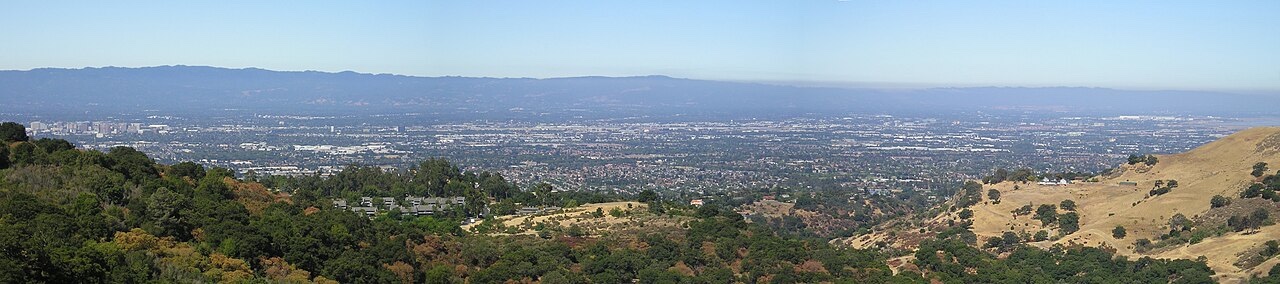
The Santa Clara Valley looking west from Alum Rock Park, with downtown San Jose at left and the Santa Cruz Mountains beyond. Oak woodland, grass hills, and a valley floor of cities, each with its own ground, weather, and position, all under one state template. Photo: "AlumRockViewSiliconValley w" by Elf, CC BY-SA 3.0.

Why social engineering fails
These cases share a name. Social engineering, the attempt to design how a people lives from above, has a deservedly bad reputation, and the reason is structural rather than a matter of bad intentions. An engineer needs a blueprint and a finished state. The processes that make a people authentic have neither. A culture answering its land and weather is never done: it adjusts every season, through millions of small decisions made by people who each know a little about their own corner of the given. To install a design, the engineer has to stop that process, or at least overrule it, and hold the design in place against it. Social engineering can never abide natural social processes, because those processes are what it exists to replace.
Karl Popper drew the line in The Open Society and Its Enemies (1945) between piecemeal reform, which changes one thing, watches what happens, and corrects, and what he called utopian engineering, which works toward a complete blueprint and must therefore silence whatever contradicts it. James C. Scott's Seeing Like a State (1998) followed the utopian kind through the twentieth century. One of his cases was Tanzania's villagization campaign of the 1970s, which moved millions of rural people into planned villages laid out on grids, sited where the plan said rather than where the soil and water were. Harvests fell. The farmers had known things about their land that the planners never asked.
California's housing laws are a far milder case, and they come from a real need. But they share the defect in small. They fix the answer in advance, the same answer for every place, and then hold each place to it regardless of what its land, weather, and position would have told the people living there.
Three claims about the given
The problem fits the three-claim form this collection uses for hard questions.
First: a people becomes authentic by being shaped by what it did not choose: its land, sky, weather, position, and inherited culture.
Second: liberty means people choose for themselves how to live.
Third: the given limits choice. Every one of these factors is a constraint that no one consented to.
Put together, they seem to say that authenticity and liberty are opposed, and that a free people would want to escape its givens, while an authentic people has to accept limits it never agreed to.
In 1782 the French-American farmer J. Hector St. John de Crèvecoeur wrote that "men are like plants," and that we are what we derive from the air we breathe, the climate we inhabit, the government we obey, and the religion we profess. His list is a good one, but it mixes two different kinds of thing. The soil, the air, and the climate are given by nature. The government is given by other people.
That distinction resolves the problem. Liberty, in the sense that matters here, is freedom from coercion by other human beings, not freedom from circumstance. Hayek drew this line carefully in The Constitution of Liberty: the weather and the mountains limit what anyone can do, but they don't coerce, because no one's will is being imposed. Farmers on the polder are not unfree because the sea is high. They would be unfree if a distant authority forbade them to build dikes, or built the dikes badly and forbade them to fix them.
So the first two claims were never in conflict. The third is true but misplaced: the given limits choice the way the ground limits a dancer. What conflicts with both authenticity and liberty is the substitution of one human will for the given, through the uniform code, the mandated style, or the subsidy that hides the flood. These are the cases where someone else's choices stand between a people and its circumstances. They take away the response that made the people authentic and the choice that made them free.
Living by the given
A few principles follow.
Govern close to the given. The Dutch water boards and the Althing worked because they were run by people who lived with the water and made the journey. Decisions about land, water, light, and building belong at the level where the people deciding share the circumstances. That is a geographic argument for municipalism, separate from the arguments this collection has already made for it.
Price the given instead of hiding it. Land value taxation prices position. Insurance at its true cost prices weather. Both let a people feel its circumstances and respond. Subsidies that blunt the signal take that response away, however kind the intent.
Let culture move. A culture answers its givens, and when the givens or the people change, the answers change too. Freezing a culture by ordinance makes a museum of it. Erasing it by uniform rule makes it placeless. Both stop the response, which is the part that was authentic.
Authenticity is open to newcomers. Blood is not on the list of givens, and neither is ancestry. Anyone who lives under the same sky, works the same ground, and answers the same weather takes on the same givens. Mau Piailug understood this when he taught the stars to people outside the families that had always kept them. A culture that refuses to teach newcomers isn't protecting its authenticity. It is ensuring the knowledge dies with its keepers.
Piailug died in 2010. The canoe he guided to Tahiti has since sailed around the world, navigated by people he trained, reading a sky none of them chose. That is what authenticity looks like when it is healthy: a set of facts no one controls, a people free to answer them, and a way of answering that anyone willing to look up can learn.
Sources
- Ben Finney, Hokule'a: The Way to Tahiti (1979), on the 1976 voyage.
- Stephen D. Thomas, The Last Navigator: A Young Man, an Ancient Mariner, the Secrets of the Sea (1987), on Mau Piailug and Carolinian navigation.
- Polynesian Voyaging Society, history of Hōkūleʻa and Nainoa Thompson's training.
- Oxford English Dictionary, "authentic," etymology from Greek authentēs.
- Hoogheemraadschap van Rijnland, institutional history (charter of 1255).
- Te Kāhui o Matariki Public Holiday Act 2022 (New Zealand).
- City of Flagstaff lighting ordinances (1958 onward), and DarkSky International, designation of Flagstaff as the first International Dark Sky City (2001).
- Jesse Byock, Viking Age Iceland (2001), on the Althing at Þingvellir.
- William Coxe and later histories of the Gotthard route; the Uri charter of 1231 and the Federal Charter of 1291.
- The Andorran paréage of 1278.
- Henry George, Progress and Poverty (1879).
- Edward Relph, Place and Placelessness (1976).
- Chris Wilson, The Myth of Santa Fe: Creating a Modern Regional Tradition (1997), on the 1912 plan and the 1957 historic-style ordinance.
- California SB 9 (2021) and SB 79 (2025); California housing element law and the Regional Housing Needs Allocation; the builder's remedy (Gov. Code § 65589.5(d)).
- National Flood Insurance Act of 1968, and FEMA and Congressional Research Service reports on repetitive-loss properties.
- J. Hector St. John de Crèvecoeur, Letters from an American Farmer (1782), Letter III.
- Karl Popper, The Open Society and Its Enemies (1945), ch. 9, "Aestheticism, Perfectionism, Utopianism."
- James C. Scott, Seeing Like a State (1998), ch. 7, on compulsory villagization in Tanzania.
- F. A. Hayek, The Constitution of Liberty (1960), ch. 9, "Coercion and the State."
A note on how this piece was written: the subject, the questions it asks, and the positions it takes are mine. Much of the research, the examples, and the sentences were drafted by an AI model working from that direction, and then edited by hand. I'd rather say that plainly than have a reader guess at it.