Few words carry as much weight on their own as death. One syllable, closed off at the end by a breath through the teeth, and a conversation changes temperature. People go a long way to avoid saying it. Someone passed, […]
Each spring in northern New Mexico, before the water is let in, the people who share an acequia walk its length with shovels. The mayordomo, elected to manage the ditch, goes ahead with a stick and marks off a section […]
On a rough day at Clapham, Benjamin Franklin fetched a cruet of oil and went down to the large pond on the common. He dropped a little on the water from the leeward side, where the waves were largest, and […]
This follows a discussion at a recent meeting. In Sometown, in the Bay Area, two commission members are at odds about why they’re there. One holds that a commission exists to help the administrative government get its work done. The […]
At the north end of the Bassin de la Villette in Paris stands a round stone building with a ring of columns, built in the 1780s by the architect Claude-Nicolas Ledoux. It looks like a small temple. It was a […]
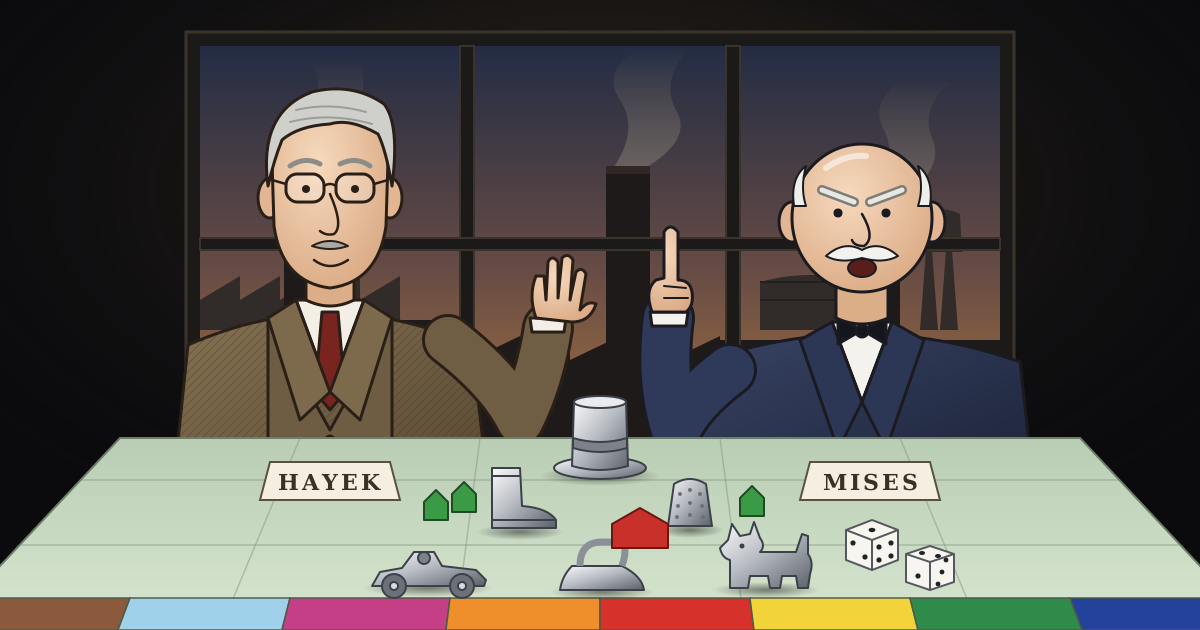
For fourteen years, from 1920 to 1934, Ludwig von Mises held a seminar in his office at the Vienna Chamber of Commerce. He wasn’t a salaried professor. The University of Vienna let him lecture without pay, and his living came […]
On almost any Saturday in the spring of 2021, an open house in Sunnyvale went something like this. The house was a three-bedroom ranch on a cul-de-sac, one of thousands put up in the late 1950s for the engineers and […]
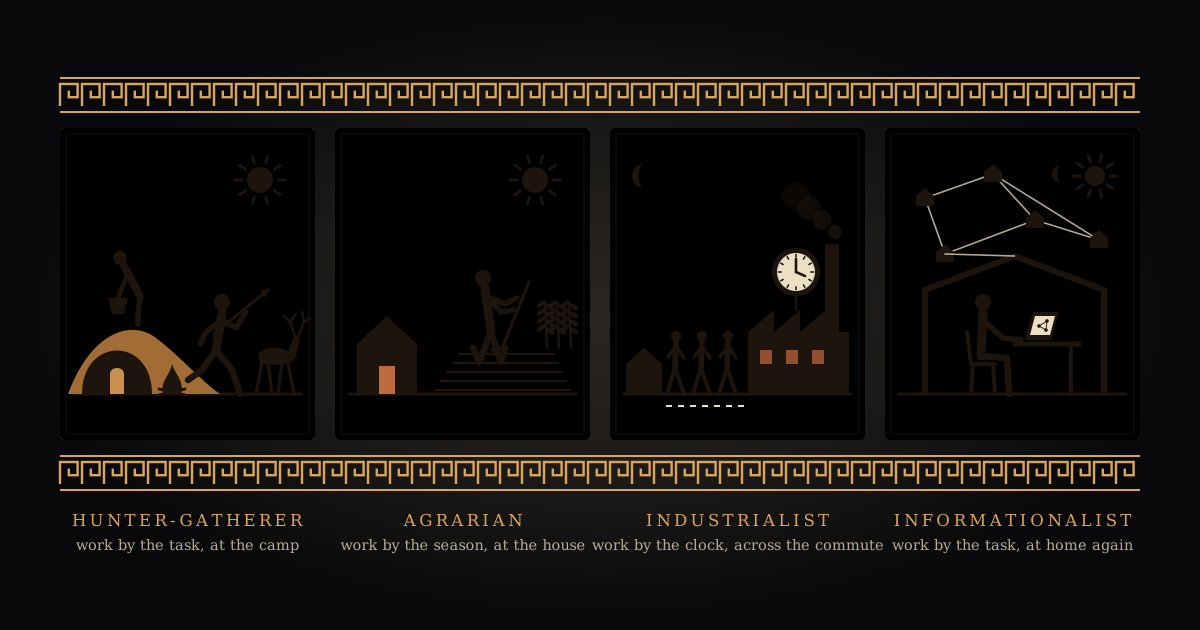
A bricklayer in 1890 laying a course of common brick stooped to the pile at his feet, picked up a brick, turned it over to find the better face, tapped it to knock off loose mortar, and carried it up […]
Early, before work, a woman walks her dog to the field at the end of the street. The field is empty. Halfway across she unclips the leash and the dog runs, nose down, in long loops through the wet grass. […]
From 1803 until 1890, a French worker who wanted to change jobs had to carry a small booklet, the livret d'ouvrier. Each employer wrote in it the date the worker was hired and the date they left, and a worker […]
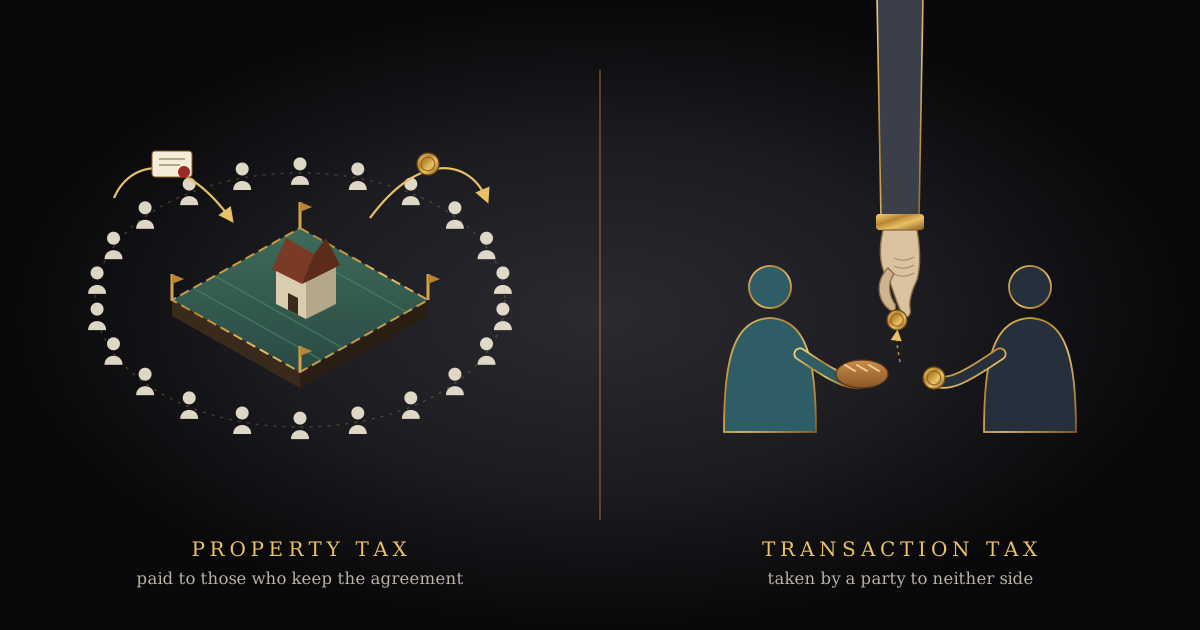
In 1569 the Duke of Alba, governing the Netherlands for Philip II, asked the States General for three new taxes. The first, the Hundredth Penny, was a one-time levy of one percent on all property. The second, the Twentieth Penny, […]
In 1268 the Republic of Venice settled on a way to choose its doge that still looks like a puzzle invented to torment students. The Great Council drew thirty of its members by lot. The thirty were cut to nine […]
In 1976 a double-hulled canoe named Hōkūleʻa sailed from Maui to Tahiti, about 2,500 miles, without a compass, a chart, or a sextant. Its navigator was Mau Piailug, from Satawal, a coral island in Micronesia about a mile long with […]
Historic events usually don't arrive on a date. The numerals Europe counts with didn't have a launch day. Leonardo of Pisa, the mathematician later called Fibonacci, brought the Hindu-Arabic system to Italian merchants in his Liber Abaci in 1202, and […]
Ask why libertarianism is so widely disliked and the answers come back remarkably consistent. One recent survey of the criticism sorts them into a few bins: the philosophy is said to put individual rights above any collective claim, to favor […]
Frédéric Bastiat's most famous essay isn't about schooling at all. A boy breaks a shopkeeper's window, and the crowd that gathers finds a silver lining: the […]
Follow one town's actual attention for a season and the allocation stops making sense. A parks department commissions two hazard assessments on a single oak […]
Ask someone why the state runs the schools and the answer arrives instantly, before the question has even finished: of course it does, who else would? That instant, unreflective quality is itself worth noticing. Almost nothing else this large — […]
Every game with a prize attached is, underneath the rules everyone actually watches, a payout structure — and that structure is never neutral. How the money gets divided among winners, losers, and everyone finishing in between is not a detail […]
An Industrial Park from a Bloated Government already traced what California's government has become in plain fiscal terms: a general fund that roughly doubled in a decade, a single-year surplus larger than most states' entire budgets, a swing into tens […]
The Municipal Trilemma worked through pickleball as the cleanest small-stakes instance of the boundary problem this site keeps finding at every scale: a court's value to the players and its cost to the neighbors are both real, both large, and […]
Swap out the council, the mayor, the party in charge of a given town, and three problems stay exactly where they were. They aren't failures of any particular administration's competence or good faith. They're built into what a municipality is[…]
Thomas Paine opened Common Sense with that distinction in January of 1776, months before any congress had declared anything, and the distinction is the whole argument this piece is built on. Society — the actual fabric of people cooperating, trading, […]
The Park walked three postures a public good can take — fenced and gated, worn and organic, natural and unmanaged — and asked, along the way, whether "public good" names anything real at all. Its answer set two conditions a […]
Almost no profession scores its practitioners the way tennis scores its own. A surgeon's skill is filtered through hospital politics, referral networks, and malpractice exposure before it becomes a reputation. A software engineer's output is filtered through a manager's judgment, […]
A Meadow of Sacred Cows named the tell: a sacred cow is an arrangement defended, when it's defended at all, in the language of necessity or tradition, while the actual reason it survives is that a concentrated beneficiary never has […]
A libertarian visiting rural Nebraska and a libertarian visiting Manhattan tend to notice opposite things. In the country, the complaint is usually that government is too far away, too slow, too indifferent to conditions only a local actually understands. In […]
Every institution accumulates arrangements nobody currently alive actually chose. "Nobody questions this" turns out to be a description that covers several genuinely different situations, and it's worth sorting them before going after any one of them, because most of what […]
Nothing on this site sorts cleanly onto a ballot line, and that's worth addressing directly rather than treating as an accident of subject matter. Personal Sovereignty argued that a Millian respect for individual judgment is the irreducible unit underneath the […]
Three words carry the entire weight of the American constitutional order, and none of the three does any defining. "We the People" names a sovereign without ever saying who belongs to it — not a list, not a franchise requirement, […]
Actual Modern Georgist Experiments went looking at what happens once a land value tax is up and running, and found a real, if uneven, track record: the mechanism reliably discourages sitting on empty land and encourages building wherever it's tried […]
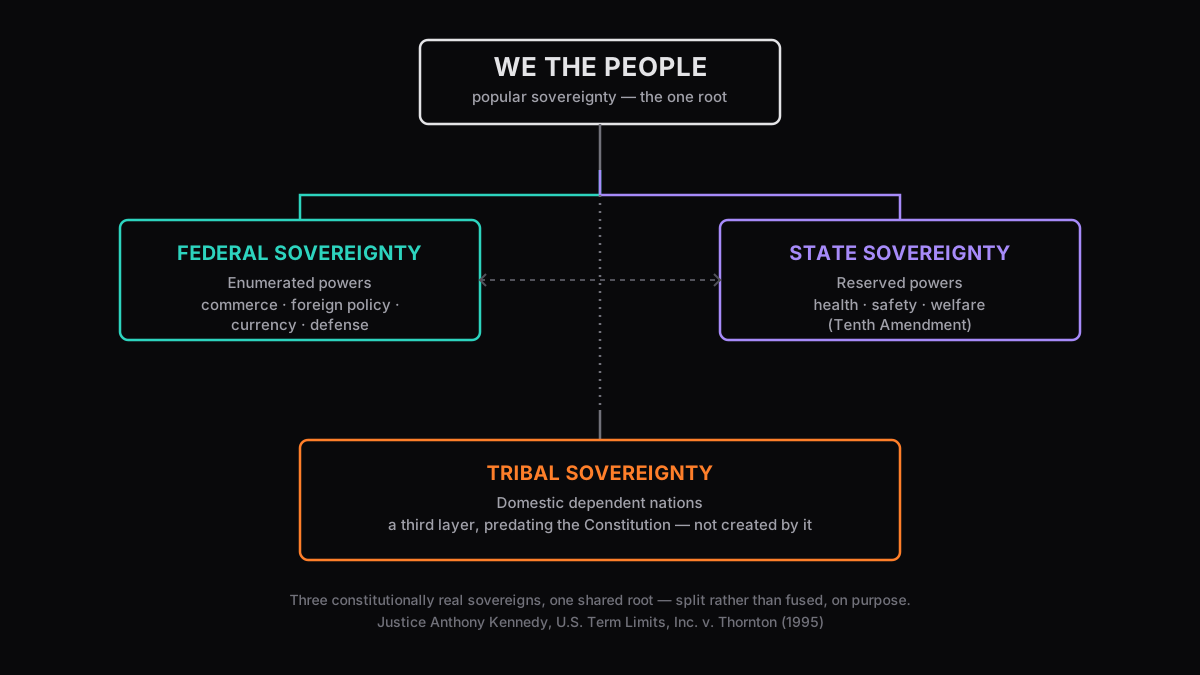
Our federalism pieces have spent months on a single recurring question: at what altitude should a given decision actually be made. Splitting the Atom of Sovereignty described a constitutional design that keeps that question open and arguable rather than settling […]
Splitting the Atom of Sovereignty described the American design as three layers of political authority, all tracing back to one root: the people themselves. We the People then asked what that root actually is — who counts as "We," and […]
Most of what a government is, historically, is one thing: a single will at the top, however that will gets chosen or replaced. A king, a parliament, a politburo — the label changes, but sovereignty itself stays whole, a single […]
Ask why a given American city sorts land into "single-family residential," "commercial," and "industrial," and the honest answer is rarely a planning theory. It's history, mostly forgotten, doing the work a theory is usually credited with. […]
What Sacramento Is Deciding and Austin's Long Recess gave this beat two structural patterns already: a legislature in continuous annual session against a hard floor deadline, and a legislature that meets once every two years and spends the other nineteen […]
Ask someone how a political movement grows and they'll usually answer in terms of message, money, or charisma — the right slogan, enough donors, a leader people will follow. Those things matter, but they're not what actually determines whether a […]
There is a form of rule that never passes a law, never posts a guard, and never asks for consent, and it governs more of an ordinary life than the legislature does. It arrives before memory starts, in the shape […]
Most arguments reach for two categories first, because two categories are cheap. On or off, true or false, life or death, us or them — a dichotomy costs nothing to state and does real work the instant it's stated, because […]
We begin this article with the observation that what is said below invalidates everything else that was said in Article 1. The previous essay in this series took chapter 50 of the Tao Te Ching mostly at face value — […]
Take the abstraction out of the last two essays and put it somewhere concrete: a public park, on an ordinary afternoon. Not a private club and not somebody's back lawn — the public good, in its landed form, on behalf […]
Henry George's proposal was simple enough to fit on a bumper sticker: tax the value of land itself, not what people build on it, because land's value comes mostly from the surrounding community — roads, schools, transit, the sheer fact […]
In September 2021, Gavin Newsom signed two bills that did something California zoning law had not done in the better part of a century: they told a single-family homeowner that the city could no longer stop them from adding a second unit, or a third, or a fourth, to their own lot […]
Current Libertarian Platform*: The Libertarian Party of California (LPCA) in 2025 bases its platform on core libertarian principles of individual liberty, limited government, and free markets, as outlined in various sources from the Libertarian Party and its California affiliate. Below is a description of a relevant Libertarian Party platform tailored to California, reflecting its current […]
Traditional and Critical Theory Max Horkheimer Outline by Philip Turetzky, [email protected] Traditional Theory & Natural Science: 1) Theory is the sum of propositions linked in a system (basic and derived), where derived propositions are consonant with the facts. Theory consists of useful hypotheses – stores of knowledge (library analogy). 2) This view of theory descends […]
The Libertarian Party (US): a political party in the United States that promotes civil liberties, non-interventionism, laissez-faire capitalism, and limiting the size and scope of government. The party was conceived in August 1971 at meetings in the home of David F. Nolan in Westminster, Colorado, and was officially formed on December 11, 1971, in Colorado Springs, Colorado. The organizers of the party drew inspiration from the works and […]
The social cost of the tax that pays for the subsidy is greater than the gain to the buyers, because the extra buyers are able to to buy it at less than the market price. A subsidy lets people buy stuff below the price that would be set in a market. In a free market, […]
[ Fred E. Foldvary, Dept. of Economics, Santa Clara University, and School of Management John F. Kennedy University, California. Bradley Fellow, Center for Study of Public Choice, 1989-91. ] In the Calculus of Consent: Logical Foundations of Constitutional Democracy, James Buchanan and Gordon Tullock analyzed “the calculus of the rational individual when he is faced with questions […]
1. Planning as a Synonym for Socialism The term ‘planning’ is mostly used as a synonym for socialism, communism, and authoritarian and totalitarian economic management. Sometimes only the German pattern of socialism — Zwangswirtschaft — is called planning, while the term socialism proper is reserved for the Russian pattern of outright socialization and bureaucratic operation […]
Road to Serfdom, Friedrich Hayek, 1944 cartoon summary Contents Chapter I. The Abandoned Road Human will has made the world what it is — The individualistic basis of modem civilization — Liberalism not a stationary creed — But it has not been allowed to develop and was abandoned — Germany as the leader in […]
From Chico Enterprise Record 12/06/22 CHICO — Valley’s Edge, the largest development project Chico has seen, got a 5-2 recommendation last week from the planning commission and seems to be on its way to becoming a reality. The plan, which is about 14 years in the making, came from developer Bill Brouhard who began looking […]
Village of Euclid v. Ambler Realty Co., 272 U.S. 365 (1926), more commonly Euclid v. Ambler, was a United States Supreme Court landmark case argued in 1926. It was the first significant case regarding the relatively new practice of zoning. The Supreme Court’s finding that local ordinance zoning was a valid exercise of the police power bolstered zoning in the United States and influenced other […]
From 1874 to 2006, the Surah Jute Mill was part of the sprawling network of jute production in Kolkata. Since then, it has been sitting vacant in an otherwise centric and lively neighborhood. With land being in high demand and low supply in the city, we view the site as an opportunity to provide […]
It is encouraging to see there is a growing awareness of the commons. This is partly through good historical research and partly through the pressing question of global warming. Research has shown how the commons have been eroded through land enclosure driving populations off the land into towns and cities, usually creating slums. Here the […]
From mises.org Seventy-five years ago, Henry George spelled out his “single tax” program Progress and Poverty, one of the best-selling economic works of all time. According to E.R. Pease, socialist historian and long-time secretary of the Fabian Society, this volume “beyond all question had more to do with the socialist revival of that period in England than […]
Saturday, May 29, 2021 · 1:02 PM ALERT: Critical Recall Fundraising Deadline is approaching and we are being outspent. Please Contribute TODAY to help remove Gov Newsom. https://bit.ly/3fSUsoa Monday, May 31, 2021 · 6:02 PM The Recall Fundraising Deadline is tonight and we are short several contributions. Will you give in the next hour to […]
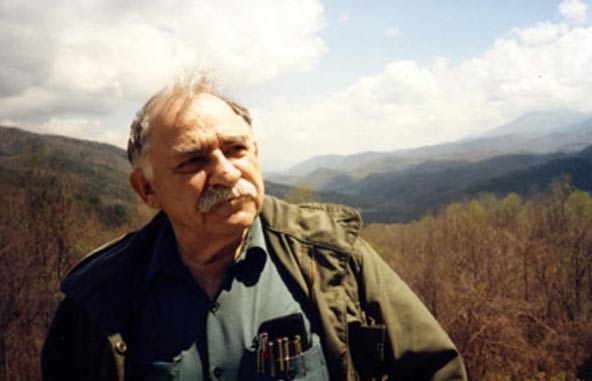
Murray Bookchin For some two centuries, anarchism — a very ecumenical body of anti-authoritarian ideas — developed in the tension between two basically contradictory tendencies: a personalistic commitment to individual autonomy and a collectivist commitment to social freedom. These tendencies have by no means been reconciled in the history of libertarian thought. Indeed, for much […]
Introduction This series of articles on libertarian approaches to mid-level state political office that attempts to answer the question: do libertarians know how to actually govern? We are seeing an upsurge in the interest of influencing local elections…municipal councils, county supervisors, school boards, assessors, state senate and assembly, water districts. A libertarian approach to […]
Emma Goldman The history of human growth and development is at the same time the history of the terrible struggle of every new idea heralding the approach of a brighter dawn. In its tenacious hold on tradition, the Old has never hesitated to make use of the foulest and cruelest means to stay the advent […]
https://www.reddit.com/r/georgism/comments/qaf39r/how_would_geomutualism_work_in_practice_is_it/ I feel like this poster doesn’t understand what capitalism or socialism are. If by capitalism and socialism, it means neo-liberal capitalism and state socialism, then yes, mutualism and Georgism are two ideologies outside this paradigm. Capitalism is the control of capital by single people, who pay their workers wages, while keeping the […]
Marcel Wissenburg ABSTRACT Libertarians are not famed as friends of nature – but is that a matter of principle? I examine consequentialist, deontological and teleological versions of left- and right-libertarianism on three dimensions: their concepts of natural law, geo- and biological nature, and human nature – the latter subdivided into what characterizes humans and what […]
Implement the universal ethic into the constitution, so that there be no restriction or imposed cost on acts which do not coercively harm others. Replace existing taxes with public revenue from user fees, pollution charges, and land value. Replace mass democracy with cellular democracy: small-group voting with bottom-up multi-level governance.
Fred Folvary Introduction Conventional macroeconomics lacks a warranted explanation of the major business cycle, while the Austrian and geo-economic (Georgist) schools have incomplete theories. A geo-Austrian synthesis, in contrast, provides a potent theory consistent with historical cycles and with explanations about the root causes. The geo-economic and Austrian schools have had little interaction in the […]
Land value taxation is impeded by the same national sentiment that has reacted so strongly to the Supreme Court’s Kelo decision. That decision has sparked an intense national debate over the private property versus land use regulation and, ultimately, over the ability government to define a “public purpose.” State legislatures across the country are in […]
from John Ikerd, July 2008 In 1879, Henry George, a journalist and philosopher, proposed to abolish all taxation save that upon land values in his classic book, Progress and Poverty. He suggested that people were not poor because of any lack of productivity of either natural or human resources, but instead because of distribution of […]
Probably no agitation has ever attained the magnitude, either in the number of its recruits or the area of its influence, which has been attained by Modern Socialism, and at the same time been so little understood and so misunderstood, not only by the hostile and the indifferent, but by the friendly, and even by […]
Chellis Glendinning Most students of European history dismiss the Luddites of 19th century England as “reckless machine-smashers” and “vandals” worthy of mention only for their daring tactics. Probing beyond this interpretation, though, we find a complex, thoughtful, and little-understood social movement whose roots lay in a clash between two world-views. The worldview that 19th century Luddites […]
All right: Even if we concede that full private property in resources and the free market will conserve and create resources, and do it far better than government regulation, what of the problem of pollution? Wouldn’t we be suffering aggravated pollution from unchecked “capitalist greed”? There is, first of all, this stark empirical fact: Government […]
murray rothbard Left-liberal intellectuals are often a wondrous group to behold. In the last three or four decades, not a very long time in human history, they have, like whirling dervishes, let loose a series of angry complaints against freemarket capitalism. The curious thing is that each of these complaints has been contradictory to one […]
In grateful response to Hans-Hermann Hoppe 1 Cultivate a sense of Home Stop Mass Immigration 2 Mind your own business Stop attacking, killing and bombing people in foreign countries 3 Let funding return to natural distribution Defund the ruling elites and its intellectual bodyguards 4 Replace Fiat with Cryptocurrency End the FED and all central […]
Hans-Hermann Hoppe Speech delivered at the 12th annual meeting of the Property and Freedom Society in Bodrum, Turkey, on September 17, 2017 We know the fate of the term liberal and liberalism. It has been affixed to so many different people and different positions that it has lost all its meaning and become an empty, […]
The International Workingmen’s Association, 1868 The Rules and Program of the International Alliance of Socialist Democracy Founded in Geneva in October 1868 Written: by Bakunin, October 1868; Translated: (from French) by the Institute of Marxism-Leninism (Moscow). The socialist minority of the League of Peace and Freedom having separated itself from the League as a result […]
Almost a century and a half ago Thomas Carlyle described economics as “the dismal science.” The term was to stick, especially as it applied to economics premised on a supposedly unavoidable conflict between “insatiable needs” and “scarce natural resources.” In this economics, the limited bounty provided by a supposedly “stingy nature” doomed humanity to economic […]
from: the general idea of the revolution in the 19th century To you, business men, I dedicate these new essays. You have always been the boldest, the most skillful revolutionaries. It was you who, from the third century of the Christian era, drew the winding-sheet over the Roman Empire in Gaul, by your municipal federations. […]
Here, I shall try to show how the new technology can be used ecologically to crystallize man’s sense of dependence upon the natural world into the human experience, so we can contribute to the achievement of human wholeness. Town and Country Classical utopians fully realized that the first step in this direction must be to […]
1. reverse national debt trajectory 2. relax or remove all government standards as requirements, all standards are optional 3. reduce regulation …end drug war
We, the Citizens of the Free Republic of Liberland, in order to secure Life, Liberty and Property, for ourselves and future generations, do ordain and establish the Constitution of the Free Republic of Liberland, attempting a harmonious consensus for the benefit of all those willing to assume responsibility over the course of their lives. Being […]
2015-2017 National Platform The Socialist Party stands for the abolition of every form of domination and exploitation, whether based on social class, gender, race/ethnicity, age, education, sexual orientation, or other characteristics. We are committed to the transformation of capitalism through the creation of a democratic socialist society based on compassion, empathy, and respect as well […]
Two old engineers are talking of their lives and boasting of their greatest projects. One of the engineers explains how he had designed one of the greatest bridges ever made. “We built it across a river gorge…It was wide and deep. We spent two years studying the land, and choosing designs and materials. We hired […]
Even more troubling are the writings of George Bradford (aka David Watson), one of the major theorists at Fifth Estate, on the horrors of technology — apparently technology as such. Technology, it would seem, determines social relations rather than the opposite, a notion that more closely approximates vulgar Marxism than, say, social ecology. ‘Technology is […]
Hakim Bey Since absolutely nothing can be predicated with any real certainty as to the “true nature of things”, all projects (as Nietzsche says) can only be “founded on nothing.” And yet there must be a project—if only because we ourselves resist being categorized as “nothing.” Out of nothing we will make something: the Uprising, […]
adapted from Murray Bookchin — Social Anarchism or Lifestyle Anarchism: An Unbridgeable Chasm One of the most unsavory examples of lifestyle anarchism is Hakim Bey’s (aka Peter Lamborn Wilson) T.A.Z.: The Temporary Autonomous Zone, Ontological Anarchism, Poetic Terrorism, a jewel in the New Autonomy Series (no accidental word choice here), published by the heavily postmodernist […]
Social anarchism is made of fundamentally different stuff, heir to the Enlightenment tradition, with due regard to that tradition’s limits and incompleteness. Depending upon how it defines reason, social anarchism celebrates the thinking mind without in any way denying passion, ecstasy, imagination, play, and art. Rather than reify them into hazy categories, it incorporates them into […]
Contrary to the cosmic order, there are some days in history that do not rise up. In order to appear, these new things disguise themselves and possibly their borrowed dress, yesterday’s will stifle them. This fragile moment is also that of human decision that will sort among possible destinies. To this instant, which lets […]
adapted from Murray Bookchin — Social Anarchism or Lifestyle Anarchism: An Unbridgeable Chasm Ideological individualism did not fade away altogether during this 19th century period of sweeping social unrest. A sizable reservoir of individualist anarchists, especially in the Anglo-American world, were nourished by the ideas of John Locke and John Stuart Mill, as well as […]
adapted from Murray Bookchin — Social Anarchism or Lifestyle Anarchism: An Unbridgeable Chasm For some two centuries, anarchism — a very ecumenical body of anti-authoritarian ideas — developed in the tension between two basically contradictory tendencies: a personalistic commitment to individual autonomy and a collectivist commitment to social freedom. These tendencies have by no means […]
Open Economy The economy in Cizîre/Rojava is functioning on a survival basis. The other cantons, Afrin and Kobanê, depend on the wealth of Cizîre. Our economy is vital for the others. We are paying all costs for institutions of self-government and public services. We have no surplus to reinvest. We don’t have the means to […]
Edmund Burke You hope, sir, that I think the French deserving of liberty. I certainly do. I certainly think that all men who desire it, deserve it. It is not the reward of our merit, or the acquisition of our industry. It is our inheritance. It is the birthright of our species. We cannot forfeit […]
Above all, I have tried to show in my previous writings how confederation on a municipal basis has existed in sharp tension with the centralized state generally, and the nation-state of recent times. Confederalism, I have tried to emphasize, is not simply a unique societal, particularly civic or municipal, form of administration. It is a […]
Decentralism and self-sustainability must involve a much broader principle of social organization than mere localism. Together with decentralization, approximations to self-sufficiency, humanly scaled communities, ecotechnologies, and the like, there is a compelling need for democratic and truly communitarian forms of interdependence — in short, for libertarian forms of confederalism. I have detailed at length in […]
The assumption that what currently exists must necessarily exist is the acid that corrodes all visionary thinking (as witness the recent tendency of radicals to espouse “market socialism” rather than deal with the failings of the market economy as well as state socialism). Doubtless we will have to import coffee for those people who need […]
Murray Bookchin Few arguments have been used more effectively to challenge the case for face-to-face participatory democracy than the claim that we live in a “complex society.” Modern population centers, we are told, are too large and too concentrated to allow for direct decision-making at a grassroots level. And our economy is too “global,” presumably, […]
In a DAO Democracy, how do we propose a bill, and how does it get adopted? Initially, anyone can propose a bill. It can be submitted at any time. If the prediction market says it has a positive impact on the collective welfare, it is adopted. If not, it is not. If the bill is […]
If we grant that the final result is desirable, how might it be achieved? What are the paths from the world as it exists today to this future, better world where sound governance is the rule and not the exception? An existing organization might already be taking an annual poll of its members, and if […]
Anyone can propose a bill at any time. All proposals are reviewed equally, without bias. Proposals that improve the general welfare (according to the prediction market’s evaluation of the publicly known metric for the general welfare) will be adopted. The mechanism by which bills are reviewed is open to all. Anyone can investigate and present […]
While we have considered DAO’s as a base for a stable democracy, it is apparent that they can serve as a base for any computation. Further, given the persistence of a successful DAO (the DAO for Bitcoin has persisted since January 3rd, 2009), it seems inevitable that Darwinian selection will be applied quite vigorously to […]
A problem that might occur with prediction markets and governmental policies might be described as the End of the World problem. Suppose we are evaluating a policy that is very good, but has the small problem that is has a 20% probability of causing the end of the world. Normally, if a prediction market is […]
Most democracies have an Executive Officer, such as the President of the United States, typically elected either directly or indirectly by the people. In a DAO Democracy, assuming we retain the Executive Branch in more or less its current form, the simplest approach would be to appoint, as President, that person the prediction market said […]
Another problem with evaluating collective welfare is membership in the collective: who do we add and who do we remove? We consider criteria that are suitable for membership in a nation (in contrast with membership in the local chess club, or a student in a school, or a shareholder in a company). Traditionally, for democracies, children of […]
We now give an example of how to buy and sell DCWi in a prediction market. First, a trader purchases a pair of conditional bearer bonds from a bank for $1 in the year 2016. The first says “Pay to bearer $1 times DCW2016” The second says “Pay to bearer $1 times (1-DCW2016)”. Because DCW2016 is between […]
– Ralph Merkle State of Satisfaction. Annually, all citizens are asked to rank the year just passed between 0 and 1 (inclusive). If you wish, you can think of this as a poll of each citizen’s individual welfare, where 0 means the welfare of the citizen that year was the worst possible, and 1 is the […]
– Ralph Merkle Futarchy, proposed by Robin Hanson, is a proposal to govern by prediction markets. The proposal seems like an excellent approach for improving upon existing democratic forms of governance. The general concept: To aggregate knowledge from across a community of people, using a method that’s known to be effective: prediction markets. Use that […]
– by Mark Twain “Give me whereon to stand”, said Archimedes, “and I will move the earth.” The boast was a pretty safe one, for he knew quite well that the standing place was wanting, and always would be wanting. But suppose he had moved the earth, what then? What benefit would it have been […]
Land Use and Public Property We recognize the right of property owners to control, use, transfer or dispose of their property in any manner that does not violate the rights of others. We believe that rights to land and any related water, oil or mineral rights are entitled to the same respect and protection. We […]
Iroquois society was based in the matrilineal clan where women lived with their classificatory sisters – applying the principle that “my sister’s child is my child”. Because they lived and worked together, women in these communal households felt strong bonds of solidarity with one another, enabling them when necessary to take action against uncooperative males. […]
Derived from Abdullah Ocalan The right of self-determination of the peoples includes the right to a state of their own. However, the foundation of a state does not increase the freedom of a people. The system of the United Nations that is based on nation-states has remained inefficient. Meanwhile, nation-states have become serious obstacles for […]
In some of your writings, you, and some of your colleagues talked about how each mode of production, to borrow the Marxist terminology, tends to create a certain epistemology or way of looking at the world. Are there any other ideological trends commensurate with this economic change that are worth commenting on briefly? Well, the […]
 Social Liberty