 Social Liberty
Debates Within, Mises Versus Hayek
Mises and Hayek are filed together as "the Austrians," but they disagreed about nearly everything behind what they opposed, and the split still divides their heirs, down to the Libertarian Party's Project Decentralized Revolution.
Click to enlarge
For fourteen years, from 1920 to 1934, Ludwig von Mises held a seminar in his office at the Vienna Chamber of Commerce. He wasn’t a salaried professor. The University of Vienna let him lecture without pay, and his living came from the Chamber, where he was an economic adviser on trade and currency. Every other Friday evening during the academic year, twenty or so people crowded around his desk: economists, a philosopher of law, a sociologist, a historian of art. After the paper and the argument they walked to an Italian restaurant, the Ancora Verde, and later to the Café Künstler, where the argument continued past midnight. One member, the legal philosopher Felix Kaufmann, wrote songs about the seminar’s debates, set to Viennese tunes, and the group sang them.
Friedrich Hayek was one of the regulars. He had worked under Mises since 1921 in a government office settling Austria’s prewar debts, and in 1927 Mises helped set up an institute for business cycle research with Hayek as its director. Hayek said later that Mises’s 1922 book Socialism had turned him from a mild Fabian into a liberal. Between them the two men produced most of what is now called the Austrian School’s case against central planning, and they’re usually filed together, as if one could stand for the other.
They can’t. Mises and Hayek agreed on what they opposed and disagreed on nearly everything about why. This collection of essays draws on both, and where they part is where several of its own arguments are decided. The split also runs through the most recent attempt to put Austrian ideas into practice, a caucus that took Mises’s name, took over a national party, and launched a strategy that reads a good deal like Hayek.
Calculation and knowledge
In 1920 Mises published a short paper, “Economic Calculation in the Socialist Commonwealth,” that set the terms of a debate lasting the rest of the century. His argument was about arithmetic. A socialist planner who owns all the factories, mines, and farms has no market for them, and so no prices for them. Without prices for steel, coal, land, and machine time, the planner can’t compare the cost of one way of making something against another. A decision to build a railroad rather than a canal, or a canal rather than nothing, can’t be shown to waste or save anything, because there is no common unit to add it up in. Socialism, Mises concluded, isn’t merely inefficient. It’s blind.
Hayek took up the same debate in the 1930s, after socialist economists like Oskar Lange answered Mises by proposing that planners could set prices by trial and error, raising them when goods ran short and lowering them when goods piled up. Hayek’s reply, which became his 1945 essay “The Use of Knowledge in Society,” moved the problem. The trouble isn’t only that planners lack prices, it’s that the knowledge prices summarize was never in one place to begin with. It’s held in pieces by millions of people, much of it local, practical, and short-lived: the shipper who knows a freighter is sailing half-empty, the farmer who knows which field drains late. Hayek called this the knowledge of “the man on the spot.” Prices are how that knowledge travels without anyone having to write it down.
The two arguments sound like versions of each other, and for decades they were taught that way. In the 1990s a group of economists around Joseph Salerno insisted they weren’t. Mises’s argument, they pointed out, would hold even for a planner who knew everything. A planner with perfect information about every factory and every worker’s wishes would still have no prices, and so still no way to add a ton of steel to an hour of labor. Hayek’s argument depends on information being scattered. It invites the reply that better data, faster computers, or a cleverer feedback loop could gather it up, and that reply has been made in every decade since, most recently about algorithms. Mises’s argument doesn’t care how fast the computer is.
Country and City Differences used Hayek’s argument and ran it in both directions: knowledge that is truly local belongs to the township that holds it, and a city’s knowledge is a different kind. That argument is Hayekian through and through. But when these essays argue for a land value tax, they lean on Mises. An assessment of land value can’t be made from scattered local knowledge alone. It needs a price, a figure from actual sales of actual land, to measure against, and the case for an open land market under the tax is a calculation argument before it’s a knowledge argument.
Reason and evolution
The difference runs deeper than the socialist debate. Mises believed economics was a science of pure reason. He called it praxeology, the logic of human action, built from the single fact that people act on purpose to reach ends they choose. Its laws, he held, are true the way geometry is true. Experience can illustrate them and can never refute them, and an economist who tests them against statistics has misunderstood what kind of thing they are.
Hayek began there and drifted. In a 1936 lecture to the London Economic Club, published the next year as “Economics and Knowledge,” he granted that the logic of a single person’s choice could be worked out by reason alone. But a market is many people learning from one another, and how people learn, what they come to know, and whether their plans come to fit together are questions of fact. Hayek said decades later that the lecture was aimed chiefly at Mises’s apriorism, and that he had hoped to make the point gently enough that Mises wouldn’t take offense. Mises, by Hayek’s account, never commented on it.
From there Hayek went toward evolution. His mature work describes law, language, money, and morals as orders that grew from human action without anyone designing them, kept because the groups that followed them did better than those that didn’t, and often understood by nobody who follows them. Reason, for Hayek, mostly arrives after the institution and explains it. Hayek wrote of his teacher that Mises remained a child of the rationalist age. Mises thought a well-reasoned argument could show people why private property and peaceful exchange serve their own ends, and that once shown, they would choose them.
Both views have a place in a philosophy built on voluntary institutions. Hayek’s view explains why a common-pasture rule or a fire custom practiced locally for centuries can be wiser than the agency that replaces it, which is the argument of Fire Policy. Mises’s view explains why people can found something new on purpose, a land trust or a school or a cooperative, and expect it to work. A purely evolutionary account has trouble with new beginnings, and a purely rational one has trouble with old customs.
How far the state may go
The political difference is the one people notice first. Mises held the state to a single job: protecting life and property against violence and fraud. Every intervention beyond that, he argued in Interventionism and Human Action, causes problems that invite another intervention, until the economy is planned in all but name. There was no stable middle.
Hayek thought there was. The Road to Serfdom in 1944 already allowed for some social insurance and a minimum of food, shelter, and clothing for everyone. The Constitution of Liberty in 1960 went further, accepting public provision of some goods and a guaranteed minimum income, so long as they were delivered under general rules that applied to everyone alike rather than by discretionary favors to particular people. For Hayek the danger was arbitrary power, not public spending as such.
The moment that captures the split came at the first meeting of the Mont Pelerin Society, which Hayek convened at a hotel above Lake Geneva in April 1947 to gather the liberals of Europe and America after the war. Milton Friedman, who was there, recalled a session on the distribution of income where Mises stood up, said “You’re all a bunch of socialists,” and walked out. Friedman told the story fondly, and some accounts place it at a later meeting. Either way it was Hayek’s society, and Mises was the guest who couldn’t stand its compromises.
On money the roles reversed. Mises defended the gold standard all his life as the one restraint on governments that inflate. In 1976, three years after Mises died, Hayek published Denationalisation of Money, which proposed letting private banks issue competing currencies and ending the government monopoly on money altogether. On that question the moderate was the radical. Separation of Currency and State follows Hayek’s lead, not Mises’s.
Where the land falls
Neither man had much use for Henry George. In The Constitution of Liberty Hayek granted that the single tax was one of the most persuasive proposals ever made for taking unearned wealth, and then rejected it on practical grounds: there was no way, he argued, to tell the value of land itself from the value of everything owners had done to it. Mises treated land as one more factor of production, privately owned like any other, and saw no special case for taxing its rent.
These essays answer Hayek’s objection with assessment: land values are separable in practice. New South Wales has valued land apart from buildings for more than a century, and Pennsylvania cities from Harrisburg to Allentown have taxed the two at different rates. The answer to Mises is older. Thomas Paine’s Agrarian Justice in 1797 argued that the earth in its natural state was the common property of everyone, that private ownership of it was useful and should stay, and that owners owed a ground rent to the community in exchange, paid out as a dividend to every citizen. Hayek’s guaranteed minimum, paid from general taxes, sits close to Paine’s dividend in what it delivers and far from it in where the money comes from. Paine took it from the value of land and left labor untaxed. Hayek’s would have come from general taxes, wages included.
The argument stalls
Libertarian ideas have been in American bookstores for eighty years and on American ballots for fifty, and they’ve never held more than a sliver of any legislature. Some of the reasons lie outside the movement. Ballot-access laws written by the two parties, winner-take-all districts that punish a third choice, and debate rules that keep minor candidates off the stage would hold back any small party, whatever it believed.
Other reasons lie inside the argument, and two of them run back through both Mises and Hayek. The tradition has been weak on land, and it has been weak on the social ties that hold people in a place. Those are the two things most people’s daily lives are made of: where they live and whom they live among. An argument that has little to say about either can win debates and still leave a listener cold.
Mises treated land as one more factor of production, a means like a lathe or a ton of coal, whose owner puts it to its best use because the market rewards it. Murray Rothbard, the most influential libertarian writer after him, gave land a moral history: a person acquires unowned land by mixing labor with it, as Locke said, and owns it from then on like anything else. Both answers fit a frontier. Neither fits a city where every parcel has been titled for a century and a family arrives to find the ground already spoken for. A renter in a growing town watches rent climb every year for reasons that have nothing to do with anything a landlord built, and hears libertarians answer that the trouble is zoning. The answer is half right. Zoning does restrict supply, and Control of Human Actions Through Land traced how far. But lift every restriction and the value the town creates by growing still flows to whoever holds title, and to the renter a program of lower taxes and fewer rules sounds like a program written for the landlord.
On social life the tradition starts from the individual and the contract, and it has a hard time seeing what comes before either. Nobody arrives at a market as a free-standing adult. A person is raised by a family, taught a language, held by a neighborhood, a congregation, a team, a union hall, a set of graves. Robert Nisbet argued in The Quest for Community in 1953 that the modern state grew strong by stripping away those intermediate associations, until the individual and the state faced each other with little in between. Libertarians quote Nisbet on the state. They have done less with the other half of his argument, that people want to belong somewhere and will turn to whoever offers it, and that a philosophy offering only freedom from will lose to one offering a home, even a false one. Hayek came closer than Mises here, with his respect for traditions nobody designed. But Hayek’s traditions are rules, and what people miss when a town hollows out isn’t the rules.
Hayek’s own vocabulary held the missing piece. He disliked calling the market an economy, since an economy in the old sense is a household run toward one set of ends, and he borrowed instead the Greek verb katallattein for the order that exchange produces: catallaxy. The verb meant to exchange, and also to admit into the community and to turn an enemy into a friend. Alexander Carey, a professor of social economy in Germany, built a 2023 paper on how hegemony arises around that second meaning. The market’s catallaxy, he argues, is only a second-order exchange, resting on a first order of reciprocity through which people bind themselves into communities, and people are at most minimally economic beings and mainly cultural ones. A later essay in this collection will take up Carey’s model in full. For now it’s enough that Hayek’s own word for the market pointed at the layer where belonging is made, and that the tradition he helped found mostly looked past it.
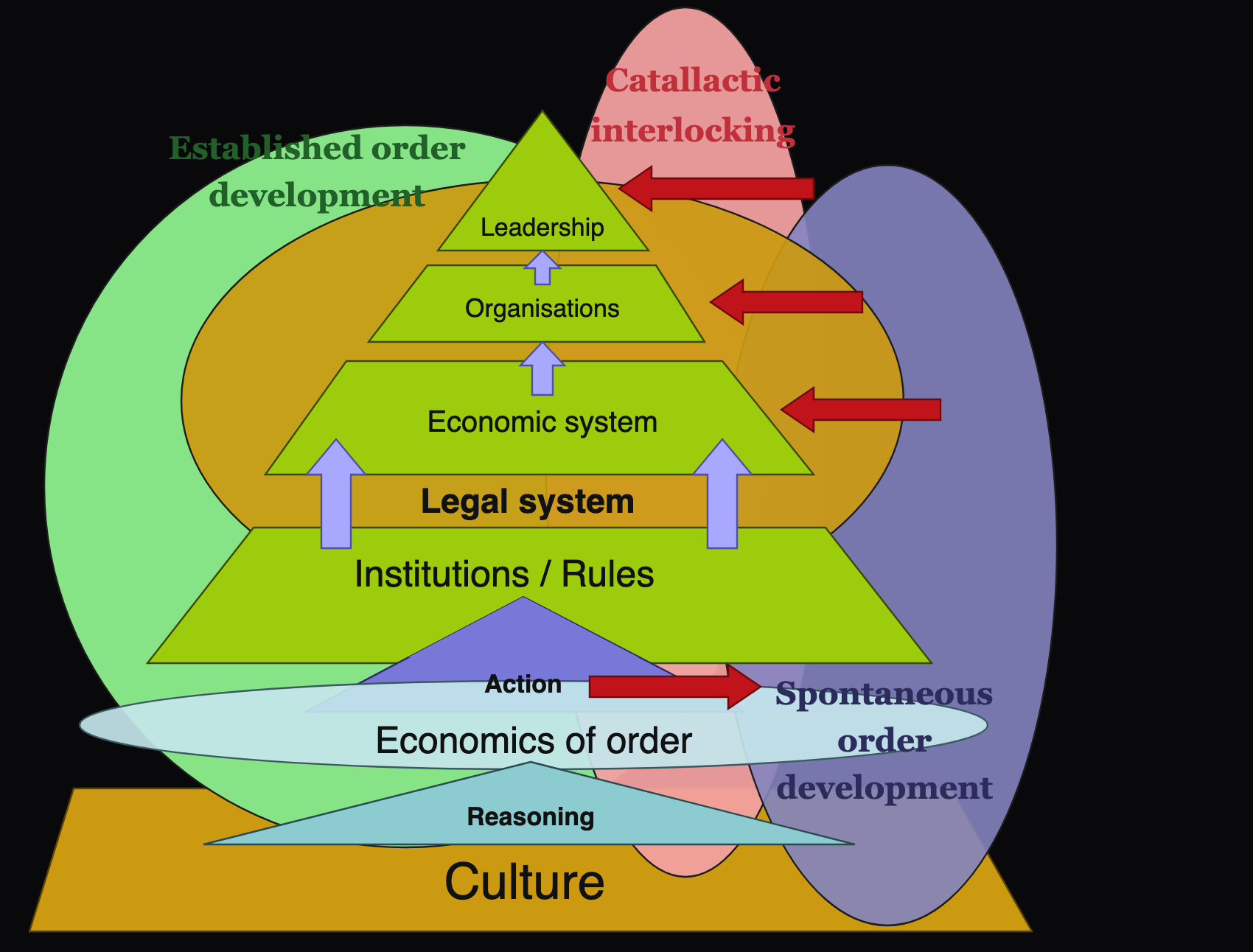
Catallactic interlocking, redrawn after Carey (2023), fig. 1. Orders that grow on their own feed the established orders built on top of them at every level, and both rest on culture.
The third problem
For social liberty, land is far deeper than a productive good. It is the one thing nobody made, nobody can make more of, and nobody can carry away. Its value comes almost entirely from where it is: the people nearby, the work and schools within reach, the river, the road, the cemetery where a family’s dead are buried. A sale of land settles more than who may farm a field or build on a lot. It settles who may live near whom, and who has to leave.
Carey’s paper draws two logics living side by side in every person. One is the logic of values: identity, community, region, the goods people care about for their own sake. The other is the logic of worth: organisation, supply, technology, economy, what is judged by whether it works and pays. Law, politics, and ethics reach across both, and the two meet in what Habermas called the lifeworld. Under both runs a single band of ground. On the side of values it is social space, on the side of worth it is territory, and beneath both it is nature. The Austrians saw the right-hand end of that band. A family sees the left.
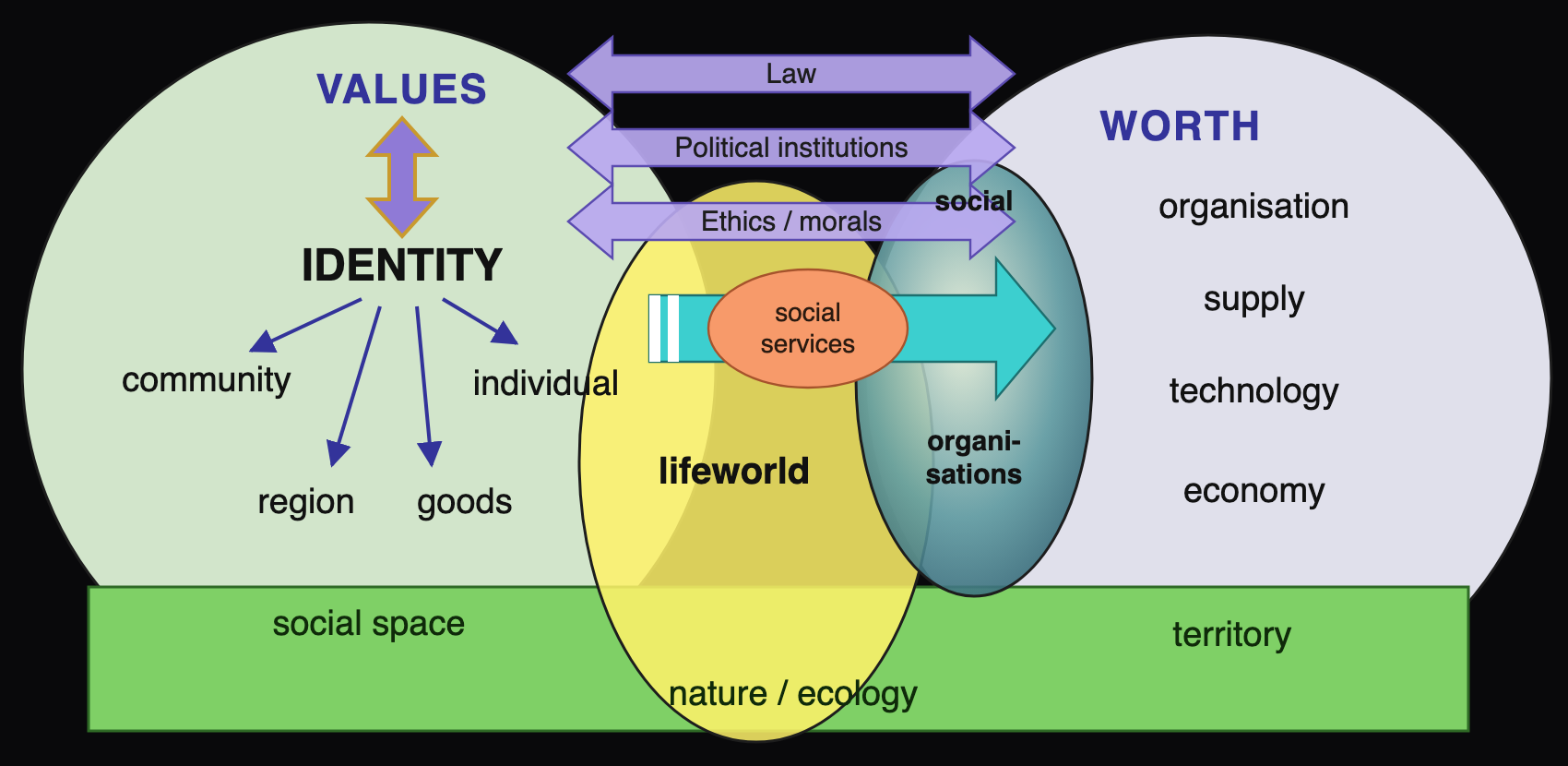
Values and worth, redrawn after Carey (2023), fig. 10. Carey labels the hinge between them with Habermas’s term, translated here as “lifeworld.”
The Hawaiian Kingdom learned this in a single generation. Before 1848 land in the islands was held in layers. Each ahupuaʻa ran from the mountains to the reef, and the chief who oversaw it, the commoners who farmed it, and the families who fished its waters and gathered on its slopes all had rights in the same ground. The Great Māhele of 1848, followed by the Kuleana Act of 1850, divided that land into fee-simple parcels that could be bought and sold. The commoners, the great majority of the population, received under one percent of the land in kuleana awards. Within a few decades much of the rest had passed to sugar planters. The land market worked: prices formed, and the knowledge of which valleys would grow cane traveled through them efficiently. What the market couldn’t price was a family’s right to fish the reef its grandparents fished. Hawaii’s constitution has protected traditional gathering rights since 1978, and its courts have held since then that a title to land doesn’t erase them. A layer of the older arrangement survived inside the new one, because the people living there wouldn’t let it go.
That is why the land problem goes beyond both of the problems the Austrians solved. Mises’s calculation problem asks whether a society can compare costs without prices, and land has prices. Hayek’s knowledge problem asks whether scattered knowledge can be gathered without a central mind, and land prices carry knowledge about location better than any planner could. A perfectly priced, perfectly informed land market can still let the value a whole town creates collect in a few hands, still reward an owner for holding a lot empty while its price rises, and still price a family out of the town where its parents are buried. Calculation and knowledge are problems about how to use resources well. The land problem is about who belongs where, and who keeps the value a community makes by living together. Henry George answered the second half with the land value tax. Held in Trust described a voluntary answer to the first, land held for a purpose by people bound to it.
Mises and Hayek, between them, gave the case for liberty its two strongest arguments against planners. Neither gave it an argument a family facing eviction would recognize as being about them.
Local Action
The argument didn’t stay in Vienna or Mont Pelerin. In 2017 a group of Libertarian Party members formed the Mises Caucus, drawing on Ron Paul’s campaigns and Murray Rothbard’s radical reading of Mises, and set out to take the party back from what they saw as a leadership too eager to sound reasonable. At the national convention in Reno in May 2022 they won nearly every seat on the national committee, and Angela McArdle became chair.
Later that year the caucus announced its long-term plan and called it Project Decentralized Revolution. It would give up chasing the presidency, where ballot-access rules are stacked against a third party and the odds of winning are nil, and recruit candidates for city council, school board, county commission, sheriff, and judge, through a training site called RunAsLibertarian.com. Once in office, those candidates would cut local taxes and spending and use the Tenth Amendment and a sheriff’s or a county’s own discretion to decline state and federal mandates, building what the plan called a patchwork of legal and political resistance. The caucus cited figures showing about a third of its local candidates winning in some cycles. Its speaking tour was named Take Human Action, after Mises’s treatise.
The name on the caucus is Mises, and the strategy reads like Hayek. A county sheriff knows which roads wash out and which families are feuding. A school board member knows which teacher the parents trust. That is the knowledge of “the man on the spot,” the kind no national committee holds, and a patchwork of local offices each using what its holders know is close to the order Hayek described: no designer, many pieces, and a whole that nobody planned.
The decentralization is Mises’s too, though, and in plainer terms than Hayek ever used. In Liberalism in 1927 Mises wrote that whenever the people of a particular territory, whether a single village, a whole district, or a series of adjoining districts, make it known by a free vote that they no longer wish to stay in the state they belong to, their wish should be respected. He wanted that right of self-determination to reach down as far as it practically could, to the village if possible. Hayek wanted general rules applied alike to everyone, and a patchwork of counties choosing which laws to enforce sits uneasily with that. Mises gives the caucus the right to its patchwork. Hayek gives the reason a patchwork might work better than the whole it breaks from.
Where the caucus was most Misesian was in its temper. The new leadership rewrote parts of the platform, removing a plank condemning bigotry, and fought members it considered too accommodating. State parties pushed back. New Mexico’s affiliate disaffiliated within months. Massachusetts split into rival parties. Virginia’s affiliate voted in 2023 to dissolve itself rather than continue under the new national direction. Critics said the party had turned toward the right wing of the Republicans, and supporters said it had returned to its principles. Membership and donations fell. At Mont Pelerin the purist had been the one to walk out. In the Libertarian Party the purists held the chair, and it was the others who left.
Hayek’s sharpest objection would have come at the plan itself. A decentralized revolution announced by a national committee, with a training site, a speaking tour, and later contracts for operators measured against targets for 2026, is decentralization designed from the center. A local candidate recruited through a national website to carry a national message brings knowledge of the town to the race, and the caucus brings the message. Hayek spent the second half of his career arguing that the institutions worth having grow from many people’s practice before anyone writes them down, and a revolution with a launch date is the opposite.
The results ran between the two readings. In 2024 the party’s convention nominated Chase Oliver, not the caucus’s favorite, and some state parties resisted putting him on their ballots. McArdle resigned in early 2025, and the caucus’s choice to succeed her lost. The new leadership talked about rebuilding membership and asked those who had left to come home. The local races kept going under the old banner, and the caucus still runs a podcast called Decentralized Revolution. Each of the school board seats it won was won by somebody whose neighbors knew them.
After Vienna
The seminar ended in 1934, when Mises left Vienna for a post in Geneva, a few years ahead of the Anschluss. He came to New York in 1940 with almost nothing, and from 1945 he taught at New York University as a visiting professor whose salary was paid by private donors rather than the university. He held a seminar there too, on Thursday evenings, for twenty-four years. Hayek had gone to the London School of Economics in 1931, then to Chicago, then back to Europe at Freiburg and Salzburg. They corresponded, and each wrote warmly about the other in public.
Mises died in October 1973. A year later, the Swedish academy gave the economics prize to Hayek, jointly with Gunnar Myrdal, a social democrat and architect of the Swedish welfare state. The committee cited Hayek’s work on money and economic fluctuations. The theory of the business cycle it rewarded had started in 1912, in Mises’s Theory of Money and Credit, and Hayek had built it out in the years when he was coming to Fridays at the Chamber. Hayek’s lecture in Stockholm that December was called “The Pretence of Knowledge.”
Sources
- Alexander Th. Carey, “The Genesis of Hegemony: An Explanatory Model with the Economic Approach of the Catallaxy of Hayek” (Die Genese von Hegemonie), Momentum Congress 2023, track 7, “The Role of Hegemony” (PDF).
- Ludwig von Mises, The Theory of Money and Credit (1912); “Economic Calculation in the Socialist Commonwealth” (1920); Socialism (1922); Liberalism (1927), ch. 3 on the right of self-determination; Interventionism (1940); Human Action (1949).
- F. A. Hayek, “Economics and Knowledge,” Economica (1937); The Road to Serfdom (1944); “The Use of Knowledge in Society,” American Economic Review (1945); The Constitution of Liberty (1960); Law, Legislation and Liberty, vol. 2 (1976), ch. 10, on catallaxy; Denationalisation of Money (1976); “The Pretence of Knowledge,” Nobel lecture (1974).
- F. A. Hayek, Hayek on Hayek: An Autobiographical Dialogue, ed. Stephen Kresge and Leif Wenar (1994).
- Jörg Guido Hülsmann, Mises: The Last Knight of Liberalism (2007), on the Vienna Privatseminar, the move to Geneva and the NYU years.
- Joseph T. Salerno, “Mises and Hayek Dehomogenized,” Review of Austrian Economics 6, no. 2 (1993).
- Oskar Lange, “On the Economic Theory of Socialism,” Review of Economic Studies (1936–37).
- Milton Friedman and Rose D. Friedman, Two Lucky People: Memoirs (1998), on the Mont Pelerin meetings.
- Murray N. Rothbard, The Ethics of Liberty (1982), on homesteading.
- Robert Nisbet, The Quest for Community (1953).
- Marcel Mauss, The Gift (1925).
- Antonio Gramsci, Prison Notebooks (1929–35).
- Thomas Paine, Agrarian Justice (1797).
- Henry George, Progress and Poverty (1879).
- Lilikalā Kameʻeleihiwa, Native Land and Foreign Desires: Pehea Lā E Pono Ai? (1992), on the Māhele; Great Māhele, Wikipedia.
- Constitution of the State of Hawaii, art. XII, sec. 7 (1978); Public Access Shoreline Hawaii v. Hawaii County Planning Commission, 79 Hawaii 425 (1995).
- Libertarian Party Mises Caucus, Wikipedia, on the 2022 Reno convention, Project Decentralized Revolution and the state-affiliate splits.
A note on how this piece was written: the subject, the questions it asks, and the positions it takes are mine. Much of the research, the examples, and the sentences were drafted by an AI model working from that direction, and then edited by hand. I’d rather say that plainly than have a reader guess at it.