 Social Liberty
Valuing the Culture of Death
The word itself does most of the work against it. Read another way, defense is death and offense is life, both have their virtues and their practitioners, and the culture of death deserves more respect than our inherited reflexes allow.
Click to enlarge
Few words carry as much weight on their own as death. One syllable, closed off at the end by a breath through the teeth, and a conversation changes temperature. People go a long way to avoid saying it. Someone passed, was lost, is gone; a hospital records an expiration, a newspaper an obituary, an army a casualty. Put the word in front of “culture” and the phrase becomes an accusation before it has said anything, and that is how this collection first used it. Cultures of Life and Death took the phrase from John Paul II’s Evangelium Vitae and turned it, through chapter 50 of the Tao Te Ching, into a portrait of bracing: a person, or a state, so busy defending life against its end that the defending itself becomes a way of dying. Three Cultures added that life is what moves and death is where movement settles, and it treated the settling as hardening.
Both essays let the word do some of the judging. This one sets the word aside for a while and asks what the settling half of things is good for.
A night on Janitzio
On the night of November 1 the island of Janitzio, in Lake Pátzcuaro in Michoacán, fills with candlelight. Purépecha families carry marigolds, bread, fruit and the favorite foods of their dead up the steep lanes to the cemetery, lay them on the graves in arches of orange cempasúchil, and sit there through the night. Boats cross the black water from the shore with candles in their bows. Nobody is grim about it. Children fall asleep against the headstones, and the talk around the graves is about the people under them, what they liked, how they laughed, what they would think of the bread.
All over Mexico the same days are full of skulls with names written across the forehead in icing, sometimes the names of living friends. Newspapers print calaveras literarias, short satirical verses that imagine a politician or a neighbor already dead and say what death made of him. José Guadalupe Posada’s etching of a skeleton in a grand lady’s hat, made around 1910 to mock Mexicans who aped European fashion, became La Catrina after Diego Rivera put her at the center of a mural in 1947, and now she is everywhere. Octavio Paz wrote in The Labyrinth of Solitude in 1950 that the Mexican frequents death, mocks it, caresses it, sleeps with it and celebrates it. He did not think this made Mexicans less afraid. He thought it made them less estranged.
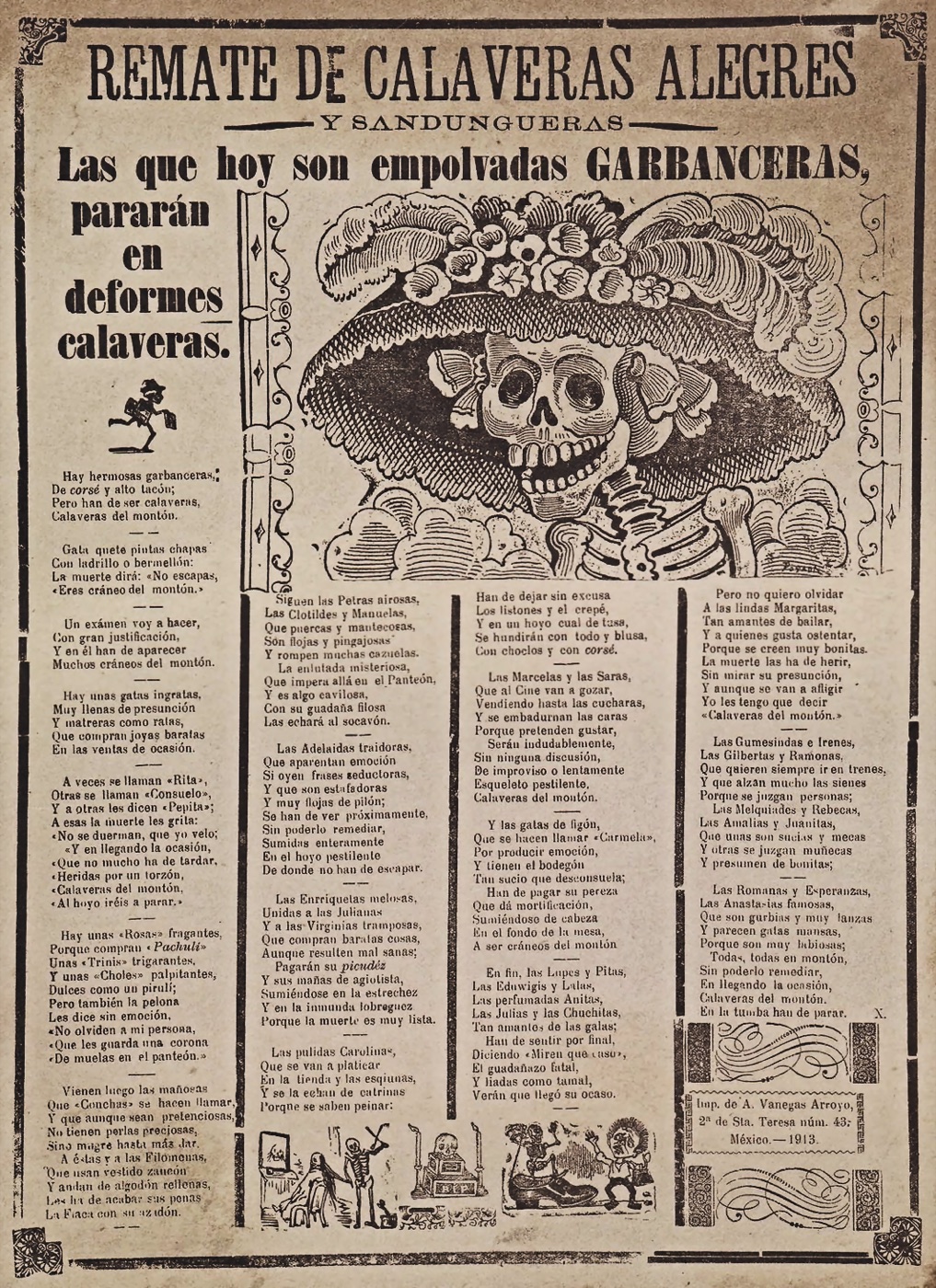
José Guadalupe Posada, “Remate de calaveras alegres y sandungueras,” a broadside of calaveras literarias printed by Antonio Vanegas Arroyo, Mexico City, 1913. Its skeleton, the Calavera Garbancera, is the figure Rivera later made La Catrina.
The word has a different weight on Janitzio. And what goes on in the cemetery all night is not a celebration of an ending. It is the keeping of what an ending left behind: memory, likeness, the taste of particular food, a name. The living spend the night defending the dead against the one thing that could finish them, being forgotten.
Defense is death, offense is life
Here is another way to cut the pair. Life is offense: it reaches, expands, takes ground, tries the new thing and accepts the risk of losing. Death is defense: it holds, keeps, settles, guards what has already been made, and accepts the cost of not reaching. Neither is a moral side. They are two postures toward the world, and every living thing needs both. A tree is offense at its tips and defense in its bark and heartwood, and the heartwood is dead tissue holding the whole thing up.
Chess had two world champions in the same decade who stood for the two postures almost perfectly. Mikhail Tal, who took the title in 1960, attacked: he sacrificed pieces for positions no one could calculate to the end and won by making the board too alive for his opponents. Tigran Petrosian, champion from 1963 to 1969, defended. His art was prophylaxis, the word Aron Nimzowitsch had given to stopping an opponent’s plan before it was a plan, and he was so hard to beat that the press called him Iron Tigran and complained that his games were dull. Tal’s games are the ones people replay for joy. Petrosian’s are the ones strong players study to learn what a position actually is. Both men were world champions.
Clausewitz, who is usually read as a theorist of attack, wrote in On War that defense is the stronger form of war. Its purpose is negative, he said, preservation rather than conquest, and that is why it is stronger: the defender chooses the ground, waits, and lets the attacker spend himself. The attacker has the positive aim and the weaker form. A strategy that only attacks wins brilliantly until the first time it doesn’t, and then has nothing behind it.
This is where the earlier essays need a correction. They judged defense by its worst form. The man in chapter 50 who flinches from a blow that hasn’t landed is defending badly, from fear, with no sense of what he is guarding. Petrosian was not afraid of anything on the board. The families on Janitzio aren’t bracing against death. They know exactly what they are guarding and why, and they are calm. Fear-driven bracing is to defense what recklessness is to attack: the posture’s failure, not its nature.
The practitioners
Every culture has people whose work is the defensive half, and they are rarely the ones it celebrates. A hospice nurse does not cure anyone; she keeps a person whole, comfortable and recognized through the last weeks, which is a skill as exacting as surgery. An archivist keeps papers no one has asked for in sixty years, on the bet that someone will. A conservator spends a year taking varnish off a painting so that it can last another three hundred. A goalkeeper, a fact-checker, a forester who thins and burns so that a stand won’t be lost to a crown fire, an editor who cuts: all of them are defined by what doesn’t happen on their watch, and what doesn’t happen is hard to photograph.
The starkest case I know is in Leningrad. When the German siege closed around the city in September 1941, the staff of the plant-breeding institute that Nikolai Vavilov had built found themselves guarding one of the largest seed collections in the world: hundreds of thousands of samples of wheat, rice, potatoes and other crops gathered from five continents. Through that winter, as the city starved, they kept the collection locked away, defended it from rats and from desperate people, and refused to eat it. Several of them died of starvation at their desks, surrounded by food. Vavilov himself was already in one of Stalin’s prisons, where he died of hunger in 1943. The seeds survived the siege, and breeders around the world have drawn on that collection since.
Nothing in that story is offense. The staff took no ground, invented nothing, and lost their lives holding still. It is about as pure an example of a culture of death as exists, in the sense this essay means: people who gave everything to keeping what had been made, for people they would never meet. It is also one of the most life-giving acts of the century.
What the preconception hides
A culture’s view of death is largely inherited, and ours has narrowed. The historian Philippe Ariès traced how Western societies moved, over a few centuries, from a death that was public, expected and ritualized, a person dying in their own bed with the household around them, to what he called forbidden death, removed to hospitals, hidden from children and handed to professionals. Jessica Mitford’s The American Way of Death in 1963 described the industry that grew up to manage the hiding. A society that has hidden death will tend to misread defense too. Keeping looks like stagnation, holding like fear, preservation like a failure of nerve. Growth, disruption and expansion get the vocabulary of virtue; the keepers get “maintenance,” a word that sounds like an afterthought.
The bias reaches into the ideas this collection cares about. Liberty is usually told as an offensive story, the freedom to start, build, trade, move and try. Much of its machinery, though, is defensive. A right is a wall: the First Amendment begins “Congress shall make no law,” and its whole force is in what it stops. A title to land, a trust that holds a forest in common, a guild’s rules, a constitution hard to amend, a jury that can refuse to convict all work by holding. Edmund Burke, whom A Day With Edmund Burke spent a long day with, called society a partnership among those who are living, those who are dead and those who are yet to be born. That is a defensive picture of a free people: the living as keepers of a trust that runs in both directions in time. A liberty that only attacks spends what the keepers built and leaves nothing for the next attack to stand on.
None of this is a defense of killing, of neglecting the weak, or of anything John Paul II meant to condemn when he coined the phrase. His culture of death was a society that removes what is burdensome, which is the opposite of keeping. The families in the Janitzio cemetery and the botanists in Leningrad were doing what he praised, bearing a weight instead of setting it down. The respect owed here is to the other half of the pair: holding, guarding, settling, remembering, and the people who are good at it.
Morning
On Janitzio the candles burn down toward dawn on November 2. The families gather the plates, leave the marigolds on the graves, and walk back down the lanes to the boats. Nothing has been won. The dead are exactly as dead as they were the evening before, and the island looks the way it did a year ago. What the night accomplished is that it looks the same, and that the names on the graves were said aloud again by people who knew how to say them, for children who will say them next year.
Sources
- John Paul II, Evangelium Vitae (1995)
- Laozi, Tao Te Ching, chapters 50 and 76
- Octavio Paz, The Labyrinth of Solitude (1950), “The Day of the Dead”
- José Guadalupe Posada, La Calavera Garbancera (c. 1910–1913), and Diego Rivera, Sueño de una tarde dominical en la Alameda Central (1947)
- Stanley Brandes, Skulls to the Living, Bread to the Dead: The Day of the Dead in Mexico and Beyond (2006)
- Aron Nimzowitsch, My System (1925), on prophylaxis
- Records of the World Chess Championship matches of 1960, 1961 and 1963–1969
- Carl von Clausewitz, On War (1832), Book 6, chapter 1
- Gary Paul Nabhan, Where Our Food Comes From: Retracing Nikolay Vavilov’s Quest to End Famine (2009)
- Peter Pringle, The Murder of Nikolai Vavilov (2008)
- Philippe Ariès, Western Attitudes toward Death: From the Middle Ages to the Present (1974) and The Hour of Our Death (1977)
- Jessica Mitford, The American Way of Death (1963)
- Edmund Burke, Reflections on the Revolution in France (1790)
A note on how this piece was written: every argument, source, and structural decision in this essay is mine. I chose the examples, worked out the logic connecting them, and directed what each paragraph needed to say. The sentences themselves were drafted with AI assistance from that outline and then edited by hand. I’d rather say that plainly than have a reader guess at it.