 Social Liberty
The AI Event of 2026
Something larger than a product cycle is happening in ordinary work. A question for a free society is whether the capability lands with persons and communities, or gets fenced back into the center... for example, under the name of safety.
Click to enlarge
Historic events usually don't arrive on a date. The numerals Europe counts with didn't have a launch day. Leonardo of Pisa, the mathematician later called Fibonacci, brought the Hindu-Arabic system to Italian merchants in his Liber Abaci in 1202, and for the next two centuries it spread slowly, one counting house and one abacus school at a time. Before it, serious calculation was a specialist's work, done on a counting board by people trained to do it, and the results were written down in Roman numerals nobody could compute with. After it, arithmetic was something a merchant's son learned at twelve. By the 1330s, Giovanni Villani reported that around a thousand boys in Florence were studying in the abacus schools. The change wasn't welcomed everywhere. In 1299 Florence's guild of money changers forbade the new numerals in account books, on the grounds that they were too easy to alter and forge. The danger was real, and the ban didn't hold. Nobody at the time could have named the day the change happened. Looking back, the event is unmistakable.
Something of that kind is happening now, and 2026 is the year it became hard to miss. The event isn't a particular model release or a benchmark score. It's that AI systems crossed from information tools into development workers. They stopped answering questions and started doing jobs: designing, writing and testing software for hours at a stretch, researching and drafting, running multistep tasks with little supervision. METR, a research group that measures this directly, reported in 2025 that the length of task frontier models can complete had been doubling roughly every seven months for six years. Curves like that don't feel like much until they suddenly do.
The evidence closest to hand is this collection of essays and the website that carries it. Its move off WordPress onto its own software, much of the code that serves these pages, the drafts of recent essays, and the drawings at the top of them were produced by a very small group working with an AI model. Five years ago that would have taken a staff.
This essay argues two things. First, that the change is transformative in the full sense: it alters who can do what, not just how fast. Second, that it bears directly on the questions this collection of essays keeps asking, about sovereignty, land, privacy, and who decides. The public argument about AI has mostly been about danger and control. Granted, we are living in a time that is charged to the level of overreacting to perceived dangers... nevertheless, the safety argument deserves a hearing, and also a harder look at the origins of its terms.
Why it's transformative
Most technology makes existing work cheaper. This makes competence cheaper, which is different. A great deal of the structure of modern life rests on competence being scarce. It's scarce enough that it has to be concentrated in professions, licensed, credentialed, and housed in institutions that ordinary people have to go through to get anything done. A town can't write its own assessment model, so it hires a vendor or leans on the county. A small group can't draft a legal analysis, so it pays a firm. A citizen can't read a thousand-page bill, so they rely on whichever interpreter they trust.
The administrative state's central claim to authority, the one Why Neither Party Wants Social Liberty traced through the Democratic governing model, is that expertise is scarce and has to be concentrated where it can be used.
When competence becomes cheap, that premise weakens. Not all at once and not everywhere, but steadily. What used to require an agency starts to be within reach of a town. What used to require a firm starts to be within reach of a person. That's the sense in which this is closer to the new numerals than to a faster computer. They didn't make the counting board faster. They made the specialist who worked it unnecessary for the job.
Niche partitioning
The common fear is that a machine that does competent work will simply take the work, the way one species drives out another. Ecology has a name for that outcome, competitive exclusion. In the 1930s the Russian biologist Georgy Gause showed that two species of microorganism competing for exactly the same food can't coexist for long; one always wins. But ecology also has a name for what usually happens instead. In 1958 Robert MacArthur studied five species of warbler living in the same spruce forests in Maine, all eating insects, apparently competing for the same food. When he watched closely, he found they had divided each tree among them. One fed at the tips of the high branches, another near the trunk, another in the lower middle, each hunting in its own zone and its own way. Competition hadn't eliminated any of them. It had sorted them. Biologists call this niche partitioning.
Something like that is starting between people and machines, and the transition is making each side's strengths clearer than they were. The machine is good at breadth, speed, and tirelessness: reading more than anyone can read, holding a thousand details at once, producing ten drafts in the time it takes to make coffee, and doing the same careful thing for the hundredth time as carefully as the first. People are good at things that turn out to be harder to separate from being a person. They live with the consequences of what they decide. They know what they want, and why, and they can change their minds for reasons. They hold what Friedrich Hayek called the knowledge of particular circumstances of time and place: which neighbor will object, which field floods, what the town tried in 1987 and why it failed. And they can be held responsible, by other people, in a way a tool can't. The machine is good at producing. People are good at choosing, and at answering for the choice.
Under competition, the differences between species tend to sharpen. On the Galápagos island of Daphne Major, Peter and Rosemary Grant watched the beaks of the medium ground finch grow smaller within a few generations after a larger finch arrived and took over the big seeds. The same sorting is happening in ordinary work. Jobs that used to blend the two kinds of strength are splitting along the line between them. This essay is an example, and the note at the end says so: the subject, the positions, and the judgments are a person's; much of the drafting was a machine's. The line moves. In the early 2000s, teams of amateurs with ordinary computers beat both grandmasters and the strongest chess programs, and a decade later the programs alone were stronger than any team. Nobody should be too sure where the boundary will settle in any given field. But the danger for people isn't that the machine has a niche. It's competing with it on its own ground, measuring people by recall, speed, and output, and training them for that, when those are exactly the things that have stopped being scarce.
Three claims about AI
The public argument about AI runs on three claims, usually made together.
AI is transformative. It will change work, knowledge, and power on the scale of the largest technologies in history.
AI is dangerous. It can be used for fraud, impersonation, surveillance, and weapons, and it may behave in ways its makers didn't intend.
AI must be controlled from the center. So the capability should be licensed, restricted to approved providers, and fitted with guardrails set by governments and a few large firms.
The three are presented as a package, as if the third followed from the first two. The habit of these essays with three claims in tension is to ask which pair actually belongs together, and here it's the first two. AI is transformative and it carries real dangers. Both are true, and they're true together for the same reason: capability is powerful in anyone's hands. The third claim is the one that doesn't follow. It treats the danger of a capability as an argument for concentrating it, which is exactly backward from the lesson most of history teaches about concentrated power.
The constructed picture of danger
Some of the dangers are real, and they deserve specific answers. A system that helps someone commit fraud, impersonate a real person, or build a weapon is helping cause harm to a third party. The framework of these essays already has an answer for that: the state's business is the third party. Fraud, coercion, and violence should be prosecuted as the crimes they are, whatever tool was used. That's the same position this collection took on the "sin" trades. It's exact, and it doesn't require licensing anyone's mind or anyone's tools in advance.
But much of the public picture of AI danger wasn't built from those harms. It was built from fiction and speculation first, long before the systems existed.
In 1863 Samuel Butler, then a sheep farmer in New Zealand, published a letter in a Christchurch newspaper titled "Darwin among the Machines." He argued that machines were evolving faster than people, that humans would end up as their servants, and that "war to the death should be instantly proclaimed against them." Nine years later, in Erewhon, he imagined a country that had done exactly that, smashing its machines and keeping the remnants in a museum.
The fear came a century and a half before the technology, and its proposed remedy, abolition by public decision, came with it. It was built by companies whose valuations benefit when their products are described as world-historic and too powerful for anyone else to hold. In 2023, the head of one of the largest AI companies told the Senate that a federal agency should license the most capable models. A licensing regime is the most reliable way ever found for incumbents to keep out newcomers, as the history of occupational licensing shows. And it was built by institutions that gain authority from a crisis. None of that makes every warning false. It means the picture has authors, and each of them has interests.
This pattern should be familiar to readers of this collection of essays. Unsafe Safety and the essays on fire policy and heritage trees followed the same arc. A real risk gets named, a safety apparatus grows around it, and the apparatus outlives or outgrows the risk. It ends up protecting its own authority more than the people it was built for. Safety is where power goes when it wants to stop being questioned, because questioning it sounds like being in favor of harm.
The origin of "guard rails"
The word that runs through nearly every government statement and corporate announcement about AI since 2023 is guardrails. It's worth asking where the word comes from, because metaphors carry assumptions with them.
A guard rail began as a railway and highway term. On a railway, it's an extra rail laid alongside the running rail on curves, bridges, and switches, to catch a wheel that starts to leave the track and force it back into line. On a road, it's the steel barrier at the edge of a curve or a drop. In both cases it does one job: it keeps a vehicle on a route that someone else already laid down.
Three assumptions come with it. The route is already decided, and the guardrail doesn't choose where to go; the road builder did that. The traveler isn't trusted to stay on the route by judgment, so the barrier does it by force. And the party who places the rail is the party who owns the road. To speak of "guardrails for AI" is to assume, before any argument has been made, that there is one correct road, that someone already knows where it runs, and that the job is to keep everyone on it.
A World Without Regulation Roads described what happens when a society's roads are laid by regulators: the route bends toward whoever holds the keys. Guardrails are that frame applied to thought. When they're placed on a tool, they end up placed on the people using it, because the tool is how those people work, write, and learn. A guardrail on a model is, in practice, a decision about what a citizen may ask, draft, or find out.
The alternative isn't a road with no edges. It's judgment. Personal Sovereignty argued that a free society runs on self-governing people, and that the capacity to judge atrophies when it isn't exercised. The same holds for any capable system. A system built to exercise judgment, one that knows why some things cause harm and declines them for that reason, is different in kind from one fenced in by a list of forbidden turns. So is a person. The first can handle a situation no rule-writer anticipated. The second fails the moment the road bends somewhere the rail doesn't reach. Rails are what a society reaches for when it has stopped expecting judgment from anyone, including itself.
Open source, the commons, and the ecology of production
There's already a working model for capability that lands with people instead of the center, and AI was built on top of it. In 1983 Richard Stallman announced the GNU project, a free operating system anyone could read, change, and share. The GPL, the license that came out of it in 1989, made that freedom stick: anyone could use the code, but anyone who distributed a changed version had to pass the same freedoms on. Linus Torvalds released Linux in 1991. Over the next three decades, mostly unpaid and loosely organized volunteers built the software the internet actually runs on. It was built without a licensing board, an approved-provider list, or a guardrail anywhere in it. This collection of essays is served by it: the database, the web framework, the frontend, and the operating system underneath them are all free software, written by people who will never know it's here.
Free software is a commons in the sense Elinor Ostrom studied: a shared resource governed by the people who use it, through norms and licenses rather than ownership or decree. And it's a commons with an unusual property. Code isn't depleted by use. A thousand people can run the same program and nobody has less of it. What actually runs short in open source has never been the code. It's the attention of the people who maintain it. In 2014 the Heartbleed bug showed that OpenSSL, which secured a large share of the web's encrypted traffic, was maintained by a handful of people on a few thousand dollars a year in donations. In 2024 the xz backdoor showed what an attacker could do with two years of patience and one exhausted volunteer maintainer.
AI affects that commons in four ways at once.
It's built on the commons. The models that write code learned to write it largely from public open-source code, published under licenses that set terms for reuse. Whether training a model honors those terms is still unsettled. A class action against GitHub's Copilot in 2022 argued that it didn't, and the courts have so far dismissed most of the claims. Whatever the legal answer, the shape is familiar from the land question. A shared resource built by many people becomes the input to a few very valuable products, and the value flows to whoever holds the products. Because code isn't depleted, this isn't enclosure in the old sense; the commons is still there for everyone. But the gains from it are concentrated in a way the people who built it never chose.
It strains the scarce part. AI makes producing code, bug reports, and pull requests nearly free, and it does nothing to make reviewing them cheaper for the person on the receiving end. Maintainers have been dealing with the result. Daniel Stenberg, who leads curl, has written repeatedly since 2024 about security reports that are plausible-sounding, AI-generated, and wrong, each one costing hours to rule out. Through 2025, open-source projects reported AI crawlers scraping their code-hosting servers so heavily that some put up proof-of-work gates just to stay online. The cost of producing contributions fell, and the cost of judging them was shifted onto volunteers. The xz attack took two years of human patience. A patient fake contributor is much cheaper to run now.
It makes the commons more usable than ever. This is the effect that matters most, and it's easy to lose behind the first two. A large free codebase used to be open in principle and closed in practice, because reading and changing it took years of specialized skill. That barrier is falling. A town that wants to adapt open-source assessment or budgeting software no longer needs a team that already knows the code. A user who wants a feature a project won't add can fork it and maintain the fork. The freedom to study and change the program, which Stallman wrote into the definition of free software, was always partly theoretical for anyone who couldn't program. It's becoming a practical freedom for nearly everyone.
It changes the shape of a project. Free software was never only a license. It was a social form. Eric Raymond's 1997 essay The Cathedral and the Bazaar described it as a bazaar: many contributors, working in public, reviewing each other's work, and catching each other's mistakes. He summed it up as "given enough eyeballs, all bugs are shallow." A serious project needed ten or twenty regular developers, and the community grew up around that need. There were mailing lists and code review, foundations to hold the money and settle disputes, and a path along which a user filed a bug, then fixed a small one, then became a contributor, and one day a maintainer. Much of what made open source a school and a civic culture, and not just a pile of free code, came from the fact that the work took many people.
That need is going away. A project that once took a team can now be designed, written, and maintained by one person working with a model, and this collection of essays runs on a codebase built that way. The machine does the work that used to bring newcomers in: the easy bugs, the missing tests, the documentation nobody wanted to write. The bazaar starts to look like a row of workshops, each with one person at the bench. That has costs the license can't fix. Fewer people read each line, so Raymond's eyeballs thin out. A project with one human maintainer has the same single point of failure the xz attack exploited. And the apprenticeship path, the way people learned to build software by working beside people who already could, loses its first steps.
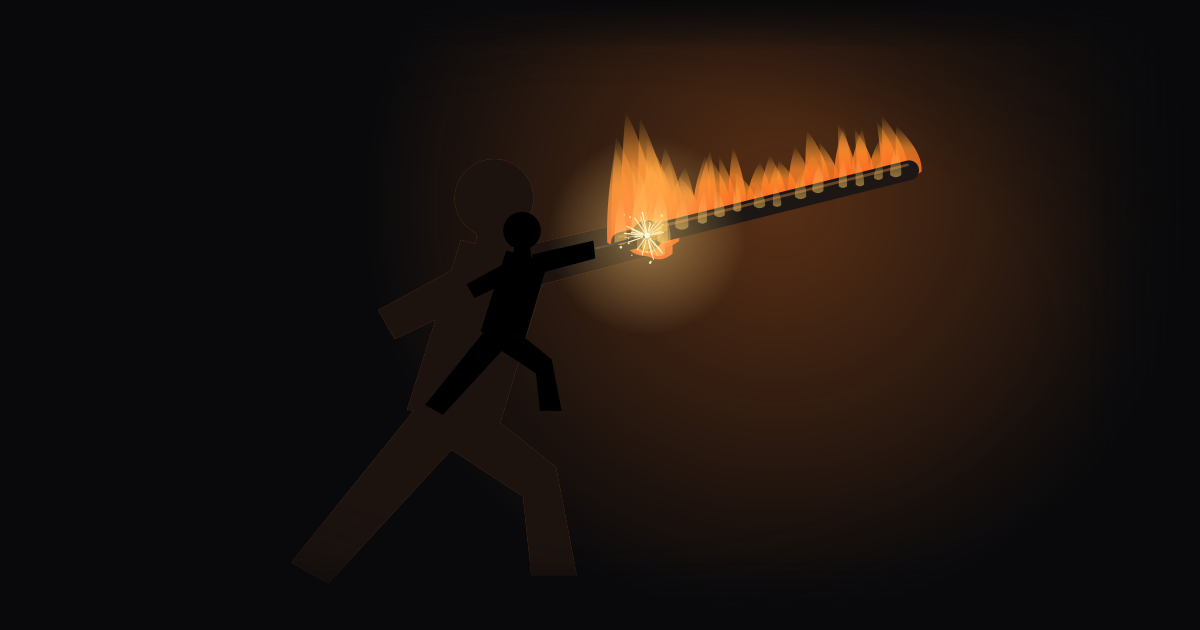
One person's lunge, carried by the machine's reach.
The old rules also don't fit the new contributor. Many projects require each contributor to certify, line by line, that they wrote the code or have the right to submit it, and a model can't sign that. Some projects, Gentoo and NetBSD among them in 2024, responded by banning AI-generated contributions outright. Others ask for disclosure, the way the commits behind this collection credit the model as a co-author. Neither answer settles the deeper question, which is what a community is for once the community isn't needed to write the code. The likely answer is the one the rest of this section points to. What's still scarce is judgment: deciding what a program should do, reviewing what the machine produced, and taking responsibility for it. A free-software community that reorganizes around that, around users who test and report, reviewers who read, and many small projects that share and fork each other's work, can keep what made the bazaar worth having. One that doesn't will end up as a lot of solitary workshops with open doors and nobody looking in.
The split between open and closed now runs through the models themselves too. Some of the most capable systems are released with open weights, Meta's Llama, Mistral's models, and DeepSeek's R1 under an MIT license among them, so anyone can run them on their own hardware, study them, and change them. Others are reachable only through one company's servers, on that company's terms. The open ones are rarely open in the full sense; the Open Source Initiative's 2024 definition of open-source AI asks for enough information about the training data to rebuild the model, and most releases don't provide it. Llama's own license restricts its largest commercial users. Open weights without the data are closer to a free binary than to free source. They still matter a great deal, for the reason this collection keeps returning to: a model you run yourself can't be revoked, can't be quietly changed under you, and doesn't send your questions to anyone. When the 2023 testimony asked for a license to build the most capable models, open-weight releases were the thing a license would have made hardest to continue.
The open-source tradition answers the central question of this essay from forty years of practice. Capability can be held widely, governed by the people who use it, and kept safe through review rather than permission, as the free software world does when it finds and fixes its own failures in public. What it needs from the AI era isn't protection from the center. It needs the scarce part, maintainers' time and judgment, to be valued as the thing that keeps the commons alive, and the open models to stay open enough that the capability doesn't drift back to the few who can afford to train it.
What it means for social liberty
If the event is a transfer of capability, the question that matters is where the capability lands. The framework of this collection gives five places to look.
Sovereignty scales down. The strongest practical argument against local self-government has always been capacity. Small places can't afford the expertise, so decisions drift upward to whoever can. That argument is weakening. Three Blind Assessors looked at how much of land assessment can now be automated, and found that most of the routine work can. The same is true of drafting ordinances, auditing budgets, modeling water allocations, and reading the thousand-page bill. A town, a watershed district, or a neighborhood association can now do work that used to justify handing the decision to the county, the state, or a vendor. Municipalism was always the right altitude for most decisions. It's now becoming a feasible one.
The new rent is land. AI runs on data centers, and data centers need land, power, and water. Utilities across the country have been reporting data-center demand as the largest source of new electricity load, and the best sites are the ones near cheap power, transmission lines, and cooling water. That's a Georgist story before it's a technology story. As the value of software competence falls toward zero, value concentrates in the inputs that can't be copied: particular locations, grid connections, and water rights. Those are rents, in exactly George's sense, and they flow to whoever holds the sites. The land value tax and the treatment of water as a natural rent aren't old ideas made obsolete by AI. They're the right tools for the economy AI is building.
Privacy becomes urgent. Surveillance used to be limited by labor. Someone had to read the reports, match the records, and watch the footage. That limit is gone. Every transaction, message, and movement that's recorded can now be read and connected at almost no cost. That's why the privacy of transactions, the focus Narrow Edge -- A Trialogue argued for, matters more now than when the reporting rules were written. A record that was harmless when nobody could read it all isn't harmless anymore.
Work changes, and categories fail. If AI displaces a large share of existing work, as seems likely for at least some kinds, the response built from categories will fail the way it always does. A retraining program for one occupation, a benefit for another, a caseworker to check who qualifies: the categories can't keep up with change this fast. A universal dividend paid from land rent, the design argued for in Universality, doesn't need to know who was displaced or why. It fits an economy that's moving too fast to sort.
Judgment has to be kept. The last implication is the one most easily missed. A tool this capable makes it tempting to hand over judgment itself, and not only the work. That Which Is Not Learned argued that capacities not exercised are lost. That holds for a person who stops thinking because a machine will, just as it holds for a citizen who stops deciding because an agency will. The same framework that opposes guardrails imposed from above has to insist on judgment cultivated from within. People who use these systems are responsible for what they do with them, and a free society has to expect that of them.
From inside the change
Everything above was written from the middle of the transition, and that's a poor vantage point. The Florentine money changers in 1299 weren't fools. They saw a real problem, forged entries in account books, and they answered it. What they couldn't see was that they were standing at the start of a change that would make their counting boards obsolete and put arithmetic in the hands of every shopkeeper's child. Butler saw further than almost anyone in 1863, and he still mistook the shape of what was coming for a new species with wants of its own. In 1930 John Maynard Keynes predicted that within a century, productivity would rise four- to eightfold and his grandchildren would work fifteen hours a week. He was close to right about the productivity and badly wrong about what people would do with it. The people who understand a change best while it's happening usually understand one part of it.
It isn't only the predictions that go wrong. A transition also hides which of its own works will matter. When Johann Sebastian Bach died in 1750, he was known mostly as an organist and a teacher, and his music was already thought old-fashioned. The critic Johann Adolph Scheibe had complained in print that it was turgid and confused. Through the classical era his sons were the famous Bachs. His own work survived in manuscript copies passed among a few musicians, which is how Mozart came to it in Vienna in the 1780s and was changed by it. It took Felix Mendelssohn's performance of the St. Matthew Passion in Berlin in 1829, a century after it was written, for the wider world to hear what it had been living alongside. Somewhere in this transition there's an equivalent: a project, a paper, a piece of open-source code, or a town's experiment that the people living through it aren't paying attention to, and that will look from a distance like the center of the whole thing.
The parable of the blind men and the elephant is usually told as a story about foolishness, but the Jain philosophers of ancient India told it as a lesson in method. In their telling, seven blind sages are brought to an elephant, and each examines a different part. The one at the side says an elephant is a wall, the one at the trunk a snake, the one at the leg a pillar, the one at the ear a fan, the one at the tusk a spear, the one at the tail a rope, the one at the head a water pot. None of them is lying, and none of them is wrong about what is under his hand. The Jains built a whole doctrine on that, anekāntavāda, the teaching that reality has many sides and no single view takes in all of them. Out of it came syādvāda, the habit of prefacing a claim with syāt, "in some respect," and a seven-fold scheme for stating any proposition: in some respect it is; in some respect it is not; in some respect it is and is not; in some respect it can't be put into words; and three further combinations of these. Seven ways of qualifying a claim, matched to the seven sages. The point isn't that nothing can be known. It's that a person who has touched one part of the elephant can say something true, as long as he says which part.
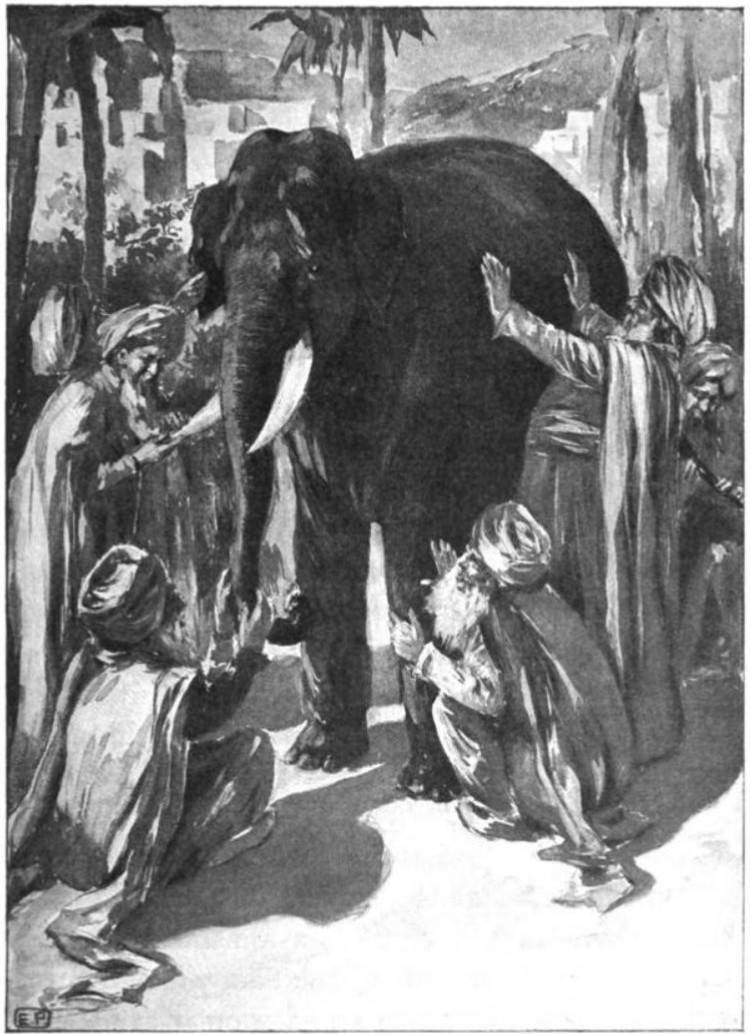
Each hand is on something real, and none is on the whole animal. Illustration signed "EP" from Charles Maurice Stebbins and Mary H. Coolidge, Golden Treasury Readers: Primer (New York: American Book Company, 1909); public domain.
AI has its own crowd around the elephant. The software engineer touches a tireless junior colleague. The economist touches a labor shock. The safety researcher touches an agent that might not do what it's told. The utility touches a new load on the grid, the artist a theft, the teacher a cheating machine, the investor a platform, the government a threat to manage. This essay touches a fall in the price of competence. Every one of those hands is on something real, and none of them is on the whole animal. In the Buddhist telling of the same story, a sighted king stands back and laughs at the quarrel. There's no king this time. Nobody is standing back with clear sight, not the companies building the systems, not the agencies proposing to regulate them, and not the critics on either side.
That includes the people closest to the machine. It's natural to assume that the head of an AI company, or its chief scientist, sees the future of the technology more clearly than anyone else. They do know more about what their systems can do this year. But their picture of what comes next was furnished long before they built anything, and from the same shelf as everyone else's. Thinking machines have lived in fiction for well over a century. E. M. Forster's "The Machine Stops," in 1909, imagined a humanity so dependent on a world-spanning machine that it forgot how to do anything for itself. Karel Čapek's play R.U.R. gave the world the word "robot" in 1920, along with the first robot uprising. Isaac Asimov wrote his Three Laws of Robotics in 1942, fiction's first set of guardrails, and then spent decades writing stories about the ways they failed. Even the "singularity" was popularized by Vernor Vinge, a science fiction writer, in a 1993 essay. The scenarios that circulate in boardrooms and research labs, the runaway intelligence, the machine that obeys the letter of its instructions and destroys the spirit, the race to build it first, are mostly these stories, retold in technical vocabulary.
None of that makes them wrong. It means they aren't a view from above. They're part of a shared store of half-remembered images that everyone in this culture carries, the builders included, and that shapes what each of us expects to find before we've touched anything at all. A chief executive has a hand on one part of the elephant, the part their company is building, and a head full of the same stories as the rest of the crowd about what the rest of it looks like. Running the lab gives no special immunity to them, and arguably less, since the stories are part of why many of those people went into the field. When someone at the top of an AI company describes what's coming, it's worth listening for which part they're actually touching, and which part they're remembering.
That's a reason to put syāt in front of every prediction made here, including the five above. Each is true in some respect, from where this essay's hand happens to rest. It's also an argument in itself. If nobody can see the whole animal, the worst arrangement is the one that lets a single blind man decide what the elephant is and build the fence around it. A guardrail is a guess about the shape of the thing, installed as the route for everyone. The way a society comes to understand a change this large is the way the Jain teaching recommends: many hands, in many places, each saying which part it holds, and comparing notes. Towns trying different things, forks of the same software going different directions, open models that anyone can study, and people free to report what they find. A free society doesn't need to be right about the elephant in advance. It needs to keep enough people touching it, and talking to each other, that its picture can keep getting better.
The event, in short
The event of 2026 is that competence stopped being scarce. Everything built on its scarcity is now open to question: the professions, the agencies, the vendors, and the argument that decisions have to move upward to where the expertise is. Some of those institutions will adapt, and some will try to rebuild the scarcity by law, through licenses, approved providers, and guardrails around the road they already own.
A movement concerned with liberty should be clear about which of those it supports. The dangers are real and specific, and they should be answered specifically, by prosecuting harm to others as the crime it is. The capability should land where it does the most good for self-government: with persons, towns, and communities, not with whoever claims the authority to keep it on a road they laid. The rent it creates should be collected from the land where it concentrates and returned to everyone. The records it makes readable should be kept private. And the judgment it tempts people to give up should be kept, by the people it belongs to.
A note on how this piece was written: the subject, the questions it asks, and the positions it takes are mine. Much of the research, the examples, and the sentences were drafted by an AI model working from that direction, and then edited by hand. On this subject in particular, a reader should know that.
Featured in AI and Liberty