 Social Liberty
Interfaces
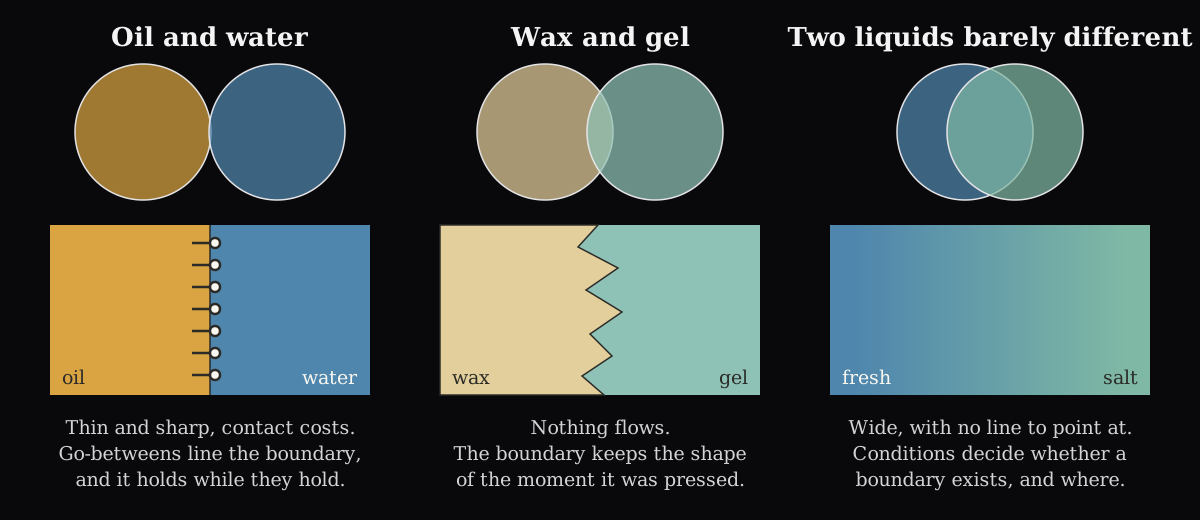
Hard dichotomies get argued from their two ends. A transition moves through the layer where they touch, and strategy there depends on how thick it is and what it's made of, oil and water, wax and gel, or two liquids barely different.
+50
Click to enlarge
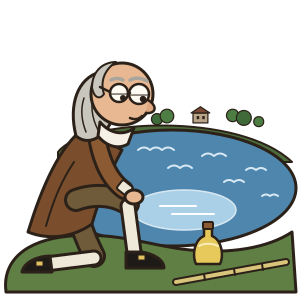
On a rough day at Clapham, Benjamin Franklin fetched a cruet of oil and went down to the large pond on the common. He dropped a little on the water from the leeward side, where the waves were largest, and the wind drove it back onto the bank. Then he walked around to the side where the waves began. There the oil, “though not more than a tea spoonful, produced an instant calm over a space several yards square,” which spread until “all that quarter of the pond, perhaps half an acre,” lay “as smooth as a looking-glass.” After that he kept a little oil in the hollow upper joint of his bamboo cane, and repeated the trick whenever he went into the country.
The pond was the same pond and the wind the same wind. Franklin’s explanation was that wind blowing over the film “cannot easily catch upon it, so as to raise the first wrinkles,” and he never worked out how thin the film had to be. Lord Rayleigh did the sum in 1890, with olive oil on a smaller surface, and got about 1.6 millionths of a millimeter, a figure later understood as a single layer of molecules. Franklin’s teaspoon over half an acre comes out close to it.
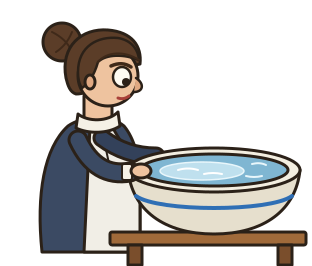 In the same years a young woman in Brunswick, Agnes Pockels, was caring for sick parents, with no university open to her, and measuring films like these in the family kitchen. Her tin trough had a sliding barrier that pushed a film into a smaller and smaller area while she measured its tension, and the film changed its behavior as it crowded, a thing with properties of its own, belonging to neither the water nor the air.
 After about ten years of this she wrote to Rayleigh, who sent her letter on to Nature, where it ran in March 1891. The apparatus now carries the name of Irving Langmuir.
Hard dichotomies tend to get the treatment the pond got before Franklin, attention to the water and attention to the sky. Liberty and order, person and community, market and state, local and central, real and artificial. Most of the writing goes into which end to favor. Some of it, in this collection of essays too, looks for a third category to adjudicate, and sometimes there’s no place for a third at all. Either way there remains the place where the two ends actually meet, and with a difficult pair it’s worth deepening strategies for working in that layer, and for moving through it, which is what a transition is, as much as arguments for either end. The layer has a thickness. It’s made of something, depending on what the two ends are made of. It formed some particular way, and a strategy that works in one kind of layer can do nothing, or harm, in another.
What the circles show
John Venn published his diagrams in 1880, and the plainest thing they show is thickness. Two circles slide toward each other, and the lens between them goes from a sliver to most of the figure. People arguing over how much public and private have in common, or church and state, are often arguing over how far apart to set the circles, and the drawing lets them see it.
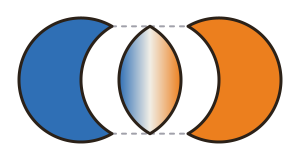 Venn drew for logic, though, and the logic is crisp. A point is in the lens or out of it, the edge has no width, and the ink is the same all the way across. A real mixing layer has a gradient in it and often behaves like neither side. The drawing is also silent about what’s inside the circles, and that decides most of what happens when they touch.
Infinitely thin
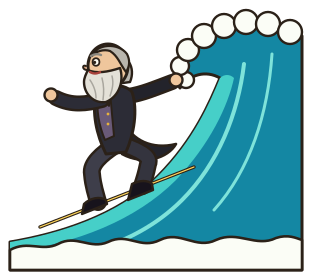 No physical interface has zero thickness. Even oil against water takes a few molecules to change over. In the 1870s, in New Haven, Josiah Willard Gibbs drew one anyway. He placed a plane with no thickness somewhere inside the layer, treated the two sides as uniform right up to it, and booked whatever didn’t fit to the plane as “excess.” The method still underlies surface chemistry. Its oddity is that the plane’s position is a free choice, and moving it changes the amounts booked, which can come out zero or negative depending on where the calculator found it convenient to stand.
Law’s lines are Gibbs’s planes. A property line has no width. A person is a minor at 11:59 and an adult at midnight, and a ballot arrives or it’s late. Drawing a line is the cheapest strategy there is. It ends arguments, and nobody has to live on it. The excess still has to go in some account, and the strategy’s real work is in deciding which account. A transition across such a line takes no time at all, which is both its strength and its trouble, since the adult at midnight is the minor of 11:59. For decades a confectioner on Wigmore Street pounded with heavy mortars against a wall at the back of his premises. Then a physician on Wimpole Street built a consulting room at the end of his garden, against that wall, and found he couldn’t use a stethoscope in it. The line between the two lots was perfectly sharp and the vibration crossed it. Sturges v. Bridgman went for the doctor in 1879, and Ronald Coase took it up in 1960 as a leading case in “The Problem of Social Cost,” asking what the two neighbors might have paid each other.
Oppositional and skewed
Dichotomies come in two types, and only one of them has a layer to work in.
An oppositional dichotomy is one thing and its negation. Pro-Trump and anti-Trump are the plain current case, one man with a plus or a minus sign in front of him. A person half for and half against holds no new position, only a looser grip on the same one. Authoritarianism and liberty are opposed in the same way, and there’s no reasonable blend of the two, since a liberty an office can withdraw is authority in a good mood. Getting from one to the other takes time, as the Transition section below describes, but that time goes to people changing frames and not to any mixed regime. Dichotomies of this type are weak and artificial, and here they’re also tedious, because they have no interface thickness. The line between them really is Gibbs’s plane, with nothing around it to study.
A skewed dichotomy is made of two separate real elements, neither defined by the other. Oil isn’t anti-water. Copper isn’t anti-tin, and melted together, about nine parts to one, they make bronze, which is harder than either. Person and community are skewed in this way, and so are know-how and purpose, which is much of what divides the two commissioners in Sometown, with the department knowing how and the town saying what for. Pairs like these are rich in possibilities, since each side is made of something and what they make together can be a thing neither was. The substances in the sections that follow are all of the skewed kind.
Oil and water
Each of these liquids prefers its own kind, so contact costs energy, and the pair keeps contact to a minimum. Droplets find each other and merge, the shaken bottle separates on the shelf, and what remains is one flat boundary a few molecules thick. Plenty of social pairs behave this way, with each side paying something for every point of contact and drifting toward arrangements with fewer of them.
The strategy here leaves both substances as they are and goes after the cost of contact. Chemistry’s version is a molecule with one end soluble in water and the other in oil. It has nowhere comfortable to go except the boundary, and sitting there it lowers the cost of contact, so that the boundary can spread out over a great many fine droplets. Lecithin in egg yolk does this for mayonnaise. Nothing has mixed in mayonnaise, and a cook who adds the oil too fast sees how provisional it is.
Transition across this kind of boundary is costly and happens one molecule at a time. The Pennsylvania frontier had such molecules, and they had names. Conrad Weiser, a Palatine German boy sent by his father to winter among the Mohawks in 1712, became from 1731 the colony’s interpreter in its dealings with the Haudenosaunee, working alongside the Oneida leader Shickellamy and later Andrew Montour. James Merrell’s Into the American Woods follows these negotiators down the forest paths and finds them distrusted from both directions and often at odds among themselves, carrying words between peoples with incompatible ideas of what the woods were. They kept contact possible for decades. When war came in 1755 the film gave way, and Weiser took a militia colonel’s commission.
Surface chemists also find a limit that will seem familiar to anyone who has attended a conference on bridge-building. Add go-betweens to a boundary and the cost of contact falls, up to a concentration where the surface is full. Past that point the tension stops falling, and the extra molecules ball up in the bulk with their heads out and their tails tucked in, in the company of their own kind.
A second strategy is to thicken the boundary, and it has conditions. Richard White’s The Middle Ground describes the Great Lakes country from 1650 to 1815, where Algonquian peoples and the French, needing one another and unable to compel one another, built a shared world of practices out of what White calls creative misunderstanding, each side justifying its acts by what it took to be the other’s premises. This layer was wide enough for people to be born, marry and trade in it. It held as long as neither side could end it by force, and it thinned quickly once the Americans could.
Wax and gel
Neither of these flows. Warm wax pressed against a set gel takes its print and keeps it, little passes from one to the other, and the boundary stays for years in the shape of the moment it was pressed. Contact occurs only at the surface, and a rougher surface holds better.
The Cathedral of St. Peter in Bautzen, in Saxony, has been used by Catholics and Lutherans at once since 1524. The town had gone over to the Reformation and the cathedral chapter hadn’t, and neither was able to remove the other. A contract in 1543 gave the choir to the Catholics and the nave to the Lutherans, with the boundary at the rood screen’s iron grille, once reported at four meters tall. A contract of 1583 set the hours when each confession may use the building, and it’s still said to be in force. Catholics were expelled for a time during the Bohemian revolt around 1620, and the old arrangement came back. The grille was cut down in the last century to about a meter, and given a door.
The strategy at Bautzen has never been a blend. Five hundred years in one building haven’t produced a Catholic-Lutheran, and what gets negotiated lies at the surface, hours, keys, repairs, with each term written down so that it holds when the people who agreed to it are gone. Nothing seeps across, so a transition here means a whole person changing confession and walking through the door. All five bells belong to the Lutheran parish. Each confession has its own organ, and the two organs are tuned to each other.
Solid against solid
Interfaces aren’t only for liquids, and most of the ones a society runs on are closer to solids, set bodies with their own structure, pressed together and staying put. Two solids touch far less than they appear to. Frank Bowden and David Tabor showed that surfaces laid flat against each other meet only at the tips of their roughness, a small fraction of the apparent area, and all the load and heat and current between them passes through those points. Two agencies with a signed agreement touch like this, through three people who know each other’s phone numbers. Clean two pieces of a metal in a hard vacuum and press them, and they can weld cold, since it was the film of oxide and grime that kept them two. Letterhead and procedure may be doing the same work.
A bar of metal is itself mostly a matter of boundaries, thousands of small crystals with their atomic planes pointing different ways. A metal deforms when slip runs along those planes, and slip stops at a grain boundary, where the next crystal’s planes point elsewhere. So the finer the grains, the stronger the bar, the relation named for E. O. Hall and N. J. Petch in the 1950s. The strategy here is to multiply boundaries, and it’s the metallurgical version of a confederation, where a failure that runs through one jurisdiction stops at the next because the rules there point another way. It has a limit too. Some work finds that at grains only a few nanometers across the metal softens again as the boundaries begin sliding past one another, though researchers still argue over it.
An interface between solids can also do what neither side can. Early in 1940 Russell Ohl, at Bell Labs in New Jersey, tested a slab of silicon with a crack down its middle and saw the current jump when bright light fell on it. The crack marked a seam between regions holding different impurities, and the barrier at that seam passed current in only one direction, a transition with a one-way rule built into it. Transistors and solar cells descend from that seam. “The interface is the device,” Herbert Kroemer said in his Nobel lecture in 2000. The way to build such a thing is to grow one crystal on another whose atoms fall at nearly the same spacing, because a mismatch shows up as strain and then as breaks in the lattice. In November 1772 the Boston Committee of Correspondence wrote out to the towns of Massachusetts, and a new body grew up on the spacing of town meetings already in place.
Given time, solids exchange as well. In 1947 Alice Smigelskas and Ernest Kirkendall wound a core of brass with fine molybdenum wires, plated it in copper and heated it. Zinc left the brass faster than copper came in, and the wires, sitting at the original boundary, moved closer together. Voids collect on the side losing faster. A county town that sends its young people to the city and gets back weekend visitors has a boundary that hasn’t moved on any map, and a Kirkendall void in its high school.
The largest solid interfaces in this part of the world run under the East Bay. The Hayward Fault is two blocks of crust moving past each other, and along most of its length the surface creeps a few millimeters a year, between about 3.5 and 6.5, with a stretch near the south end at about 9. Deeper down much of it stays locked, and in 1868 it let go. Creep and rupture are two ways through one interface. A boundary that can give a little each year spends its stress on bent curbs, as the grille at Bautzen came down over a long time, and a boundary that can’t give stores what it would have spent. Old curbs in central Hayward show several decades of offset. The old city hall, built on the fault, has long stood empty.
Gas against solid
Breathing is a gas meeting a solid. Air comes down through the branching of the lungs to some hundreds of millions of alveoli, about seventy square meters of surface folded into a chest, and between that air and the blood stands a wall around a thousandth of a millimeter thick. Nothing pushes oxygen across. It crosses because there’s less of it on the far side, at a rate that rises with area and falls with thickness, so the lung’s strategy is to take both as far as they’ll go. Every line the law draws is built to settle who is on which side, and this one is built to be crossed, some twenty thousand breaths a day, by something that never stops needing to.
The surface isn’t quite dry, and that nearly undoes it. A thin wet lining coats the alveoli, and its tension would pull them shut if go-betweens weren’t sitting on it. In 1959 Mary Ellen Avery and Jere Mead showed that infants dying of hyaline membrane disease lacked the surfactant that lowers that tension, and in August 1963 the same disease killed Patrick Bouvier Kennedy, the president’s son, at two days old. Treatment with surfactant reached the clinic in the 1980s.
Gas on solid was also Irving Langmuir’s real subject, before the clouds. At General Electric he found gas molecules holding to the hot surfaces inside light bulbs in a layer one molecule deep, the work behind his Nobel in 1932. Towns have surfaces of this kind as well. The Medici laws of the 1590s invited merchants of any nation and faith to Livorno, and the port lived on what crossed its wharves.
Two liquids barely different

Phenol and water, in the right proportions at room temperature, sit in two layers with a visible line between. Warm them and the line grows wider and fainter, the liquid near it turns milky as the layer fluctuates at scales large enough to scatter light, and at about 66 degrees Celsius the line is gone. Triethylamine and water do the reverse. They’re a single clear liquid when cold, and at around 18 degrees they separate. For a pair this close, the existence of a boundary at all depends on conditions, and in the second case heat is what produces it.
The second case will be recognizable from public meetings. The two commissioners in Sometown both do the reading, and on most items no one could find the line between them. A hot item comes up and they’re in two layers, each sure that it always was. Strategy with such a pair works on conditions more than on positions: how an item is taken up, in what order, at what temperature.
Fresh water and salt water are another such pair, and one of them lies at the top of San Francisco Bay. Between the Golden Gate and the Delta, salt thins out over tens of kilometers. Under quiet tides the fresh water slides out over the salt in layers, and under strong tides the two get stirred together. The State Water Board’s marker for this is X2, the distance from the Golden Gate at which water near the bottom holds two parts per thousand of salt. It moves with the river and the tide, down toward San Pablo Bay in a wet season and up past Suisun Bay in a dry one. A transition through water like this has no moment anyone could name.
In the dry season of 1920 the Sacramento fell to 420 cubic feet per second at the city of Sacramento, largely through upstream irrigation, and salt came up to the intake of the town of Antioch. Antioch went to court and won an injunction, and in 1922 the California Supreme Court reversed it. “The depleted volume of the stream does not hold back the rising tide of salt water from the bay below,” the court wrote, and it declined to give a town using about one cubic foot per second control over the flow that watered 300,000 acres: “It would be hard to conceive of a greater waste for so small a benefit.” The meeting point of fresh and salt moves, the court noted, and whoever draws water near it bears that risk.
By 1995 the position of the mixing layer had itself become the regulated thing. The State Water Board adopted X2 as a standard, and in certain months pumping is curtailed to hold it west of a named point, 75 kilometers from the Golden Gate at Chipps Island. Delta smelt, a finger-long fish that lives in that low-salinity water, do better in years when the layer lies in Suisun Bay. Nobody in the long fight over this water proposes to settle whether the estuary is salt or fresh. Nothing stands off to the side of that line either. The strategies there all concern where along it the layer sits, how wide it runs, who lives in it and who pays to keep it there.
Public and private
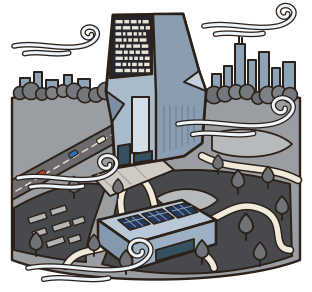 A public-private partnership is an attempt at an interface. Two separate bodies, each with a dimension of its own, agree to cooperate in the hope of some synergy, a result neither could reach alone, as Ohl’s seam does what neither region of silicon can and bronze is harder than its metals. The pair is skewed, which gives the hope its ground. Partnership Across Dimensions set out how public and private differ the way north differs from up, each with its own residual claim, its own feedback and its own clock. Whether a given partnership is any good is a question that essay took up. The interface asks what kind of layer the contract builds, and what can live in it.
Bodies this set are solids, and a long partnership is one crystal grown on another whose spacing doesn’t match. A water main stays in the ground for eighty years, the officials above it face elections every two or four, and the investors look for their return in three to seven. The contract has to hold all of those in register, and the mismatch shows up first as strain and then as breaks. J. Luis Guasch’s studies of Latin American concessions found most transport and water contracts renegotiated, on average three and a half years after signing. Some contracts try to allow no give at all. Chicago’s 2008 parking-meter lease runs seventy-five years and obliges the city to pay for each metered space it takes out of service, for a bike lane or a bus stop, which makes the curb a locked stretch of fault. London tenders its bus routes for about five years at a time, and a company that runs one badly loses it at the next round, a boundary that creeps.
The contract also draws a Gibbs plane (in the physics of fluids and surfaces, a Gibbs dividing surface is a hypothetical geometric plane used to model the boundary between two different phases of matter – known better as the Gibbs Free Energy hyperplane), a line on paper marking what each party owes, through what is in practice a thick layer of change orders, demand guarantees and refinancings. Whatever fits neither side gets booked there as excess, and a low bid recovered at a later reopening is excess in the plainest sense. Thickness is no virtue by itself. White’s middle ground was wide enough for people to be born and marry in, and this one is wide enough for a refinancing. The account that finally takes the excess tends to belong to the side that can’t walk away. When Carillion collapsed in 2018, the half-built Royal Liverpool hospital went back to the public side, which opened it four years later.
The form has drawn its go-betweens too: a World Bank resource center, a Certified PPP Professional credential, a world association in Geneva, a Canadian council with an annual conference. A surface chemist would want to know whether this boundary is already full.
The separations that have held up use strategies from earlier in this essay. Nav Canada is closer to Bautzen, an operator and a regulator under separate rules, with the terms written down at the surface and a regulator holding no stake in the operator’s revenue. A housing voucher is closer to the lung, a thin wall built to be crossed. The public side raises the money, and a family carries it across to whatever apartment it finds, and neither side has to become the other.
The wrong strategy for the layer
A strategy carried into the wrong layer fails in ways of its own. A go-between at Bautzen would have little to carry, since the terms are written down and neither congregation is waiting to be understood. Antioch’s suit asked for something like a fixed line in a moving estuary, a point the salt would be held below, and the court’s answer was that the meeting point moves and those near it bear that risk. The commissioners in Sometown can be given a mediator, who will treat two people from one liquid as if they were oil and water, and they may start to behave that way. And a line drawn through the Great Lakes country in 1650 would have had no one to enforce it, while the people living in that layer went on trading across it.

Transition
For activists and philosophers alike, transition is why to be alive. A young Chinook salmon leaving the Sacramento River for the Pacific Ocean has to know a strategy for how to come into adulthood. In fresh water the fish is saltier than what surrounds it, so water soaks in and salt leaks out, and it drinks almost nothing while its gills pull salt in. In the ocean all of that reverses. Water is drawn out of the body, the fish has to drink the sea, and its gills pump salt back out. It starts rebuilding those gills on the way downstream, and researchers working on these fish call an estuary, for a juvenile salmon, “a physiological transition zone.” The habits that kept it alive in the river would kill it at the Golden Gate. Bruce MacFarlane and Eric Norton, following Central Valley juveniles out through this estuary, found that they grew little and lost condition on the way, then grew fast once they reached the ocean.
Social liberty speaks of a frame shift of this kind, and of the need for one if liberty is to work. In one frame, a broken thing belongs to an office: who’s responsible, whom to write to, why it hasn’t been fixed. In the other, the same broken thing is a question among people nearby: who has a shovel, who’ll share the cost, what rule they’d all accept. In genetics a frame shift adds a single letter to a strand, and every word after it reads differently though the letters that follow are all still there. The facts here stay the same too, the street and the budget and the neighbors. The kinds of institutions a place needs are themselves a product of the frame they develop in.
The first frame grows complaint desks, inspectors and ombudsmen, trolls left behind to hold up the carcass. The second grows road committees, burial societies and the rules of a shared pasture, and a road committee set down in the first frame becomes one more office to write to. A person still in the first frame who is handed liberty stands at a closed window, waiting.
One step past Hayek gives the question a direction. If the knowledge problem is what makes liberty the best model, then institutions should evolve toward solving it, and their types can be judged by how well they do. Burke’s inherited arrangements hold knowledge across time, Hayek’s orders spread it across space, and neither happens by default. A town meeting brings what neighbors know about a watershed to the people deciding on it. A friendly society’s members can tell a sick man from a shirker as no distant office can. A society of engineers lets those able to judge a bridge judge its builder, and when one body’s judgment fails, clients go to another and everyone learns from it. A license board holding one standard over a whole state learns slowly, and a central office that has ended local experiment has cut itself off from the results. Progress among institutions, on this account, is measured in knowledge: more of it reaching whoever decides, sooner, with errors surfacing while they are small.
Bodies that lasted have mostly come up in the same few ways, and hardly any began with a constitution.
From a problem that keeps coming back. A friendly society started with a burial no family could pay for alone and a sickness that would come to someone sooner or later. People join what solves a thing they already can’t solve by themselves.
Small and repeated. Seven engineers at a tavern in 1771, workers on a club night with their subscriptions. Habit forms before rules, and a body that meets on a regular night has most of what it needs.
On its own money. Dues in a box give members a reason to watch it and officers a reason to answer them. One Sussex society’s box had five locks.
With rules written after practice. Rose’s Act arrived in 1793, long after the societies it recognized, and registration under it was permissive. Law did its best work by giving standing to what people had already built, and by enforcing a society’s rules on its own officers.
With a successor taught. Abraham Shackleton opened his school at Ballitore in 1726, and Edmund Burke was among its boys in 1741. In 1756 Shackleton’s son Richard became its master. A body has become an institution once it survives its founder, and that gets arranged while a founder is still alive.
On ground kept open. Next body needs no leave from last one. In June 1791, in liberty’s name, France’s Le Chapelier law forbade trades to form associations at all, and a state can do as much harm by licensing every association as by banning them.
Getting these is ordinary, local and within reach, which is the good news in Burke’s argument. Nobody has to wait for a national settlement to start a box. Different tasks need different forms, and ours need several.
Households, friendships and congregations carry care, belonging and moral formation. They depend on personal attachment and on latitude for different ways of life. A government prescribing one approved form of association weakens that latitude, so does an association treating belonging as permission to abuse a member. Independence and protection against coercion have to exist together.
Mutual-aid societies, cooperatives and member associations let people pool resources without handing a whole task to an outside administrator. Britain’s friendly societies did this in Burke’s lifetime, workers paying into a locked box for sickness and burial, and Parliament took notice of them with Rose’s Act in 1793. A member needs a real claim on such a body: access to accounts, a way to replace officers, rules on what becomes of contributions after leaving. A membership card without those powers can conceal a service provider whose customers happen to be called members.
Firms and professional bodies coordinate work and preserve skill. They need freedom to organize, make agreements and develop standards, and they need competitors and new entrants. A trade able to reproduce its knowledge but closed to a rival has preserved its position at everyone else’s expense.
Trusts and endowed institutions care for things outliving us: a woodland, an archive, a school, a building used by successive generations. Their governing documents tie control of assets to responsibility for purpose, and they need a way to correct failure and adapt. Held in Trust explored this through land, where continuity matters and an instruction written today can’t anticipate what a future steward will face.
Municipalities, courts and federations handle matters voluntary membership can’t settle. Neighbors share a watershed even when they dislike one another. A person injured by another’s conduct needs a remedy the other party can’t simply decline. These bodies need defined jurisdictions, due process and limits on expanding their own authority, with decisions close to people bearing consequences and wider coordination organized around a particular task.
No one form can do all of this. A structure suited to a household won’t govern a court fairly, a business’s response to paying customers won’t preserve every obligation of a trust, and a town’s majority vote can’t legitimately decide every question about a resident’s body or conscience.
Thickness and substance state
A transition by decree has the width of Gibbs’s plane, a date and a signature, and it changes who sits in the office while leaving the frame alone. The “transition” Washington has been speaking of in Venezuela, as Liberty Before Democracy took up, is of that kind. Other essays in this collection have gone looking for something wider, a multi-year phase-in of land value tax, or a parallel in schools, medicine and money widened until it’s ordinary, a stretch of water where a person can rebuild the gills before the salt arrives. For an institution to be transitional, it has to be consciously aware of the frame from which it comes and equally of the frame to which it goes. One that knows only the first settles in as a permanent office, and one that knows only the second hands out liberty at the closed window.
On September 6, 1774, 4,622 militiamen from 37 towns filled the main street of Worcester, Massachusetts, and the Crown’s newly appointed court officers were made to walk the length of them, reciting their recantations. Courts were closing across the province that summer, and people said they were living in a “state of nature.” It wasn’t a gentle crossing. But those towns had been running their own meetings, roads and schools for generations, and they went on doing it through committees, with no royal authority above them, nearly two years before anyone in Philadelphia drew a line. The town meeting had been their estuary, and most of the people on that street had already changed frames there without marking the day.
Surf at Portsmouth
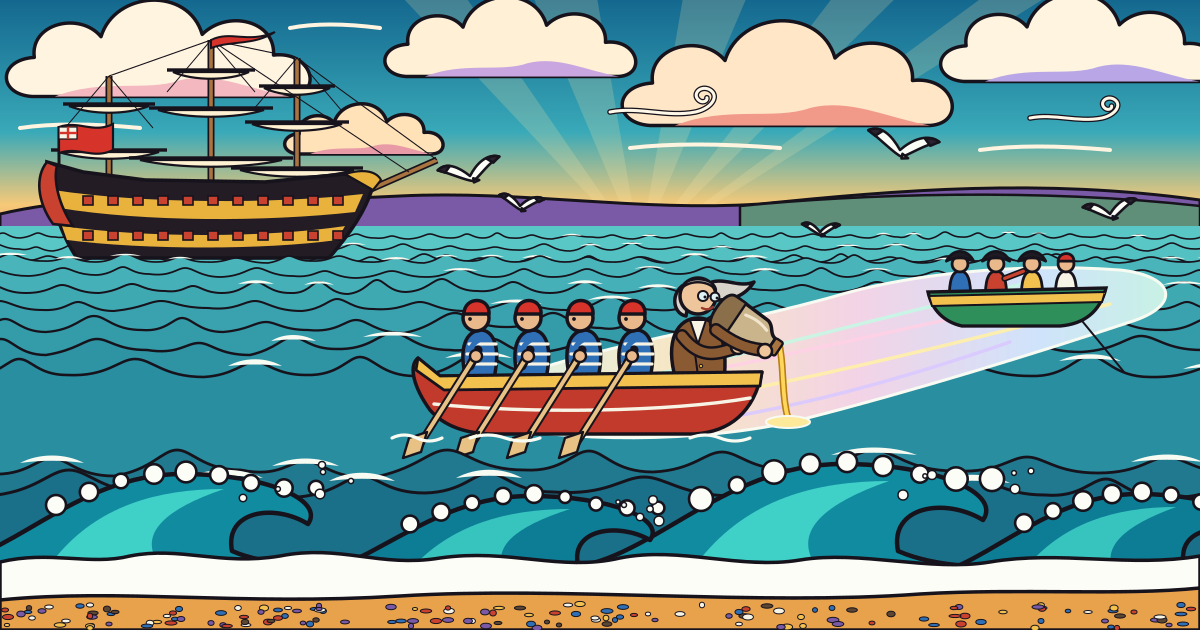
In October 1773 Franklin tried his oil on the open sea. Captain John Bentinck lent him the ship Centaur, with a long-boat and a barge, and on a blustery day off Portsmouth a barge went back and forth about half a mile from shore, pouring oil from a large stone bottle through a hole in the cork. A tract of smoothed water appeared, spreading toward the long-boat. But “no material difference was observed in the height or force of the surf upon the shore.” Franklin worked out why in a letter that November. The film could stop the wind from raising new wrinkles, and it could “take off the effect of wind on waves already raised,” but those waves had their motion, and “if the shore is not far distant, they arrive there so soon, that their effect upon it will not be visibly diminished.”
He was at the time in London as agent for four American colonies, a Fellow of the Royal Society and the Crown’s deputy postmaster for North America, and for years his strategy between them had been the oil’s, to keep the first wrinkles from rising. On December 16 a crowd in Boston put the East India Company’s tea in the harbor. A ship carrying the news reached Dover around January 19. Ten days later Franklin stood at the Cockpit in Whitehall before the Privy Council, on a Massachusetts petition, while the solicitor general, Alexander Wedderburn, spent over an hour on his character, with councilors laughing aloud. Witnesses say he didn’t move a muscle. The next day he was told he’d lost the post office.
The letter on oil was read to the Royal Society that June and printed in the Philosophical Transactions, with the surf left in.
Sources
- Benjamin Franklin, William Brownrigg, and Mr. Farish, “Of the Stilling of Waves by Means of Oil,” Philosophical Transactions 64 (1774).
- Lord Rayleigh, “Measurements of the Amount of Oil Necessary in Order to Check the Motions of Camphor upon Water,” Proceedings of the Royal Society 47 (1890).
- Agnes Pockels, “Surface Tension,” Nature 43 (1891): 437–439.
- John Venn, “On the Diagrammatic and Mechanical Representation of Propositions and Reasonings,” Philosophical Magazine (1880).
- J. Willard Gibbs, “On the Equilibrium of Heterogeneous Substances,” Transactions of the Connecticut Academy (1875–78).
- Sturges v. Bridgman (1879), 11 Ch. D. 852; Ronald Coase, “The Problem of Social Cost,” Journal of Law and Economics 3 (1960).
- James H. Merrell, Into the American Woods: Negotiators on the Pennsylvania Frontier (1999).
- Richard White, The Middle Ground: Indians, Empires, and Republics in the Great Lakes Region, 1650–1815 (1991).
- Siegfried Seifert, Bautzen: Dom St. Petri, Simultankirche; City of Bautzen, Churches.
- Town of Antioch v. Williams Irrigation District, 188 Cal. 451 (1922).
- Alan D. Jassby et al., “Isohaline Position as a Habitat Indicator for Estuarine Populations,” Ecological Applications 5 (1995); California State Water Resources Control Board, 1995 Water Quality Control Plan and Decision 1641 (2000).
- R. Bruce MacFarlane and Eric C. Norton, “Physiological Ecology of Juvenile Chinook Salmon at the Southern End of Their Distribution,” Fishery Bulletin 100 (2002); Rosalie B. del Rosario et al., “Migration Patterns of Juvenile Winter-run-sized Chinook Salmon through the Sacramento–San Joaquin Delta,” San Francisco Estuary and Watershed Science 11, no. 1 (2013).
- William A. Bennett, “Delta Smelt Life History and Population Dynamics in the Upper San Francisco Estuary,” San Francisco Estuary and Watershed Science 3 (2005).
- F. P. Bowden and D. Tabor, The Friction and Lubrication of Solids (1950).
- E. O. Hall, “The Deformation and Ageing of Mild Steel,” Proceedings of the Physical Society B 64 (1951); N. J. Petch, “The Cleavage Strength of Polycrystals,” Journal of the Iron and Steel Institute 174 (1953).
- Computer History Museum, “1940: Discovery of the p-n Junction”; Herbert Kroemer, “Quasi-Electric Fields and Band Offsets: Teaching Electrons New Tricks”, Nobel Lecture (2000).
- A. D. Smigelskas and E. O. Kirkendall, “Zinc Diffusion in Alpha Brass,” Transactions of the AIME 171 (1947).
- U.S. Geological Survey, “Revised Long-Term Creep Rates on the Hayward Fault” (1997), and “Hayward Fault: Large Earthquakes versus Surface Creep”.
- Mary Ellen Avery and Jere Mead, “Surface Properties in Relation to Atelectasis and Hyaline Membrane Disease,” American Journal of Diseases of Children 97 (1959).
- Irving Langmuir, “The Adsorption of Gases on Plane Surfaces of Glass, Mica and Platinum,” Journal of the American Chemical Society 40 (1918).
- Ray Raphael, The First American Revolution: Before Lexington and Concord (2002).
- American Philosophical Society, “How Alexander Wedderburn Cost England America”; The Papers of Benjamin Franklin, vol. 21.
- J. Luis Guasch, Granting and Renegotiating Infrastructure Concessions: Doing It Right (World Bank, 2004).
- City of Chicago Office of Inspector General, Report on the Chicago Parking Meter Concession (June 2009).
- Edmund Burke, Reflections on the Revolution in France (1790), Works, vol. 3.
- Ballitore School and the Shackletons, Kildare Libraries.
- F. A. Hayek, Law, Legislation and Liberty (1973–79).
- Smeatonian Society of Civil Engineers, Wikipedia.
- 100 Years of Engineering Licensure, National Society of Professional Engineers.
- Friendly Societies, Pint of History.
- Sussex friendly society records, Sussex Archaeological Collections, vol. 105 (1967)
A note on how this piece was written: the subject, the idea of working in the interface layer, and the three substances are mine. Much of the research, the examples, and the sentences were drafted by an AI model working from that direction, and then edited by hand. I’d rather say that plainly than have a reader guess at it.