 Social Liberty
Inside the Liberty Corner
A detailed look at what sits inside, structural suggestions for how to work with the parties.
+23
Click to enlarge
In 1844 Lysander Spooner, a Massachusetts lawyer who had read the Constitution closely and found no clause giving Congress a monopoly on carrying letters, set up the American Letter Mail Company, with offices in New York, Philadelphia and Baltimore, and charged less than the Post Office. In 1845 Congress passed a law that effectively ended every private letter carrier between American cities, and by 1851 Spooner had stopped. He kept arguing his case in print for the rest of his life.
Libertarians still use the story, and almost all of them mean the same thing by it: a person was stopped from offering a service nobody was forced to buy. Ask the same people who owns the ground the mail wagons crossed, or whether a government of any kind should have run the roads, and the agreement thins. They stand at the same corner of the Nolan chart and disagree about nearly everything below it.
The chart, drawn by David Nolan around 1970, has two axes, personal freedom and economic freedom, and a corner for high on both. This collection of essays has used it as a starting point for sorting positions past a single left-to-right line. It is also a framework in the software sense: a form with two slots, which assigns every position a coordinate and reads the corner at the top as one place. This essay zooms in on that corner. The question is what the form leaves out once someone stands inside it.
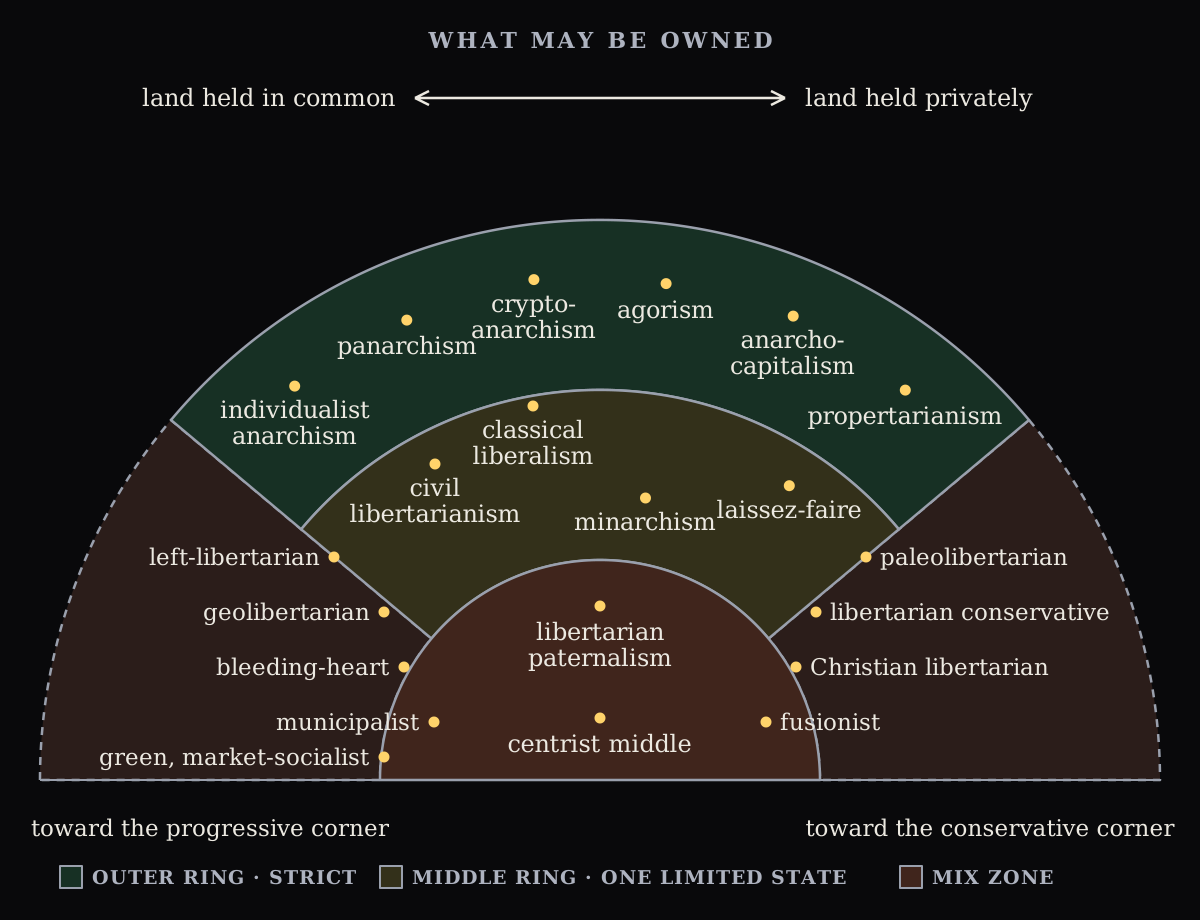
Three settings
The corner’s own framework has three settings, and every kind of libertarian on the list in the Wikipedia outline can be described by how it sets them.
The first is what counts as aggression. Nearly everyone in the sector agrees on a rule of non-aggression, that nobody may initiate force or fraud against a person or that person’s property, and the movements differ in how strictly they apply it. The second is what may be owned, and by what act. A farmer who clears wild land owns it on one reading. On another, the land and its rent belong to everyone, and what the farmer owns is the improvement. The third is who enforces the rule: no one in particular, competing private agencies, one limited government, or a person’s own choice among several.
A movement is a particular reading of those three. The outline lists some thirty branches and schools, from agorism and anarcho-capitalism to geolibertarianism, libertarian paternalism and libertarian transhumanism, and most of the list turns out to be settings.
The rings in the figure run from the center of the chart out to its edge, with distance standing for strictness, how close a movement holds all three settings to their extremes. The outer ring is the strict one. The middle ring keeps the first two settings close to the extreme and accepts one exception, a state held to protection. Near the center, where the sector overlaps the corners beside it and the centrist middle of the chart, is a mix zone, where a movement holds the rule of non-aggression as one value among others. The horizontal direction inside the sector follows the second setting, from commons-minded on the left to full private ownership on the right.
The outer ring
The outer ring holds every setting at its limit, and it still isn’t one place.
Josiah Warren opened the Cincinnati Time Store in 1827, selling goods at their cost plus a few percent and taking payment in notes promising hours of the customer’s own labor. His principle was “cost the limit of price.” The store ran for three years, and he left it to found communities on the same terms, one of them Modern Times on Long Island in 1851. Warren and the American individualist anarchists after him, Benjamin Tucker and Spooner among them, held that a person owns the product of that person’s labor and the ground the person occupies and uses, and wanted banks and courts that anyone could set up and join.
Murray Rothbard carried the same rule into a different property view. In his anarcho-capitalism the first person to put land to use owns it outright, to keep or sell, and defense, courts and law are services bought from competing firms. His colleague Hans-Hermann Hoppe tried to prove the structure from the act of arguing itself, in what he called argumentation ethics. Both positions are in the corner and they sit at opposite ends of the second setting.
Samuel Edward Konkin III, a Rothbardian by lineage, drew a different conclusion about method. His agorism, set out in a manifesto of around 1980, held that libertarian ends can’t be reached by statist means, and so neither by a party nor by voting. What he proposed instead was counter-economics: trade done untaxed and unlicensed, on the black and grey markets, until the state’s share withers. In 1988 Timothy May’s Crypto Anarchist Manifesto described the same exit with different tools, strong encryption that would let two people trade without anyone knowing who they were or being able to stop them. In 1860 Paul-Émile de Puydt had proposed a third kind of exit in an essay called “Panarchy,” in which every person would choose a government as one chooses among providers of any other service, and several governments would serve the same ground.
Read as frameworks, these differ chiefly in deployment. Spooner went through the courts and the market. Warren built a store and a village. Rothbard and Hoppe argued, Konkin and May built bypasses, and de Puydt wrote a design for an interface between governments. The settings are close to identical, and the strategies for getting there have little in common. The outline also lists voluntaryism, associated with Auberon Herbert’s 1880s argument against all compulsory taxation, and philosophical anarchism, which holds that nobody has a duty to obey a state without saying anything about what to do about it. Both are near the rim.
The middle ring
The middle ring accepts one thing the outer ring refuses, a single monopoly on force, and keeps the rest.
Robert Nozick’s Anarchy, State, and Utopia (1974) is its text. A person has rights that nothing may override, and Nozick argued that a minimal state, one protecting persons and property and enforcing contracts, can arise without violating any of them. Anything larger, taxation for redistribution among others, violates rights. This is minarchism, the night-watchman state. Classical liberalism and the laissez-faire tradition sit beside it, with a thicker state in some versions that provides roads and courts and the rule of law, and keeps its hands off markets.
The same position is reached by two kinds of argument, and the chart can’t tell them apart. Nozick and Rothbard reason from rights, which the outline calls deontological libertarianism. Friedman, Hayek and many economists reason from results, that free markets and limited governments make people better off, and the outline calls that consequentialist libertarianism. A voter marking a ballot can’t see whether the person beside them gets to the corner from principle or from evidence, and the difference matters a great deal when the principle and the evidence part ways.
For a real middle-ring case, consider Hong Kong in the 1960s. John Cowperthwaite, the colony’s financial secretary from 1961 to 1971, called his approach “positive non-intervention” and kept the government’s own statistics so thin that Milton Friedman, visiting in 1963, is reported to have asked why there was so little data. Cowperthwaite’s answer, as retold, was that if his office compiled such figures, officials would want to use them for planning. The economy that resulted was ranked among the freest in the world for decades. The colony had a governor sent from London and no elections, so on the personal-freedom axis it sat well below the corner, and the government owned all of the land and leased it, a feature Georgists point to as rent captured for the public. The most-cited libertarian experiment of its era was in the corner on the economic axis, well below it on the political one, and on property closer to the Georgist left than to Rothbard’s right.
The mix zone
The mix zone is where the libertarian corner touches the others, and its occupants carry a second commitment alongside the first.
On the conservative side, paleolibertarianism joined the rule of non-aggression to an appeal to community, religion and the local. Rothbard’s 1992 essay “Right-Wing Populism: A Strategy for the Paleo Movement” proposed an alliance with the culturally conservative right, and libertarian conservatism and Christian libertarianism hold the same two values from the other end. Frank Meyer’s fusionism, argued in the pages of National Review in the 1960s, was an early attempt to keep both in one coalition.
On the other side, bleeding-heart libertarians such as John Tomasi and Matt Zwolinski argue that markets and property are best defended by what they do for the poor, and Tomasi’s Free Market Fairness (2012) makes the case at length. Left-libertarians, the philosophers Hillel Steiner, Peter Vallentyne and Michael Otsuka among them, keep full self-ownership and deny that a first user can claim the earth: natural resources belong to all in some equal share. Geolibertarians put the same idea in tax terms, as the single tax on land value Henry George proposed in 1879, and Thomas Paine stated it in 1797 in Agrarian Justice, proposing that every person reaching twenty-one receive a sum from a fund raised by a tax on inherited estates, in compensation for the natural inheritance that private landholding had taken. Libertarian municipalism, from Murray Bookchin, shifts decisions to face-to-face assemblies in towns, and green and social libertarianisms emphasize ecology and the commons. Market socialism and mutualism, Proudhon’s tradition, let people own firms together, not own them separately.
Near the center of the chart, libertarian paternalism, Richard Thaler and Cass Sunstein’s term from 2003, which they developed into Nudge in 2008, holds that people should keep every choice they have and that the choice architecture, the default setting, may still be designed to steer them. Its tool is the default, which in a framework is the setting that applies when no one has chosen.
The mix zone has thickness, to use a term from Interfaces. A movement at its edge differs from the corner by one added value, and an anarcho-capitalist may call it an ally. One deep inside shares little beyond a vocabulary: left and right libertarians both say property, and they mean different things by it.
What the zoom shows
Two things show up on the zoom that the chart at full size hid.
First, inside the corner the two axes of the chart stop doing the sorting. Everyone in the sector is high on both. The thing that separates a Rothbardian from a Georgist is what may be owned, a question the chart assumes and doesn’t ask. A map for this sector needs a different axis, along which the sector’s left and right halves turn out to be far apart, and the chart’s usual left-to-right reading, with the progressive on the left and the conservative on the right, only partly tracks it.
Second, strictness and method turn out to be separate. The outer ring includes people who vote and people who refuse to, those who build stores and those who write ciphers, and the middle ring includes people who reach the same conclusion from rights and from outcomes.
Paine, whom the outline lists among the sector’s forebears, put his proposal for fifteen pounds at twenty-one, and ten pounds a year from fifty, in a pamphlet addressed to the legislature and executive directory of the French Republic in 1797.
Two wings, two parties
The diagram has a left side and a right side, and the sides point somewhere. The dashed margins at the base lead toward the progressive corner on one hand and the conservative corner on the other, and the people placed there are the ones whose second commitment already lives in a neighbor’s territory. That layout gives a caucus a way to organize.
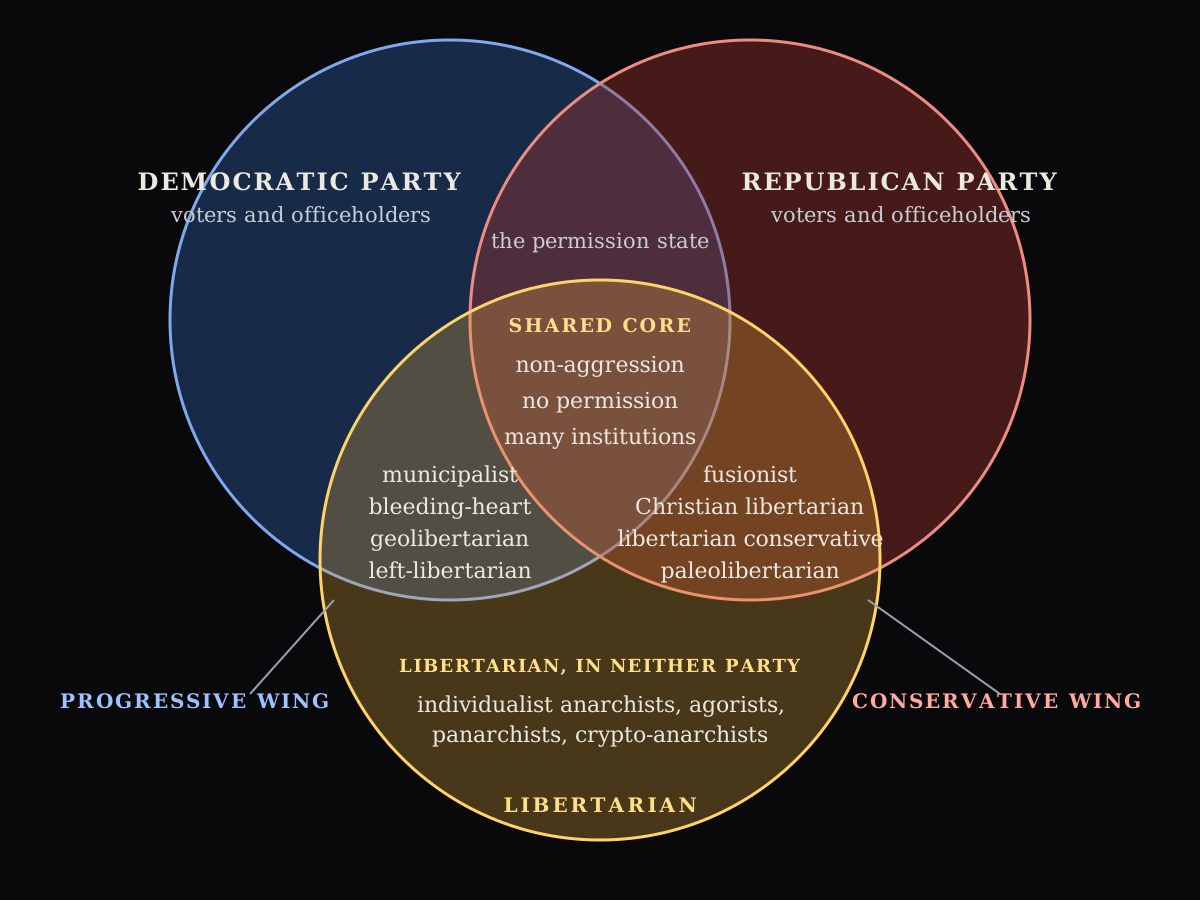
The libertarian overlay on the two parties. Each wing sits where the libertarian circle meets its party, and the shared core sits where all three meet.
The Social Liberty Caucus can have two wings. One is the progressive side of the margin, the left-libertarians, geolibertarians, bleeding-heart libertarians and municipalists, whose natural audience is the Democratic Party’s voters and officeholders. They arrive with a land value tax, a case against permission as a barrier to the poor, and a politics that starts at the town. The other wing is the conservative side, the paleolibertarians, libertarian conservatives, Christian libertarians and fusionists, who arrive in the Republican Party with property, community, the local and an old argument that the state’s reach is the enemy of both. Each wing speaks the vocabulary of the party it approaches, and each takes its place as that party’s liberty faction.
The middle of the chart doesn’t divide. The outer and middle rings and the mix zone belong to both wings: the non-aggression rule, the objection to permission, the preference for many institutions over one. A member in either party carries them. What differs is the answer to the horizontal axis of the diagram, what may be owned, which runs from land held in common to land held privately. The wings will not agree on it, and the diagram shows the disagreement as a distance on a page and not as a split in a movement. A caucus that has mapped where its wings differ can hold both.
The parties are frameworks in the sense Frameworks used the word. Each supplies slots, defaults and a sense of what is normal, and a faction inside one learns the slots first: the primary, the platform committee, the county organization. Social Liberty 2027: The Opening asked whether the Republicans’ liberty faction should be helped to rebuild inside its party or offered a home outside it. The two-wing arrangement gives a different answer, which is both, at once, in the two places where its members already live. It also asks less of a person than leaving does. A member registered in one party keeps the registration and brings the caucus into it.
First There Was One, Then There Were Two described what early members do to a small group’s character. With two wings, the question is asked twice, and the early members of each are chosen for the side they face: reachers on both, with each wing’s keepers arriving later and carrying their own party’s habits. The Republican Liberty Caucus, which formed in 1991 to work inside the Republican Party, is an example of the shape, and the Mises Caucus, which worked inside the Libertarian Party and took it, is another. Neither had a counterpart on the other side of the chart.
Sources
- American Letter Mail Company, Wikipedia; Lysander Spooner, The Unconstitutionality of the Laws of Congress, Prohibiting Private Mails (1844); Post Office Act of March 3, 1845.
- Outline of libertarianism, Wikipedia.
- Nolan Chart, Wikipedia; Advocates for Self-Government, David F. Nolan.
- Cincinnati Time Store and Cost the limit of price, Wikipedia; Josiah Warren, Equitable Commerce (1846).
- Murray N. Rothbard, For a New Liberty (1973) and “Right-Wing Populism: A Strategy for the Paleo Movement,” Rothbard-Rockwell Report (January 1992); Hans-Hermann Hoppe, A Theory of Socialism and Capitalism (1989).
- Samuel Edward Konkin III, New Libertarian Manifesto; Timothy C. May, The Crypto Anarchist Manifesto (1988).
- Paul-Émile de Puydt, “Panarchie,” Revue trimestrielle (1860); Auberon Herbert, The Right and Wrong of Compulsion by the State (1885).
- Robert Nozick, Anarchy, State, and Utopia (1974).
- Neil Monnery, Architect of Prosperity: Sir John Cowperthwaite and the Making of Hong Kong (2017); London School of Economics, Business Review on Cowperthwaite; Foundation for Economic Education, The Man Behind the Hong Kong Miracle.
- John Tomasi, Free Market Fairness (2012); Michael Otsuka, Libertarianism without Inequality (2003); Hillel Steiner, An Essay on Rights (1994); Peter Vallentyne, Hillel Steiner and Michael Otsuka, “Why Left-Libertarianism Is Not Incoherent, Indeterminate, or Irrelevant,” Philosophy & Public Affairs 33 (2005).
- Henry George, Progress and Poverty (1879); Thomas Paine, Agrarian Justice (1797).
- Murray Bookchin, The Rise of Urbanization and the Decline of Citizenship (1987); Pierre-Joseph Proudhon, What Is Property? (1840).
- Social Liberty Foundation, Frameworks, Social Liberty 2027: The Opening and First There Was One, Then There Were Two.
- Richard H. Thaler and Cass R. Sunstein, “Libertarian Paternalism,” American Economic Review 93 (2003), and Nudge (2008).
A note on how this piece was written: the subject, the idea of zooming into the libertarian sector with rings for how strict, an outer ring, a middle ring and a mix zone, and the placement of the kinds of libertarian on it are mine. Much of the research, the examples, and the sentences were drafted by an AI model working from that direction, and then edited by hand. I’d rather say that plainly than have a reader guess at it.