 Social Liberty
Liquified Frameworks
For two centuries an English landowner who wanted his land back sued through two people who didn't exist, John Doe and Richard Roe, because the court's forms bent no other way. AI makes a go-between like that cheap to build and hard to see into.
+24
Click to enlarge
A man in seventeenth-century England who believed he owned a field and had been kept off it could not simply sue the man in possession. The old actions for recovering land were slow and costly, and a faster one existed that only a tenant could bring. So lawyers wrote a lease that had never been signed. The claimant “granted” the field to a tenant named John Doe, who had never existed, and John Doe sued a second man who had never existed either, Richard Roe, for throwing him out. Richard Roe, in a letter that someone’s clerk composed, warned the real occupant that his land was at stake and advised him to appear. The occupant appeared, agreed in advance that the lease, the entry and the ejection had all taken place, and the court went on to try the one question anybody cared about, which was who held title. Nobody believed John Doe was a person, and the judges knew the story was false. The device ran for roughly two centuries, until Parliament swept it away in the Common Law Procedure Act of 1852.
It is a layer of indirection: a made-up name placed between the person who wanted something and the machinery that could deliver it, so that neither had to change. The machinery was a framework in the exact sense, a set of forms with fixed slots, each action with its own writ, and a claim that fit no slot had no court to go to. The fiction let a claim fit a slot it didn’t belong in.
This essay is about what happens to a framework when the thing reading it changes. Frameworks in law, in politics and in advocacy were shaped over centuries for a particular reader, a person with limited attention who reads one page at a time, forgets, gets tired and sits in an assembly of at most a few hundred. AI reads differently. Where software frameworks are concerned, the shift has begun, and it points to what may follow in these other fields.
Built to the size of a reader
A look at the working parts of public life shows how many of them are sized to human attention. The California Constitution says that a statute “shall embrace but one subject,” and that the subject must appear in its title, so that a legislator who reads the title knows what she is voting on. Since 2016’s Proposition 54, passed with about 65 percent of the vote, a bill must sit in print and online for seventy-two hours before the Legislature votes, enough time for a person to read it and for a newspaper to find the surprise in it. Robert’s Rules of Order, first published in 1876, give a group of people one speaker at a time, because a person can listen to only one, and a motion that has to be seconded before it is discussed, because discussion is expensive. A party platform is a list of planks, each short enough to be remembered and argued from a podium. A ballot is a form that fits on one sheet.
Another structure is built into the people instead of the paper. In 1968 the programmer Melvin Conway observed that any organization that designs a system will produce a design that copies the organization’s own channels of communication, and the observation has been called Conway’s law since Fred Brooks gave it that name. A legislature divided into committees produces statutes divided along the committees’ jurisdictions, and a government of agencies produces programs that mirror agencies.
A software framework was the same sort of accommodation. Code was expensive to write and risky to change, so the decisions about routing and requests and database models were frozen into something installed, and a developer wrote only the part that was theirs. The pattern held while writing was the scarce resource. I made the case in a post on a technical blog I keep, Fluid Frameworks, that this is no longer so. A model can write the routing, the login and the form handling in about the time it takes to describe them, and what is scarce is the decisions, which don’t have to ship as a dependency. Libraries, made of work somebody got right over years, may hold out longer, though a model can already lift the two hundred lines a device needs and write them in place. Much of how people code was developed for human constraints: Parnas’s modules cut by what each hides, so that one person need not hold the rest in mind, Dijkstra’s case against the goto, the rule against repeating yourself, the 80-column line, which is the width of a punched card from 1928. None of these is a law of computation. A model has limits too, but they aren’t those limits, and what models write and read will stop being cut to fit ours.
Three forms
That post followed software frameworks from installed code to a template, then to a notion assembled when it’s wanted, with a model’s own sense of how such things fit together underneath all three. Human groups use the same forms, and have for longer.
| Form | In software | In public life |
|---|---|---|
| Installed | A dependency, versioned, called by name | Robert’s Rules, which a society’s bylaws say govern wherever they are silent |
| Template | Code copied into the project and edited | A model building code or model charter, adopted by a town or state and amended |
| Assembled from a notion | A paragraph describing a pattern, built differently each time | Pickup basketball, a club’s custom |
Law has long used the first form under the name of incorporation by reference: a statute or bylaw that says the rules of an outside body are the rules. Robert’s Rules is the plainest case. Henry Martyn Robert, an Army engineer who found in 1863 that he didn’t know how to preside over a church meeting, published a pocket manual in 1876, and thousands of societies have installed it since like a package, with edition numbers, the twelfth having come out in 2020. The second form is as common. A town rarely writes its own building code; it adopts a model code and amends it, as California does with the national codes on a three-year cycle, and after twenty years the local copy carries what that town has learned. The National Civic League has circulated a Model City Charter since around 1900, and a city that adopts one edits it until it fits.
The third form is the oldest and the least written down. Pickup basketball has no referee and no rulebook at the court. Players call their own fouls, winners stay on, and the rest is assembled on the spot by whoever showed up, a little differently at every court. A framework of this kind is held in the players, as a sense of how a fair game or a decent meeting goes, built from having been in a great many of them. A language model holds much of that same sense, which is what lets a short description stand in for a rulebook.
Indirection
A layer of indirection is a name that stands for a thing, so that the thing can change without the callers noticing. A web address is one: it points to a machine, and the machine can be replaced while the address stays. A shortcut on a desktop is another. A computer scientist’s line, attributed to David Wheeler though its authorship is argued over, holds that every problem in the field can be solved by another level of indirection. What that leaves out is that each layer must itself be understood by somebody.
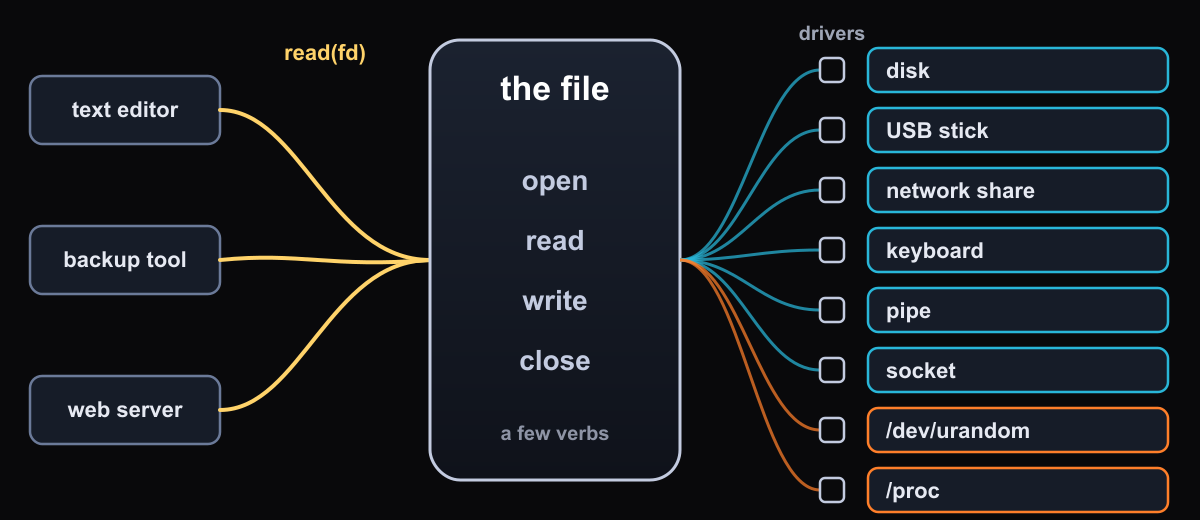
The strongest example in computing is the file. In Unix, and in Linux after it, a program that wants data opens a file and gets back a small number, a file descriptor, and from then on it reads and writes through that number with the same few calls. The program does not ask what is behind it. The bytes may come off a disk, a USB stick or a network share mounted from another continent. They may come from a keyboard, a terminal or a pipe from another program, or through a socket from a stranger’s machine. Some come from no stored thing at all: reading /dev/urandom returns bytes computed on the spot, /dev/zero returns an endless run of nothing, and the files under /proc are written by the kernel at the moment they are read, to describe the machine’s present state. Inside Linux a layer called the virtual file system hands each call to whichever driver owns that source, and a driver for a new kind of storage or a new kind of device can be added without changing the programs that read from it. Programs written decades ago read from sources that did not exist when they were written. The layer is thin, a handful of verbs, and that thinness is why it has lasted: it fixes what the caller may ask and leaves what answers entirely open.
Law and government have built such layers whenever a framework hardened faster than the world around it. In England the writs were an early example. By the fourteenth century a petitioner who could find no writ for his grievance had gone to the Lord Chancellor, and over centuries a second court grew out of those petitions, Chancery, which asked what was fair and issued remedies the common-law courts had no form for. Chancery was a layer between a rigid framework and the cases that didn’t fit it, and a thoroughly maintained one: it lasted until the Judicature Acts of 1873 to 1875 joined the two systems in one. The fictitious lessee John Doe was a smaller layer built for the same purpose.
The founders of the American states built layers on a similar principle and for a stated reason. James Madison, defending the Constitution in Federalist No. 10 in 1787, wrote that the effect of representation was “to refine and enlarge the public views, by passing them through the medium of a chosen body of citizens.” A pure democracy, in his sense, was a population that assembled and decided in person, and it could cover only as many people as could stand in one place and hear one speaker. Distance, time, literacy and numbers were limits, and representation was the layer between a people spread over thirteen states and a decision that someone had to make this month. The Electoral College was a second layer on top of the first. Whatever one thinks of either, they were designed against conditions of the 1780s, and the conditions have moved.
Layers being built
Several have been built in the last quarter century, some of them before AI, and each puts a layer between a person and a framework of the older kind.
In 2002 Germany’s Federal Agency for Civic Education put the Wahl-O-Mat online before that year’s federal election, adapted from the Dutch StemWijzer. It offered 27 theses, and a user answered agree, disagree or neutral on each, and the tool lined those answers up against what the parties had said about the same theses. It has been run for most German elections since, and tens of millions of uses have been counted. The thing sitting between the voter and the platform is a questionnaire, and the editors who write the theses choose which differences between parties will show.
In 2010 the Berlin branch of the German Pirate Party began preparing motions for its conferences in LiquidFeedback, software built by four developers in the previous year around what its users called liquid democracy. A member could vote on a question directly or delegate that vote to someone trusted, on that subject only, and take it back at any time, and delegations could be passed along a chain. The Berlin branch later amended its statutes to give the system’s assembly a formal place. Liquid democracy has the shape Madison described, representation as a medium through which views pass, but with a medium that each person can pick for each topic and replace at will.
The Taiwanese government worked in the summer of 2015 with the civic network g0v on a four-week Pol.is survey about how to regulate Uber, in which some three thousand participants voted on statements anyone could write. The software grouped people by how they voted and surfaced the statements that people on both sides of a divide agreed with, and these set the agenda for a live-streamed meeting at which Uber agreed to steps that included professional licensing for its drivers. What Pol.is did was make a crowd’s opinions into a space that could be mapped, something no person could do reading three thousand comments.
In 2024 a team at Google DeepMind reported in Science on a language model they called the Habermas Machine. Groups of participants each wrote their opinions on a contested question, and the model drafted statements meant to reflect the group’s common ground, which participants then rated. They preferred the model’s statements to those of human mediators. This is a layer that reads in both directions: it takes what each person says, and writes what the group might say.
What the layer would hold
A framework built for a person who reads one page at a time carries its structure on the surface: titles, sections, planks, a single subject per bill. What a model needs is different, and in the technical post I put it in a sentence: what shape is wanted, what must always hold, what may never happen, how fast, within what limits, and how anyone would know. Engineering drawings and SQL already work this way, stating the part or the rows wanted and leaving the how to the machinist or the engine. The sentence reads strangely like a description of a constitution. The shape is the structure of branches, and the invariants are the separations. The prohibitions are the Bill of Rights, “Congress shall make no law.” The limits are the enumerated powers and the budgets, and verification is judicial review and the audit.
A liquid framework in this sense would keep that short list fixed and let the long statute beneath it be generated. A city that wants to protect tenants from sudden eviction states the shape of the protection, the cases it must never break and the cost it can bear, and the text that comes out is fitted to that city’s housing stock, its courts and its fee schedule, as a state’s version of a national building code is fitted today by people who spend months on it. The same statement could produce a neighboring city’s version, differently, because the neighbors differ. This is the owned form with the copying and editing done by a model, and it brings the economics of local fitting close to the economics of copying. The case for local variation has always met one standing objection, that each place would have to write all of its own law. That objection weakens when writing is cheap and the stating of purposes is the work.
Advocacy has the same structure. A coalition now spends great effort on its platform, a list agreed upon line by line, because the platform has to survive being read by delegates, journalists and opponents, each with limited attention. A coalition held together by a paragraph of purpose, with a fitted platform generated for each audience and each locality, would be a different kind of organization, one whose members could see how their own concern appears in it, and whose opponents would have a harder time quoting a plank out of context, since a plank would be one of many possible expressions of the paragraph. It would also be harder to hold to account, and that is where the layer stops being simple.
Creating a neutral shell
The layers above each stand between a person and one framework. A different kind stands around two. Suppose two frameworks built on different assumptions both have a claim on the same thing, such as a city’s code and a state’s, or a party’s platform and a coalition’s. A person caught between them is read by one framework at a time, in its slots, and what the slots lack falls out. A neutral shell is an outer layer that takes the thing in once, by its stated purposes and its prohibitions, passes it through whichever framework applies, and brings back a single result, without either framework being rewritten to suit the other. It holds a few parts of its own, outside both: a stand-in for the person who entered, so that neither framework has to know more than the shell tells it, and a record of what each framework made of the thing, kept where the person can read it. The word neutral is the hard part. A shell owned by one of the frameworks is only another layer of it, as Chancery began as an office of the Lord Chancellor. A shell is neutral to the degree that neither side holds the pen on it, both can read it, and its own parts are as few as the work allows.
The person using a shell does not know what happens inside it and has no reason to care. A writer who saves a document does not ask whether it landed on a disk, a flash chip or a server in another city, and expects only that it will be there when opened. A resident who files for a permit, pays a bill or renews a license is in the same position, and the shell works when it behaves as the resident expects: the same steps, the same words, the same result, whichever framework sits behind it and however many are changed or swapped while the resident is not looking. The test of a neutral shell is that the person never has to learn which framework answered. The cost of that is borne by the record, since a resident who does not look inside must be able to, on the day the result is not what was expected.
A plain example is a government that keeps its tax rates exactly where they are and changes how the spending is structured. Taxes and spending are two frameworks with different readers. The tax side has its rates, its bases and its exemptions, each fought over and each watched by the people who pay it. The spending side has its agencies, categories and formulas, which almost no one reads. A fight over a change in either is a fight over both, because a proposal to restructure spending is heard as a proposal to raise or lower a tax. A shell around the two holds the rates fixed as a stated invariant, a promise that no one’s bill moves, and lets the spending beneath it be rebuilt: cash in place of categories, one account in place of twelve, formulas rewritten for the people they reach. The people who pay see no change in what they owe, so their guard stays down for the right reason, and the argument turns to what the spending does. That same arrangement carries the standing problem of every layer. Whoever writes the spending structure holds the pen, and a rate that never moves is a poor check on a structure that does, so the record of what was changed, kept where a taxpayer can read it, is what keeps the shell neutral.
What stays solid
Indirection has costs that run through each example above. John Doe worked because everyone knew he was fiction, and an occupant who didn’t understand the ritual could lose his land by ignoring a letter from a man who didn’t exist. In the Wahl-O-Mat the choice of theses shapes what voters learn. LiquidFeedback exposed which member had cast which vote, and the German Pirates argued over what it meant to have a ballot nobody could keep secret. A layer shifts power to whoever holds the pen on it, whether a Lord Chancellor, a committee of editors, or the author of a purpose statement from which a model writes law.
The same post ends on what stays hard, and some of it carries over directly. A framework is a shared vocabulary, so that an electrician called to a stopped line in the middle of the night can open a ladder program written by a stranger and follow the rungs, and a codebase assembled from its own description loses that unless the description is kept written and true. And a frozen rule is a discipline. A fluid one will agree to anything, including bylaws redrawn to suit whoever asked last.
The legal principles that people lean on assume text. A person is entitled to notice of what the rule is before being held to it. The Constitution bars ex post facto laws (Article I, Sections 9 and 10), and courts void a statute so vague that no one can tell what it forbids. A rule that is regenerated for each case, or for each person, offers no fixed text to be given notice of. The stated purposes and the prohibitions would have to be the part that doesn’t move, written in language a court and a citizen can read, and the generated layer beneath them would have to be one that can be shown on request, one rule, one case, one reading, to a person who wants to contest it. In the terms of Interfaces, the layer has a thickness, and it matters how thick it is and what it is made of.
That post called a frame shift the move that lets liberty work. A change in what reads the framework is a frame shift of a plain kind. The framework itself can stay, and what changes is who it is for. The writs were retired in 1852, and nobody has had to plead a fictitious lease since. Frederic Maitland, in lectures on them published in 1909, said of the forms of action that they had been buried, but still ruled the law from their graves.
Sources
- Ejectment and its fictions: Ejectment, Wikipedia; Common Law Procedure Act 1852, 15 & 16 Vict. c. 76, ss. 168-169; Illinois and Maryland abolitions as described in the case-law collections cited there.
- F. W. Maitland, Equity, Also the Forms of Action at Common Law (1909).
- Judicature Acts 1873 and 1875 (United Kingdom).
- California Constitution, Article IV, Section 9 (single subject); California Secretary of State, Proposition 54 (2016), title and summary; Ballotpedia, California Proposition 54 (2016).
- Henry M. Robert, Pocket Manual of Rules of Order for Deliberative Assemblies (1876); Robert’s Rules of Order Newly Revised, 12th ed. (2020).
- D. L. Parnas, “On the Criteria To Be Used in Decomposing Systems into Modules,” Communications of the ACM 15 (1972); Edsger W. Dijkstra, “Go To Statement Considered Harmful,” Communications of the ACM 11 (1968); Harold Abelson and Gerald Jay Sussman, Structure and Interpretation of Computer Programs (1985).
- Melvin E. Conway, “How Do Committees Invent?,” Datamation (April 1968); Frederick P. Brooks Jr., The Mythical Man-Month (1975).
- Alan Forester-Kaiser, Fluid Frameworks, rednaxus.com (November 12, 2026).
- The Federalist No. 10 (1787).
- Federal Agency for Civic Education (Bundeszentrale für politische Bildung), history of the Wahl-O-Mat.
- The History of LiquidFeedback; Marco Deseriis, Is Liquid Democracy Compatible with Representative Democracy? Insights from the Experience of the Pirate Party Germany, Partecipazione e Conflitto.
- vTaiwan case study, Computational Democracy Project; “The simple but ingenious system Taiwan uses to crowdsource its laws,” MIT Technology Review (2018).
- Michael Henry Tessler et al., “AI can help humans find common ground in democratic deliberation,” Science 386 (2024).
- National Civic League, Model City Charter (first issued c. 1900; later editions).
- California Building Standards Commission, California Building Standards Code (Title 24), triennial adoption cycle.
- U.S. Constitution, Article I, Sections 9 and 10, and the First Amendment (“Congress shall make no law”).
A note on how this piece was written: the subject, the idea that frameworks designed for human understanding must become liquid as AI becomes part of how things are done, and the layer of indirection as the way to do it are mine. Much of the research, the examples, and the sentences were drafted by an AI model working from that direction, and then edited by hand. I’d rather say that plainly than have a reader guess at it.