 Social Liberty
We The People
The phrase does enormous work by never specifying its own membership. It's worth asking what work it's actually doing right now.
Click to enlarge
Three words carry the entire weight of the American constitutional order, and none of the three does any defining. "We the People" names a sovereign without ever saying who belongs to it — not a list, not a franchise requirement, not even a plural noun with fixed membership, just a pronoun standing in for whoever the reader is willing to imagine standing behind it.
Splitting the Atom of Sovereignty covered what the document built on top of that pronoun — three separately real, separately enforceable layers of authority, all tracing back to the same root. This is about the root itself. Before asking which layer should hold which power, it's worth asking a harder question about the thing every layer claims to answer to: who is We, and are we certain it's the We we actually want deciding.
Who counted, and who didn't
The 1787 "We" was never as wide as the phrase implies, and it was constructed, not discovered. The document that opens with it also counted enslaved people as three-fifths of a person for apportionment purposes, while granting them no vote at all — a "We" that included some men's political weight while denying the same men political voice, counted for representation but not consulted about it.
It excluded women from suffrage as a matter of near-universal state law, not federal silence. It excluded Native nations explicitly — "Indians not taxed" sit outside the apportionment count entirely in Article I, a small phrase doing the same work Chief Justice Marshall's "domestic dependent nations" would later do: acknowledged as present, defined as outside. And in most states it excluded any man who didn't hold enough property to vote, well into the nineteenth century.
None of that membership was fixed by accident, and none of it stayed fixed. The story of the amendments that follow the Bill of Rights is, more than anything else, a story about renegotiating who "We" refers to: the Fourteenth extending citizenship and equal protection to the formerly enslaved, the Fifteenth barring race as a voting disqualification, the Nineteenth adding sex, the Twenty-Fourth striking down the poll tax that had quietly kept the freedman's vote conditional on his wallet, the Twenty-Sixth lowering the voting age to eighteen because a nation drafting eighteen-year-olds into a war had run out of principled reasons to also deny them a ballot.
Read as a sequence, the amendments aren't really a list of separate reforms. They're one long argument, run over two centuries, about the actual boundary of the pronoun in the Preamble — proof that "We the People" was never a fact about 1787, only a claim, one each generation has had to either ratify or renegotiate for itself.
That exclusion isn't only a documentary fact about the eighteenth century, either. It's still audible, in something close to its original form, whenever the third layer in Splitting the Atom of Sovereignty comes up in ordinary conversation:
I don't want to hear about indian sovereignty, all they want to do is open gambling houses and not pay taxes.
That sentence does exactly what "Indians not taxed" did in 1787 — acknowledges tribal nations exist, then reasons its way to dismissing the thing that makes them sovereign rather than subject, and even reaches for the same word the Constitution itself used to mark the exclusion.
Gaming and tax immunity are, in fact, two of the clearest live exercises of the sovereignty the speaker is impatient with, not evidence against it: California v. Cabazon Band of Mission Indians (1987) held that states couldn't regulate gaming on tribal land the way they regulated it off it, precisely because a reservation isn't state territory, and the Indian Gaming Regulatory Act that followed in 1988 built federal law around that same premise rather than against it; a tribe's own on-reservation economic activity is likewise generally outside state taxing authority for the same jurisdictional reason, not as a favor but as a consequence of being a separate sovereign at all. The complaint isn't really about gambling or taxes. It's the modern register of the same move the apportionment clause made two centuries earlier — count the presence, discount the standing.
The We that actually shows up
That's the historical answer to who counts on paper. It doesn't touch a quieter version of the same question: on any given Tuesday night, in any given hearing room, who is the We that actually speaks?
Beacon Hill's Interval Training described what happens when a state devolves a decision down to the municipal level — not a fourth sovereign in Kennedy's sense, but the state's own reserved power, handed down as policy, exercised at whatever public meeting the town happens to hold. What "the people" says, in that setting, is whatever the handful of residents who show up says, and what they say rarely sounds like political theory. It sounds like this:
I know you like native plants, but, you know, I'd rather not have to clean up acorns.
I don't see what's so important about having plants near streets, if streets can be made safe.
I like that government is very busy protecting us from fire, so what if a few million trees die.
People need housing, I like that they are trying to make housing be affordable.
I'm not against the new building, I just don't think it should be taller than what's already there.
Nobody asked me if I wanted more traffic on my street, so why should I have to live with it.
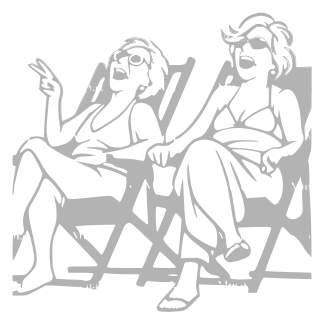
Six sentences, six different values, most of them in open tension with each other and none of them dishonest. Nobody in that room is lying about what they want.
But "the people" invoked to justify the outcome of that hearing is not the same entity as the sovereign invoked in the Preamble, even though both get called by the same name. The hearing-room We is a self-selected sample of whoever had a free Tuesday evening and a strong enough preference to drive to a municipal building and wait for public comment — filtered by free time, temperament, and proximity to whatever's at stake for them personally, not by any claim to represent the town, let alone the People the Constitution is talking about. Municipal home rule counts on that room's voice standing in for the town's. It's worth being honest about how thin a substitute that actually is.

Can an aggregate even know its own interest
Set the self-selection problem aside for a moment and grant the more generous case: suppose every resident of a town, not just the four who showed up, cast a fully informed vote on the tree ordinance. Would the tally then tell you what the town actually wanted?
Not automatically — and the reason isn't cynicism about voters, it's a structural fact about aggregation that Rousseau named directly. He distinguished the volonté générale, the general will — what genuinely serves the collective, considered as a whole — from the volonté de tous, the will of all, which is merely the sum of everyone's particular wills, added up. His claim was that the two can diverge, and diverge badly: a town's tree ordinance decided by summing four residents' private preferences about acorns, fire risk, and housing cost is a will of all, arithmetically real, but it carries no guarantee of being the general will — the outcome that actually serves the town considered as a whole, including the residents who weren't in the room.
Kenneth Arrow's 1951 impossibility theorem sharpened the same worry into a formal result a century and a half later: no method of aggregating individual preference rankings into a single collective ranking can simultaneously satisfy a short list of conditions that sound, individually, like bare minimum fairness — no dictator, respect unanimity, don't let an irrelevant third option flip the ranking between two others, and be able to produce some consistent collective ordering no matter what preferences go in. Every voting rule fails at least one of them.
That's not a design flaw waiting on a cleverer algorithm. It's a proof that "the People's preference," in the strict sense of a single coherent ranking that a vote reveals, doesn't reliably exist to be discovered at all — only a procedure that manufactures an outcome, with its own hidden thumb on the scale built into whichever rule was chosen.
There is a more hopeful result sitting right next to that pessimistic one, and it's worth holding both rather than only the convenient half. Condorcet's jury theorem, from 1785, shows that a large group voting on a binary question actually gets more reliable than any individual member as its size grows — but only under a condition doing all the load-bearing work: each voter's error has to be independent of everyone else's.
The moment that independence breaks — the moment a falsehood spreads through a shared feed, a shared church, a shared cable channel, and starts moving many minds together instead of separately — the theorem's guarantee inverts. Correlated error doesn't average out with scale; it compounds with it. A crowd that's wrong together gets more confidently wrong, not less, the bigger it grows. Whether an aggregate can know its own interest, in other words, was never simply a question of whether enough people show up. It depends on whether their errors are independent of each other — and that's exactly the condition a saturated, algorithmically curated information environment is best at destroying.
A sovereign that can be sick
Put the aggregation problem together with a second one and the picture gets worse before it gets useful: majorities aren't only structurally hard to read, they're also capable of being, in a fairly literal sense, unwell.
Madison made the diagnosis explicit in Federalist No. 10, writing that the "propensity of mankind to fall into mutual animosities" is "sown in the nature of man" and that faction — a group united by "some common impulse of passion, or of interest, adverse to the rights of other citizens, or to the permanent and aggregate interests of the community" — was among the diseases most incident to republican government. Not a bug introduced by bad actors. A predictable feature of what happens when human beings form groups at all.
Tocqueville, touring the young republic a half-century later, gave the same worry its most famous name: the tyranny of the majority, a majority that, precisely because it speaks in the name of the whole People, can silence dissent more completely than any single tyrant ever could, since there's no separate authority left standing to appeal to.
Neither man had to wait two centuries for a case study. Covid-19 supplies one on both sides of the diagnosis at once — first as a genuine external shock to the sovereign body itself, then as a demonstration of exactly the reasoning failure the previous section warned about.
As a shock, it was real and it was severe: over a million American deaths, hospitals rationing care, an economy paused by government order at a scale with no peacetime precedent. It was also, whatever else it was, a live stress test of the split-atom structure — the federal government issuing guidance it had no uniform way to enforce, fifty states running fifty different experiments in lockdown length, school closure, and business restriction, some diverging sharply from their own neighbors, with courts drawn in to referee the boundary in real time. South Bay United Pentecostal Church v. Newsom (2021) and Roman Catholic Diocese of Brooklyn v. Cuomo (2020) argued over how far a state's emergency police power — the same reserved authority Jacobson v. Massachusetts (1905) had upheld a century earlier for compulsory smallpox vaccination — could reach into a specifically enumerated First Amendment right before the split itself gave out. The architecture didn't fail, exactly. It did what it was built to do, producing fifty different answers under pressure instead of one — which is its own kind of answer to whether that's actually what a country wants during a genuine emergency.
The reaction was the sicker half of the case study, and it's the half that matters more for this piece's actual question. Mask-wearing, vaccine uptake, and even which treatments a person trusted sorted almost perfectly along preexisting partisan lines within a matter of weeks — not because two groups had independently reviewed the same evolving evidence and reached different conclusions, but because, for most people on both sides, the evidence was never actually independent of which tribe they already belonged to. That's Condorcet's condition failing in the most legible way it has failed in this country in a generation: correlated belief masquerading as individual judgment, at a scale and speed no eighteenth-century pamphlet could have produced. Official guidance made its own contribution — the reversals on mask efficacy, transmission routes, and surface cleaning were mostly honest updates on a genuinely new pathogen, but each reversal taught a certain kind of listener to trust their in-group's priors over the institution issuing the update, while it taught another kind of listener to treat every dissent as bad faith regardless of its merits. Both postures were forms of the same weakened judgment: neither was actually assessing the claim in front of it anymore, just its source.
Neither man was describing a hypothetical. Both were describing why the constitutional design treats the sovereign's own voice as something that needs checking, not just channeling. That's what the whole architecture in Splitting the Atom of Sovereignty is actually for, read this way: not only a division of labor between federal, state, and tribal authority, but insurance against the possibility that any one of those layers — including the People acting through any one of them, at any one moment — might be in the grip of a passing fever rather than a considered judgment.
A bicameral legislature slows a single chamber's temporary mood. Judicial review gives an individual a court to appeal to when a majority, however sincere, votes to take something the Constitution says isn't the majority's to take. The amendment process's supermajority threshold doesn't ask "what does the People want today" — it asks whether the People can still want the same thing after argument, time, and the friction of persuading three-quarters of the states one at a time. Each of those mechanisms is a quiet admission that the Framers didn't trust the undivided sovereign they'd just invoked in the Preamble, not fully, not without a second opinion built into the structure by design.
Are we certain it's the We we want
None of this is an argument for discounting popular government, and it would be a strange one for a site organized around social liberty to make. It's an argument for taking seriously a question the founding phrase itself never answers: every time some process invites "the people" to decide something — a hearing, a referendum, a comment period, an election — it's worth asking which We actually showed up, how it was selected, whether its stated preference is a stable interest or a passing temperature, and whether anything in the mechanism can catch the difference.
Sometimes the honest answer is that the room was representative enough, the preferences durable enough, the aggregation clean enough, and the outcome deserves the name it's given. Sometimes the honest answer is that four people with strong feelings about acorns produced a policy wearing the town's name, or that a genuinely large and engaged public arrived at its answer through a shared, correlated error rather than independent judgment, and the theorem that was supposed to make its size a virtue instead made its mistake bigger.
The Constitution split sovereignty three ways rather than leaving it whole, and the case for that design was never only administrative convenience. It was, at bottom, a bet that no single undivided voice claiming to speak for the whole People — however sincerely, however large the room, however confident the majority — should ever be trusted with the final word by itself. That bet included the sovereign the document was itself invoking in its own first three words.
Splitting the atom wasn't just cleverness about jurisdiction. It was the Framers' own answer to the question this piece is asking: not confidence that We would always know its own interest, but a structure built for the years it wouldn't.
Sources: U.S. Const. pmbl.; U.S. Const. art. I, § 2 (three-fifths and "Indians not taxed" apportionment clauses); U.S. Const. amends. XIV, XV, XIX, XXIV, XXVI; Jean-Jacques Rousseau, The Social Contract (1762) (the volonté générale/volonté de tous distinction); Kenneth J. Arrow, Social Choice and Individual Values (1951; rev. 1963) (the impossibility theorem); Marquis de Condorcet, "Essai sur l'application de l'analyse à la probabilité des décisions rendues à la pluralité des voix" (1785) (the jury theorem); James Madison, Federalist No. 10 (1787) ("sown in the nature of man"); Alexis de Tocqueville, Democracy in America, Vol. I, ch. 15 (1835) ("the tyranny of the majority"); Chief Justice John Marshall, Cherokee Nation v. Georgia, 30 U.S. (5 Pet.) 1 (1831); Jacobson v. Massachusetts, 197 U.S. 11 (1905); Roman Catholic Diocese of Brooklyn v. Cuomo, 592 U.S. 14 (2020); South Bay United Pentecostal Church v. Newsom, 593 U.S. ___ (2021); CDC and WHO public guidance revisions on masking, transmission, and surface disinfection, 2020–2021; Pew Research Center and Kaiser Family Foundation polling on the partisan divergence of Covid-19 attitudes and vaccine uptake, 2020–2022.