 Social Liberty
Cross-Filing
California once let a candidate win both parties' nominations, and for forty-six years party meant little there. This week Alaska may send Democrats to two statewide offices while Oregon might elect its first Republican governor since 1982.
Click to enlarge
In 1946, Earl Warren ran for reelection as governor of California and won the Republican primary. He also won the Democratic primary. On the general election ballot, he was effectively unopposed by either party. A 1913 law, written under Hiram Johnson’s Progressives to break the grip of the party machines, allowed any candidate to file in any party’s primary, and for decades the ballot didn’t even say which party a candidate actually belonged to. Warren was one of many officials to take both nominations that year.
Cross-filing is gone from California, but the Pacific states still carry its habit of treating parties as optional. Alaska uses an open primary and ranked-choice general elections. Washington and California send the top two finishers to November regardless of party. If the country is really seeing a switchover from its traditional party alliances, with Democrats making inroads over a war, the economy, and a perception of plain corruption, the Pacific ought to show it first, and in the most interesting forms.
It shows it in both directions. On the same Tuesday, Alaska could elect a Democratic senator and governor, and Oregon could elect a Republican governor for the first time in over forty years. What Sacramento Is Deciding began this collection of essays’ reading of state capitals in August, and Councils of the US 2026 placed the region on the map.
Alaska: the northernmost inroad
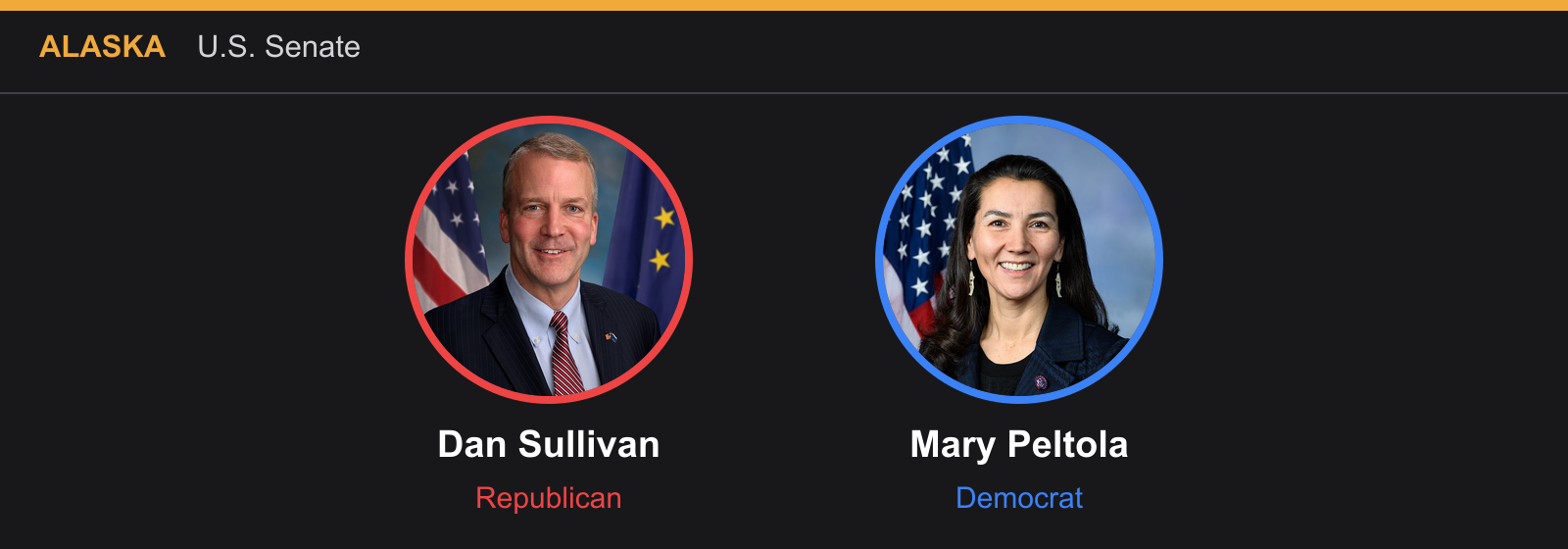 Photos: Dan Sullivan, United States Senate, public domain; Mary Peltola, Leah Herman, House Creative Services, public domain.


Trump won Alaska by about thirteen points in 2024. Former Rep. Mary Peltola, a Yup’ik Democrat with a record of winning Alaskans who vote Republican for most other things, is challenging Sen. Dan Sullivan, and nearly every recent survey has them within a couple of points. PollCheck’s average has her at 47 to 44. Data for Progress had Peltola 51 to 49 on October 20. Alaska Survey Research, on October 7, had her 51 to 49 after the ranked count. InsiderAdvantage had her 50.1 to 48, and Quantus had a 46-46 tie, and Trafalgar, in late September, had Sullivan by one. Political Wire summed up the month’s Alaska polling as three tight races.
If Republicans lose North Carolina and one or two others, this seat may determine whether they’ve lost three or four. Ranked-choice tabulation doesn’t happen until November 18, so if nobody clears 50 percent on the first count, control of the Senate could depend on a count two weeks after everyone else has gone to bed.
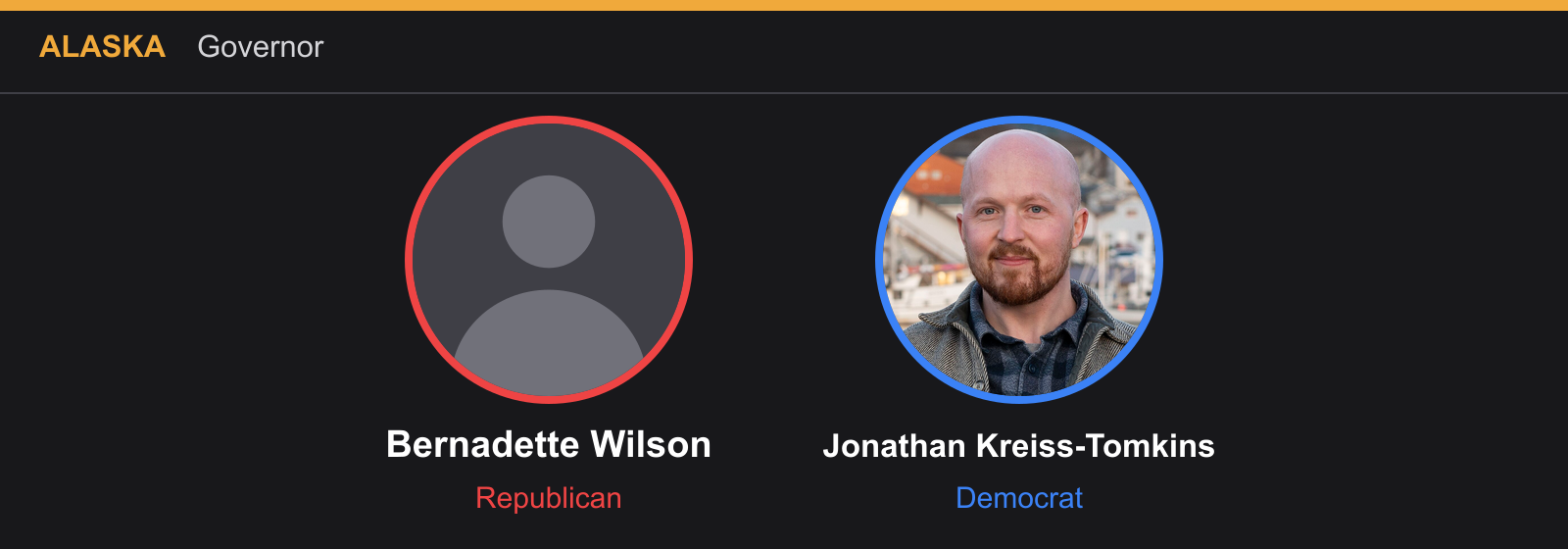 Photos: no freely licensed photo of Bernadette Wilson was found; Jonathan Kreiss-Tomkins, unknown author, CC BY-SA 4.0.

Gov. Mike Dunleavy is term-limited, and the race for his seat has drawn seventeen candidates. Former state Rep. Jonathan Kreiss-Tomkins, a Democrat from Sitka, leads Bernadette Wilson, a Republican business owner, 54 to 46 in an Alaska Survey Research ranked count, and 52 to 48 in the Times/Siena poll in late September. Wilson has spent weeks calling on her Republican rivals to drop out, arguing that many voters who favor Republicans don’t rank all of them. That complaint is a precise description of how a party loses its hold when the ballot stops enforcing it.
Ballot Measure 2 would end the system entirely and return Alaska to partisan primaries. Its 2024 predecessor failed by fewer than eight hundred votes. So voters on Tuesday are choosing, in the same booth, between candidates and whether they want to keep choosing this way. Peltola’s first win, in 2022, came under this system, and repeal has drawn its strongest support from Republicans, Gov. Dunleavy among them.
Oregon: the inroad running the other way
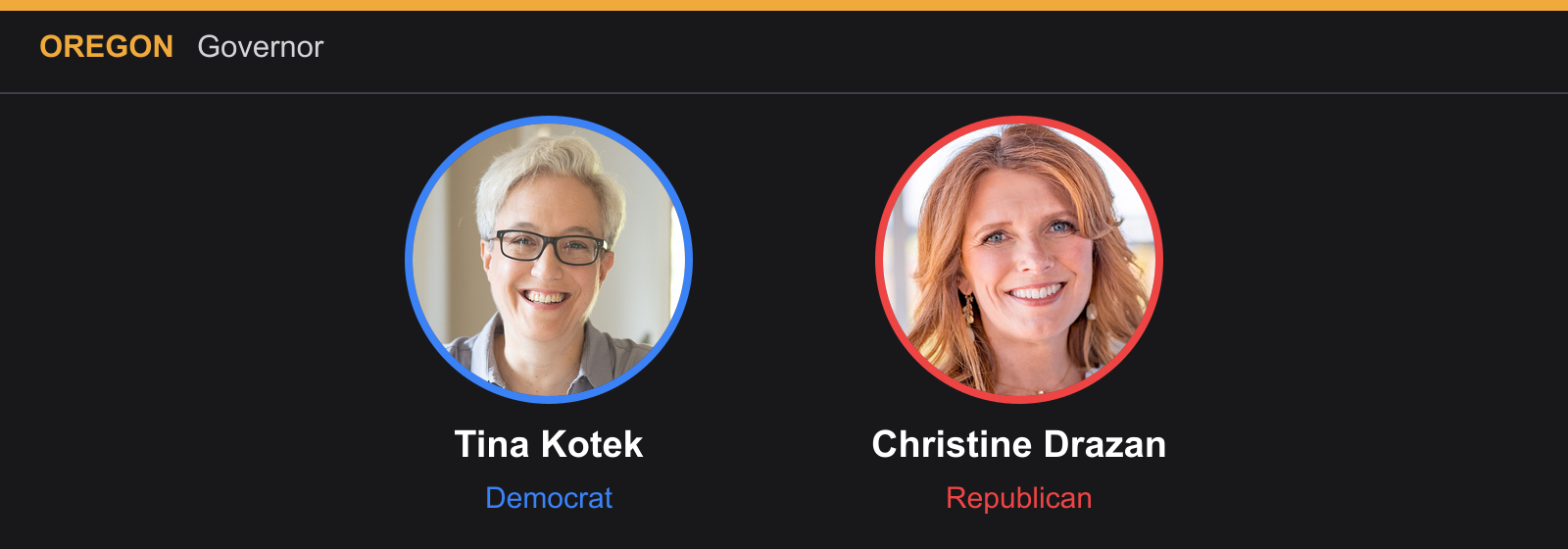 Photos: Tina Kotek, Tony Miller, public domain; Christine Drazan, Oregon State University, CC BY-SA 2.0.


Oregon voted for Harris by about fourteen points and hasn’t elected a Republican governor since 1982. Gov. Tina Kotek is in real danger of losing to state Sen. Christine Drazan anyway. OPB’s poll at the end of September had Drazan up 46 to 44. An Oregonian/DHM Research poll a week later had Kotek up 46 to 44, and Kotek’s internal poll had her up 46 to 42. PollCheck’s average on October 27 was Kotek 45.8, Drazan 44.5, with Brett Smith of the Green Party at 4.2. In the 2022 race, polls favored Drazan for much of October and then shifted, and Kotek won by 3.5 points.
The most striking number in the OPB poll is that Kotek’s favorable rating was 38 percent, and Trump’s in Oregon was 37. Her internal poll put Trump at 29. Voters in this state plainly don’t care for the president. Drazan’s campaign is built on complaints about their own government, arguing that Kotek hasn’t improved housing, student achievement, or the economy under a party that has held the office since the 1980s.
This is the case that complicates the rest of the region. A national mood can’t explain Oregon. People appear to be punishing whoever is in charge, and where the Democrats are in charge they get punished too. If Drazan wins while Peltola wins, then what moved this year was less an alliance toward one party than a willingness to leave whichever one owned the problem. A Green at 4 percent may also be the difference in a state where Democrats need every left-leaning ballot, which is the Montana problem turned around.
Washington: both candidates running from their parties
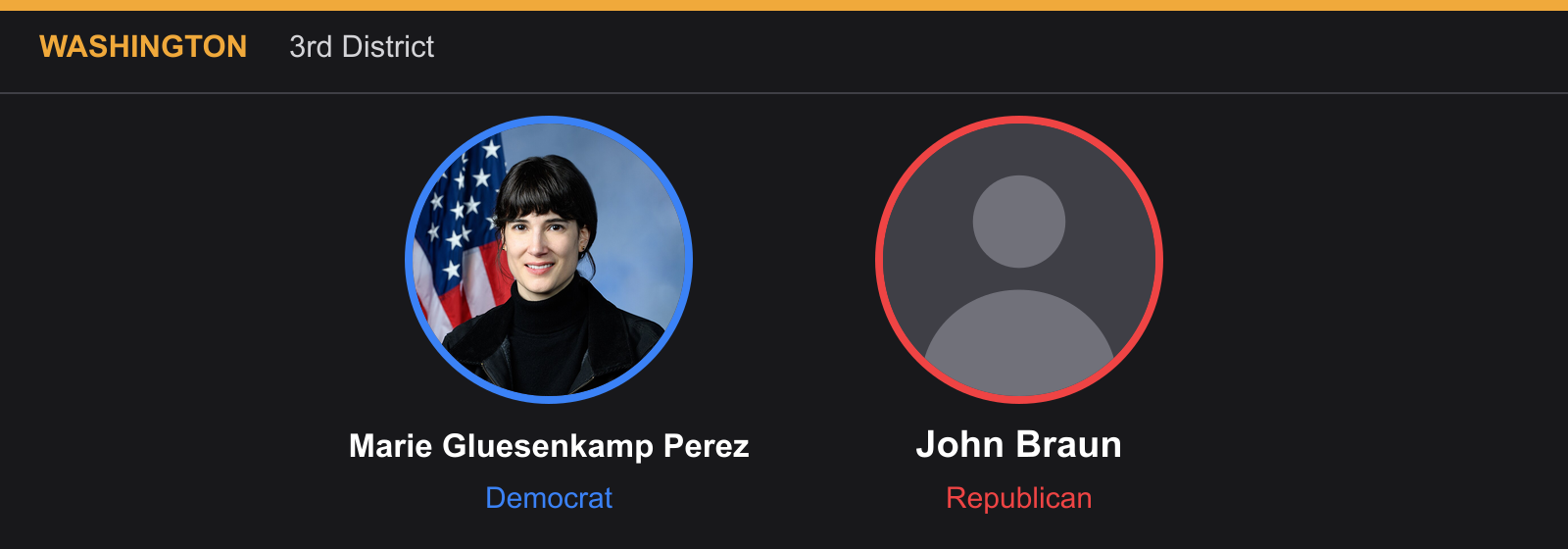 Photos: Marie Gluesenkamp Perez, U.S. House of Representatives, public domain; no freely licensed photo of John Braun was found.

Southwest Washington’s 3rd has voted for Trump three times, each by single digits, and Rep. Marie Gluesenkamp Perez, an auto shop owner, holds it as a Democrat. She edged state Senate Minority Leader John Braun by 263 votes in the top-two primary in August. OPB’s DHM poll in late September had Braun up 46 to 44, and 48 to 47 with leaners. Both candidates are emphasizing their independence from their parties. Her list of priorities includes small business, rural health care, and ending the Iran war, which isn’t something you often hear from a Democrat in a Trump district. Braun’s is taxes, policing, and domestic energy, with Trump’s endorsement behind him. Pollster John Horvick describes him as a “more establishment” candidate than Joe Kent, who lost to her twice.
Every likely voter in the poll, 100 percent, called the economy and cost of living very or somewhat important. Eighty-eight percent said they had little or no confidence that Congress will make progress on issues they care about. In a district that’s really up for grabs, that’s the mood in which both parties have to operate.
California: a map, a tax, and an afterthought
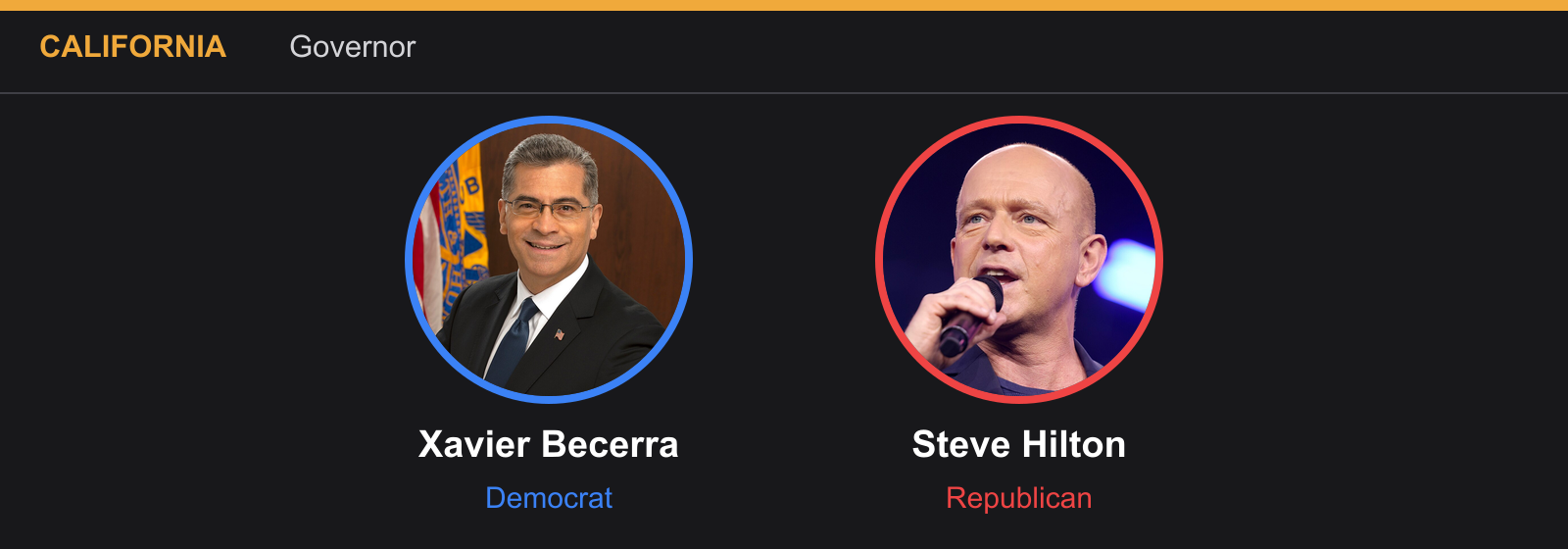 Photos: Xavier Becerra, United States Department of Health and Human Services, public domain; Steve Hilton, Gage Skidmore, CC BY 2.0.


The governor’s race is the least suspenseful in the region. Xavier Becerra leads Steve Hilton by a very wide margin, 61 to 37 in PPIC’s poll and 60 to 33 in Emerson’s. Hilton, a former adviser to David Cameron and a Fox News host, got into the top two under a primary that’s a distant relative of cross-filing.
The real news has already happened. Proposition 50 passed last November and let Democrats redraw the map to offset Republican gains in Texas. Rep. Darrell Issa retired in March. Republican Reps. Young Kim and Ken Calvert are fighting each other in the new 40th, in the top-two system’s starkest form. Rep. David Valadao’s Central Valley seat grew more Democratic, in a district that also saw heavy Latino movement to Trump. Whatever inroads Democrats gain in California on Tuesday will be hard to separate from the map.
The ballot measures may be more telling about alliances. Fourteen statewide measures are on the ballot. Proposition 40, the one-time tax on billionaires, had the support of 54 percent of likely voters in May, and by PPIC’s late October poll had dropped to 46 with 52 opposed, after nearly $400 million in spending on it and two rival measures. Prop 41 and Prop 42 could block it if they get more yes votes. Prop 43 would raise the threshold for citizen-driven tax initiatives. Voters who are about to give a Democrat a twenty-point win for governor may also reject a sharply redistributive idea. Those two facts sit fine together in California, and they’re a useful reminder that a vote for a party isn’t a vote for its program.
Forty-six years without a label
Cross-filing lasted from 1913 to 1959. It came from a real grievance, since the Southern Pacific Railroad had run California’s Republican Party for a generation, and the Progressives wanted to make party machinery too weak to sell. It worked. California parties became unusually feeble, candidates won on name and reputation, and incumbents of both parties collected each other’s nominations. William Knowland won both parties’ Senate nominations in 1952.
It also had a clear victim. A party in the minority, and in those years that usually meant California Democrats despite their registration edge, couldn’t get its own label attached to its own candidates. After Knowland’s win Democrats tried to abolish the practice, and Republicans countered with a measure that kept cross-filing but required party labels on the ballot. The Republican measure won in 1952, and it marked the beginning of the end. As soon as voters could see the labels, they started using them. Democrats won power in 1958, and they abolished cross-filing the next year.
That sequence is a useful thing to remember in an Alaska voting booth. The parties’ strength had always been something voters were willing to set aside as long as it wasn’t on the page. Once the page named the alliance, many voters obeyed it. Washington’s blanket primary, Oregon’s long fascination with independents, and Alaska’s ranked ballot are all efforts to loosen the same thing, and they’ve all had opponents who benefited from tightening it.
A switchover, in that light, also depends on what the ballot allows. A Montana voter who wants to leave Republicans has to guess between two exits. An Alaska voter can rank both. A California voter gets two Democrats in some districts, and an Oregon voter who is angry at a Democrat has a Republican to go to. If there’s a general shift in party alliances this year, each state’s rules will determine how much of it can be seen and how much of it reaches an office.
What to read on Tuesday night
The Pacific closes last. Oregon votes by mail, with results beginning at 8 p.m. Pacific, and Washington’s late ballots often move toward Democrats in the days after. Close California races take weeks. Alaska’s polls close at midnight Eastern and 1 a.m. in the Aleutians, and its final count is November 18.
So this region may be the last word on the Senate, and it won’t be fast. In the meantime, the number to find is Multnomah County’s share of Kotek’s total, and how far Clark County, Washington, differs from 2024. The Measure 2 result in Alaska will say whether the voters who made the state’s politics strange want to keep it that way. Warren’s own voters would have recognized the question.
Sources: Wikipedia, Cross-filing; Political Wire, Three tight races in Alaska and Kreiss-Tomkins leads in Alaska governor’s race; Anchorage Daily News, Wilson again calls on her Republican opponents to drop out; Alaska Public Media, What to know about Alaska’s general election; Ballotpedia, U.S. Senate, Alaska election, 2026; OPB, New polls: Kotek may lead, OPB poll shows Oregon governor’s race virtually deadlocked, and Gluesenkamp Perez and Braun in Southwest Washington’s 3rd District; PollCheck, Oregon governor; Washington State Standard, Poll shows Gluesenkamp Perez and Braun neck-and-neck; PPIC, Californians and Their Government, October 2026 and 2026 election preview; CalMatters, California governor race final stretch; CPA Practice Advisor, Poll: California billionaire tax loses majority support; LAist, Proposition 50 just rewrote California’s 2026 congressional map; CBS Los Angeles, Republican showdown in California’s new 40th.