 Social Liberty
Five Centuries Under One Crown
A live oak that germinated in 1526 is still standing. The tree has outlived every institution that might vote to remove it — until now.
Click to enlarge
Sapling when Copernicus published and the Mughals rose. Young when Jamestown was planted. Mature when the United States and Haiti declared independence, before the human expansion westward. Ancient through Darwin, two world wars, the moon landing, the web, and a pandemic — and still living. Live oaks commonly live 500 to 1,000 years.
Somewhere in the American South, or on a chaparral hillside in California, there is very likely a live oak — one of a handful of evergreen Quercus species that share the name for their wide, low, spreading crowns — that was already a sapling when Copernicus published, already young when the Mayflower landed, already mature when the United States and Haiti both declared independence within thirty years of each other, and already ancient before Darwin, both world wars, the moon landing, or a global pandemic had happened.
The southern live oak, Quercus virginiana, is the one usually pictured with Spanish moss hanging off a plantation-house lawn, and the species commonly lives five hundred to a thousand years — as long as ten human lifetimes laid end to end. California's own live oaks keep the same company: canyon live oak (Quercus chrysolepis), tucked into foothill drainages up and down the state, routinely reaches into that same five-hundred-plus range; coast live oak (Quercus agrifolia), the species draped over coastal towns and canyons from the Bay Area to the border, is more typically counted in centuries than millennia, but its own venerable specimens are documented well into that same company.
A live oak germinating today, on either coast, by design and evolution, has a plausible shot at watching the twenty-sixth century arrive the way this one watched the twenty-first — and at only being half done.
That span is not a curiosity. It's a unit of measurement, and it's worth holding next to the unit of measurement a city actually uses when it decides what to do with one.
What the tree is a unit of
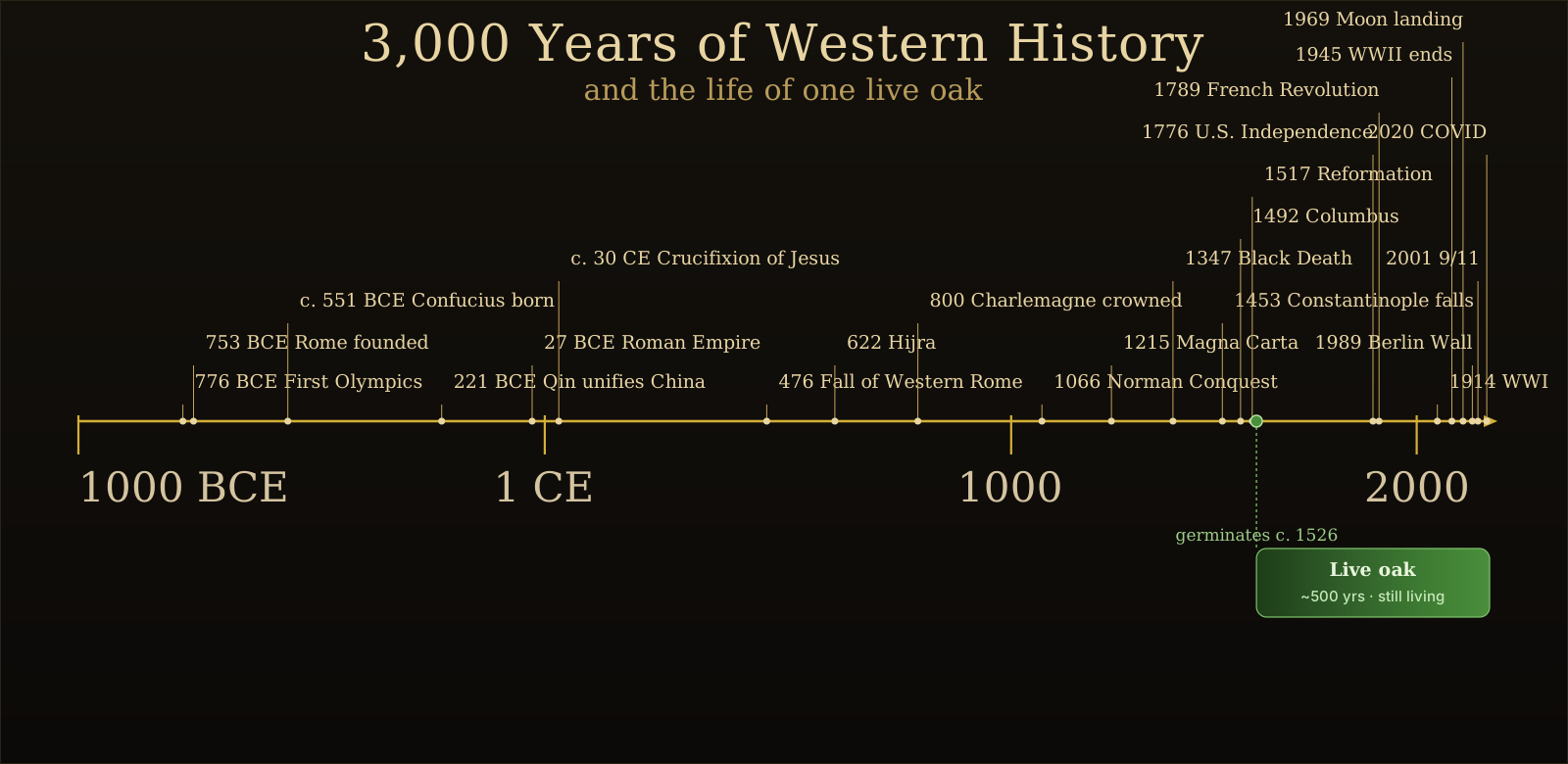
Scale is linear: the oak's first 500 years occupy roughly the rightmost sixth of this 3,000-year line, and it's likely only at its own midpoint.
Set against 3,000 years instead of just its own 500, the tree gets smaller and the point gets sharper. The oak's whole life — germination to now — occupies roughly the rightmost sixth of written human history.
Our human lifetime is roughly one of ten a live oak may live through. A single term of elected office is roughly a two-hundredth of it. A municipal department's risk-management review, the kind that actually produces the memo recommending removal, typically covers a window measured in months.
Every institution capable of authorizing a chainsaw for one of these trees operates on a clock that is, relative to the tree, close to instantaneous — and every one of those institutions is, not coincidentally, the one being asked to weigh a diffuse, multi-century, mostly unbillable value against a specific, immediate, potentially billable liability. How can we not fail?
That asymmetry isn't unique to trees. Fire Policy already traced the same shape in a different ecosystem: a management doctrine — total wildfire suppression — that looked unambiguously correct on the timescale of any single fire season and produced, over the accumulated century nobody was managing for, exactly the catastrophic outcome it was built to prevent.
The common failure isn't malice or even incompetence. It's that "safety," measured against this year's incident report, is a fundamentally different quantity than safety measured against the multi-generational record a five-hundred-year-old tree is a physical instance of — and only one of those two measurements has a budget line, a legal department, and a name on the memo if it goes wrong.
The unreachable honest version of the risk
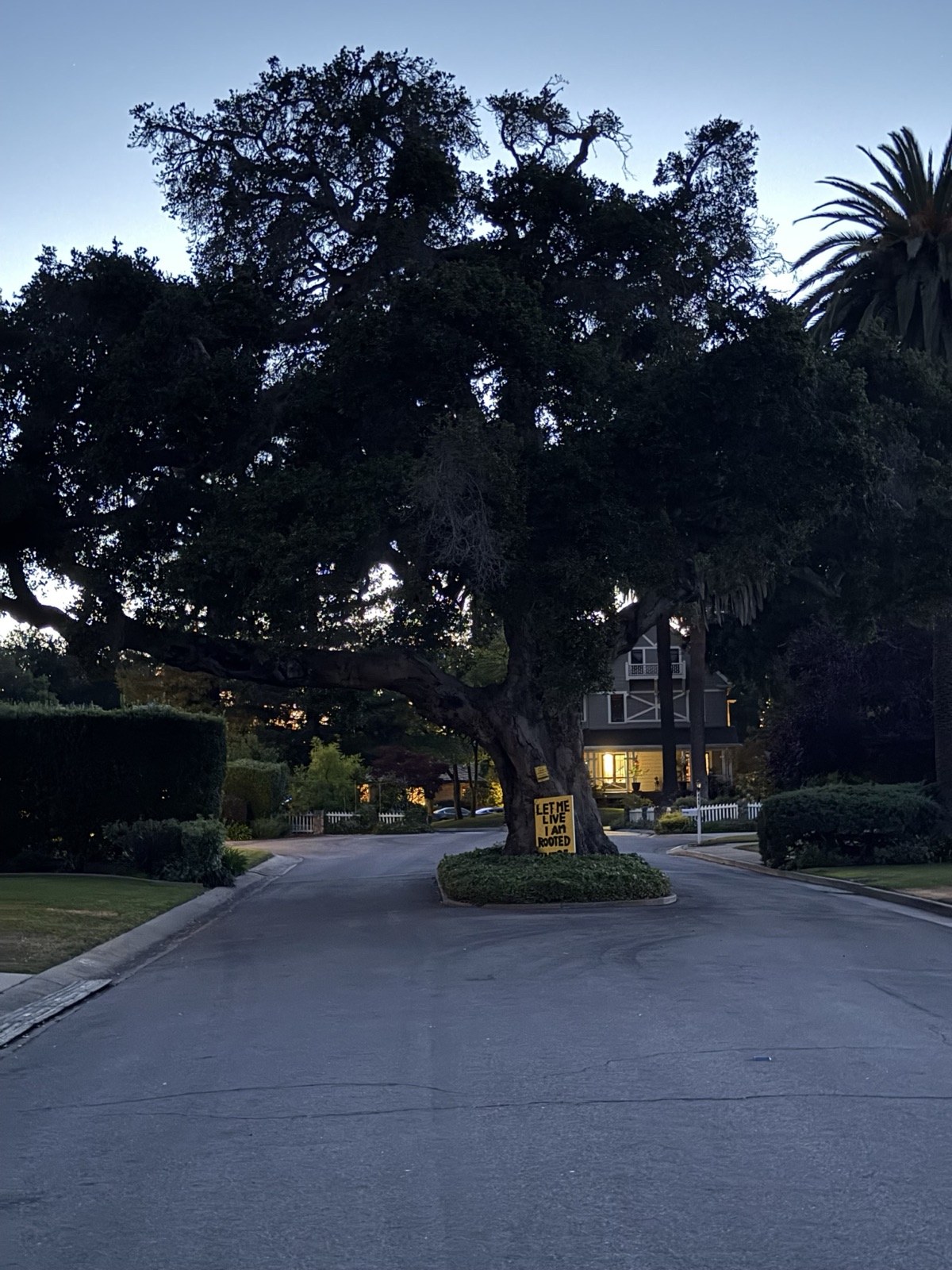
Live Oak to be "removed" by the Los Altos municipality for "safety" — the idea of killing a healthy 500-year-old life that predates the nation for our fashions of perceived notions of safety.
None of this is an argument that a live oak can never be a hazard. Trees fail. Included bark, root rot, storm-compromised limbs, and decades of soil compaction from the sidewalk poured six inches from the trunk are all real, and a genuine structural risk assessment sometimes really does conclude that a specific tree, in a specific condition, over a specific target — a playground, a road, a row of parked cars — needs to come down. An arborist's job is to tell that story from the wood and the crown, not from the calendar.
What deserves scrutiny isn't tree removal as such. It's a specific, very common substitute for that assessment: treating the mere existence of any residual risk as sufficient justification, without asking whether a live oak standing in a park has ever, at any point in its five centuries, presented zero risk to anyone under it — and without weighing the answer against what mitigation short of removal was actually available.
A heavy government is not a loving government; death and finality is more often the choice than life and stewardship. Real care -- crown reduction, cabling major limbs, restricting a hazard zone during storms, seasonal monitoring, and simply moving the thing underneath it — a bench, a parking spot, a trail — are all cheaper and less irreversible than a stump, and a genuine risk-benefit analysis has to at least price them before defaulting past them.
It rarely gets priced, because the institution doing the pricing faces a lopsided bet, and is especially bad at ongoing care for anything. A tree that's destroyed generates no lawsuit, no news story, no city council special session, ever, for any reason. A tree that's preserved and cared for and later drops a limb on someone generates all three, and the plaintiff's attorney in that hypothetical future case will have no trouble finding a paid arborist willing to testify, after the fact, that some risk was foreseeable — because with a mature tree, some risk is always foreseeable, in exactly the way some flood risk is always foreseeable in a floodplain.
The asymmetry isn't "safety versus liability." It's "a five-hundred-year cost, diffuse and unbillable to anyone in particular" against "a five-year cost, concentrated and billable to the specific person who signed off." A risk-averse parks director facing that trade isn't behaving irrationally by leaning toward removal. They're behaving exactly the way anyone would who's personally exposed on one side of the ledger and not the other — the same diffuse-cost, concentrated-cost mismatch that shows up whenever the person weighing a decision doesn't bear the full weight of getting it wrong in either direction.
None of this runs on vague institutional vibes. It runs on an actual insurance and liability apparatus, and that apparatus has a documented paper trail as its raw material. The moment a municipality commissions an arborist's risk assessment, that report itself becomes evidence: a written record that the city knew.
From that point forward, every day the tree is left standing is a day the city's own insurer or risk pool can point to as documented, foreseeable risk left unaddressed — which is a materially worse position, actuarially and legally, than never having commissioned the report at all.
Insurance underwriting doesn't price "we did a nuanced cost-benefit analysis and chose monitoring." It prices "known hazard, mitigated" versus "known hazard, outstanding," and only one of those two answers is removal. A risk pool's incentive isn't public safety in any full sense; it's minimizing the specific, itemizable claims a specific insurer might have to pay, and a live tree can only ever be a line item on the liability side of that ledger, never the asset side, because nothing about what a five-hundred-year canopy is worth to a neighborhood shows up on an actuarial table.
That's what makes the culture of death self-terminating only in the most literal sense: it doesn't stop until it runs out of trees. There's no version of the assessment that ever certifies a mature tree "safe" in the way that ends the exposure, because age itself is the risk factor being measured, and age only accumulates.
There's no version of the assessment that has a category for beautiful or soulful or sublime. The logic that removes one five-hundred-year-old live oak this year will, on identical premises, remove the next one, and the one after that, for as long as any specimen old enough to have outlived its own paperwork is still standing.
It isn't a policy that manages risk to some acceptable equilibrium according to core notions of human value. It's a policy that can only fully succeed, on its own terms, once every tree old enough to be dangerous has already been cut down — a stopping condition indistinguishable from the thing having killed everything it was ever going to kill.
At best all this structural determinism (it's nobody's fault) serves as strong arguments for not giving it power in the first place.
Two cultures, and only one gets to call itself safe
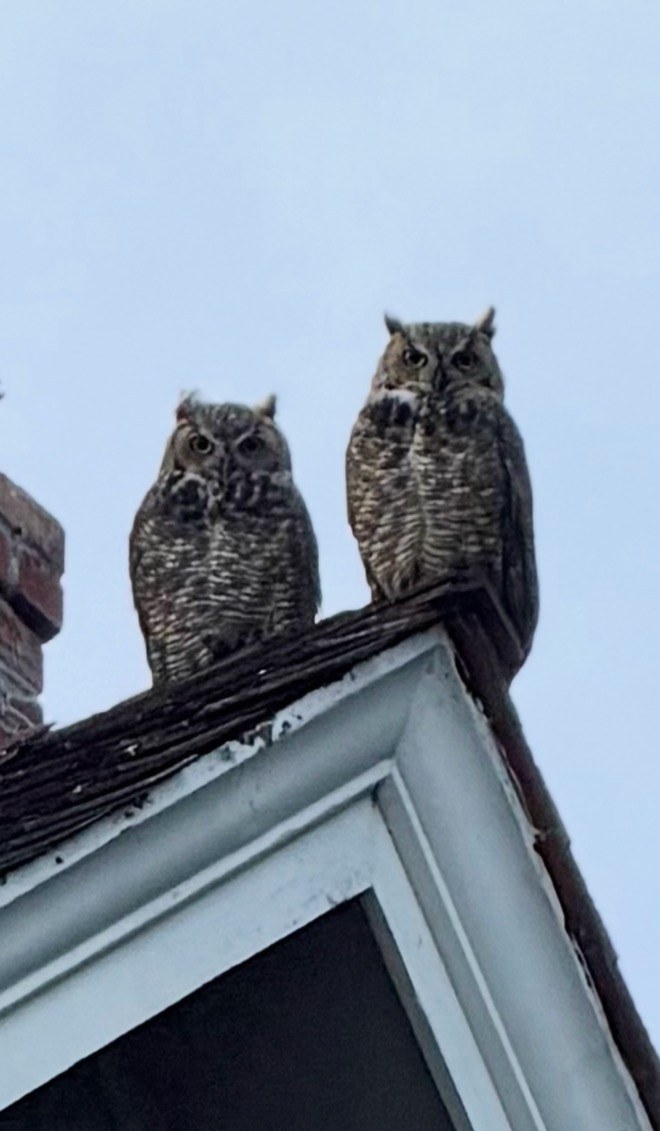
A five-hundred-year-old tree isn't a single life on the ledger. It's a habitat — the reason a pair of great horned owls has a place to roost at all. A risk memo prices the tree. It never prices them.
Every institution that manages living things eventually settles into something closer to a disposition than a policy — a default lean it falls back on whenever the paperwork runs out before the judgment does.
Moral philosophy has had names for the two poles of that lean for a long time: a culture of life, which treats continuity as the thing that needs no further justification and destruction as the thing that has to earn its case, and a culture of death, which inverts it — treating removal as the default, liability-minimizing, professionally defensible action, and continued life as the exception that has to keep re-justifying itself, tree by tree, budget cycle by budget cycle, forever.
A private landowner can lean either way and the consequences mostly stop at their own fence line -- and is limited to scale by the value of force needed to accomplish the perceived intention.
A bloated government has no such natural limits. Its decisions apply at the scale of every tree in every park it manages, generation after generation, under whichever administration happens to be holding the risk memo that year — which means whichever culture a parks department defaults into isn't a one-time judgment call, it's a standing policy that outlives everyone who set it.
And the incentive already described above doesn't just tilt any single decision toward destruction. It trains the whole institution, over enough of these decisions, to treat the culture of death as the responsible-sounding default and the culture of life as the one that requires some individual employee to personally absorb a risk that removal would have made someone else's problem, or no one's at all.
The culture of death even has its own house style. Look at the verb a public agency actually files: a tree isn't killed, isn't destroyed, isn't even cut down — it's removed, the same bloodless word a public works crew would use for a fallen branch, a rusted guardrail, or a dead rat.
Rats are destroyed. Trees are removed. The choice of verb isn't an accident of bureaucratic style; it's the culture of death doing what euphemism always does, which is take an action nobody would defend in plain language and rename it into one nobody has to. "Removed" describes a piece of municipal inventory being relocated.
It does not describe ending five hundred sublime years of continuous life, of its meaning to the land or the people. A government agency that reaches for the first phrase instead of the second has already decided, before any risk assessment gets written, which side of the argument it's not going to have to make out loud.
That's the real danger, and it has nothing to do with whether any particular memo about any particular tree happens to be right. It's that once a government lets destruction become the institutionally safe answer, destruction stops being weighed against preservation on the merits at all. It becomes the null hypothesis — the option nobody inside the institution has to defend — and the burden of proof quietly, permanently shifts onto the thing that's still alive.
A government is supposed to be the one actor in this story answerable to everyone the decision touches, including the people five centuries from now who won't get a vote on whether their live oak existed. That's precisely why it can't be allowed to have a side, and precisely why, left to its own incentives, it will keep finding itself on one anyway.
What actually gets lost
Five centuries of undisturbed growth and incredible survival through years of drought and abundance to produce a tree like this. It takes a government crew exactly one day to extinguish that entire span of history on the land where it stood — a chainsaw doesn't work at the tree's pace, it works at the budget's, and the asymmetry between how long a thing takes to become irreplaceable and how briefly it takes to make it gone is precisely the asymmetry no risk memo is required to mention.
The case for keeping a tree like this standing is not entirely about the tree. It's about what a five-century organism and memory of this land does to the argument that any particular political moment's judgment should be final. A live oak that was mature when the Constitution was ratified is a standing rebuke to the idea that whatever a given decade finds inconvenient, unsightly, litigation-adjacent, or merely in the way of a repaving contract is thereby disposable — because the tree is direct physical evidence that almost everything else which felt urgent and permanent across its lifetime wasn't.
Empires it predates have dissolved. Wars it witnessed have ended and been mostly forgotten by everyone but historians. The oak tree is still here.
A municipality that removes a demonstrably healthy specimen of one of these trees because a generic risk memo said "trees can fail" isn't making a safety decision in any meaningful sense — it's discharging institutional liability onto the one party in the transaction with no standing to object and no next election to lose.
The correct question was never "can this tree, in principle, ever hurt someone." Every tree can. It's whether this tree, assessed on its actual condition by someone qualified to read it, poses a risk that mitigation can't responsibly manage — weighed honestly against the fact that whatever gets planted as a replacement will not be five hundred years old again for five hundred years, and the city council approving the stump grinding will be a rounding error in its life, the way every city council for the last five centuries already has been in this one's.
This, finally, is why a story about one tree belongs on a site about social liberty rather than a gardening column. Authoritarianism has never strictly required a human victim; what it requires is an institution that has arrogated to itself the unaccountable power to end a life — any life, animal, vegetable, or human — because the paperwork is easier than the alternative and no one with standing can make it answer for the choice.
A government that can walk up to something five hundred years old to destroy it without batting an eye, something that predates its own charter, its own constitution, and every official who will ever sign the work order, and end it by memo, without appeal, without having to name a beneficiary, is exercising exactly the kind of power a free society is supposed to have specifically withheld from it.
Social liberty, in the sense this site keeps returning to, isn't only a claim about what one person may do free of another person's coercion. It's a broader claim about what no concentration of power — including a democratically elected one — gets to do simply because it can and because the thing on the other end of the decision has no vote, no lawyer, and no lobby: the right of a living thing to go on living being the least controversial right there is, right up until the moment an institution decides enforcing it is inconvenient.
A live oak that has outlasted the nation itself is not a mascot for that argument. It's the argument, standing peacefully in a quiet cul-de-sac, still alive only because it hasn't been gotten to yet.
Featured in Land Trusts and Liberty and Municipal Social Liberty