 Social Liberty
Once-Safe Ground
Kansas, Iowa, and Nebraska were states Republicans stopped worrying about. Discontent with the president, the Iran war, and his reach for power have made all three close enough that a Libertarian's three percent could decide them.
Click to enlarge
On October 27 the Associated Press reported that Republicans fear Libertarian candidates could cost them the United States Senate. The party holds fifty-three seats and can lose three and keep control with Vice President JD Vance breaking ties. The AP named four states where a few points for a third party could decide a razor-thin race: Ohio, Texas, Kansas, and Iowa. Party strategists told the AP that unhappiness with President Trump, an unpopular war with Iran, and his expansion of executive power had given the Libertarian message of nonintervention and limited central authority an audience among conservatives looking for a protest ballot.
Two of those four states are on the plains. What the Plains Decided Not to Change found the West North Central states, North Dakota, South Dakota, Nebraska, Kansas, Minnesota, Iowa, and Missouri, running quiet experiments in how much consensus a government needs. On November 3 the region votes in three Senate races close enough to decide the chamber and a fourth that’s closer than its lean, plus a set of ballot measures that ask, in several different forms, how hard it should be for citizens to change their own constitutions.
What November Reassembles sorted the Great Lakes by who draws the lines, and Lines Already Drawn found the South’s lines settled in May. The plains question is whether a region Republicans have long counted as theirs still is, and how little it would take to lose it.
Kansas: three percent and a tie
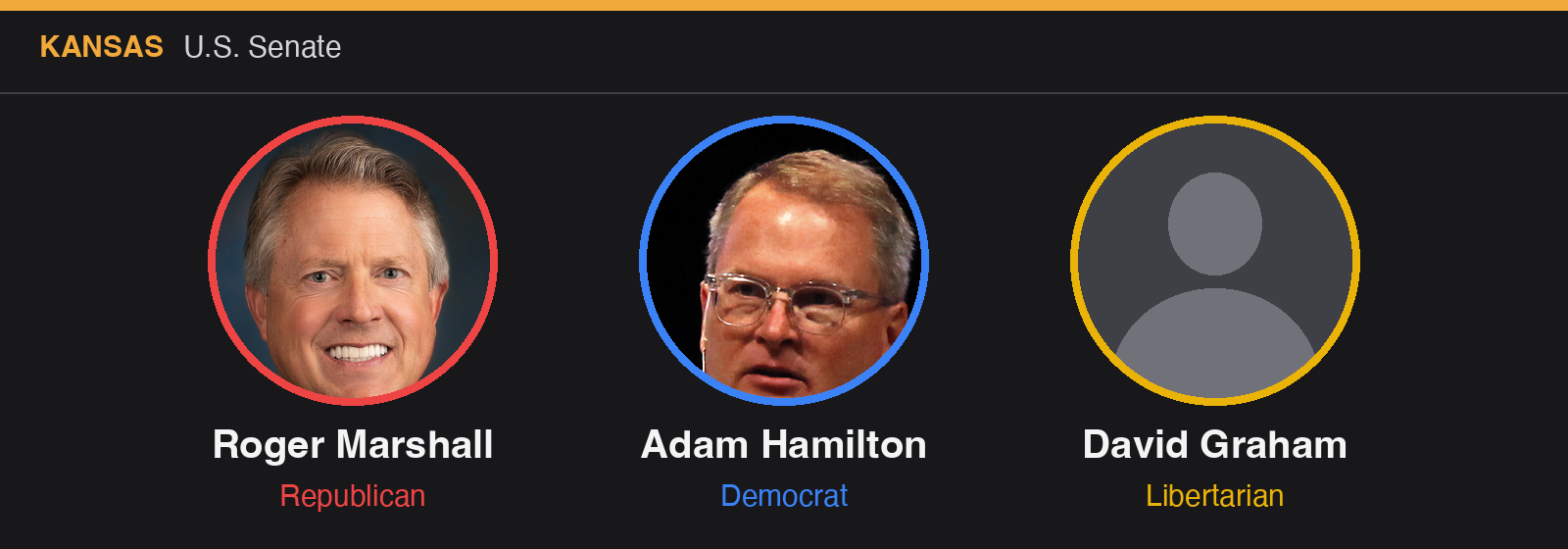 Photos: Roger Marshall, U.S. Senate Photographic Studio, public domain; Adam Hamilton, Western Pennsylvania Conference - United Methodist Church, public domain; David Graham has published no campaign photo.


Kansas hasn’t elected a Democrat to the Senate since 1932. Sen. Roger Marshall, a former obstetrician seeking a second term, is tied with Adam Hamilton, the founding pastor of the United Methodist Church of the Resurrection in Leawood, who is endorsed by Gov. Laura Kelly and by former governors of both parties. A RedBox Research poll for Democrats, taken October 20 to 23, had Marshall at 46 percent, Hamilton at 45, and the Libertarian, David Graham, at 3. An InsiderAdvantage poll for Republicans a week earlier had it 48, 47, and 3. Emerson had Graham at 4 in September. The Cook Political Report rates the race a toss-up, in a state Trump carried by sixteen points.
Graham is an Overland Park attorney running for the second time. In 2022 he took 3 percent against Sen. Jerry Moran, who won by twenty-three points, and nobody called him a spoiler. He doesn’t appear to have a campaign website. He says he wouldn’t answer to either party’s leadership. His three percent is a vote for the line on the ballot rather than for a campaign, and this year it’s wider than the margin between the other two.
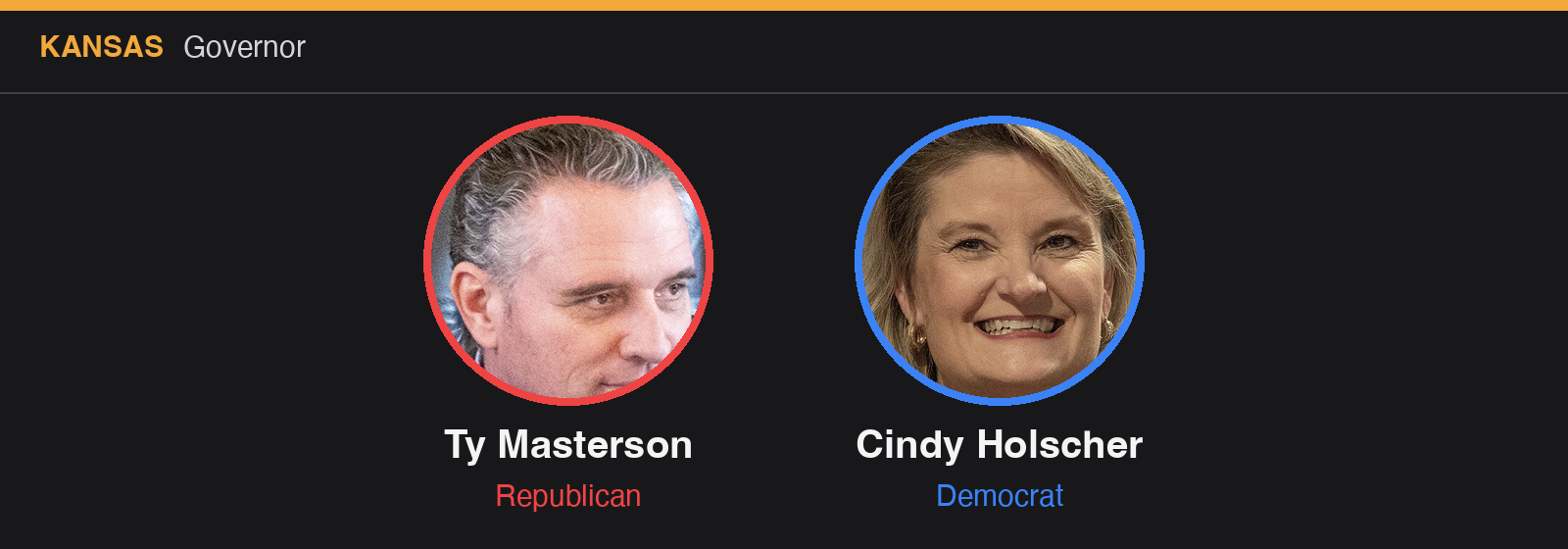 Photos: Ty Masterson, NicholasGian25, CC BY-SA 4.0; Cindy Holscher, Catboy69, CC BY 4.0.


The governor’s race is open, since Kelly is term-limited. Ty Masterson, the Republican president of the state Senate, leads state Sen. Cindy Holscher by about four points in the averages, and most forecasters expect the seat to flip. Kansas voters have one statewide question, an amendment saying that only citizens may vote, which state law already requires. Their larger constitutional decision came in August, when they rejected 61 to 39 an amendment that would have replaced the commission that nominates Supreme Court justices with direct elections.
Iowa: the only Libertarian ever elected
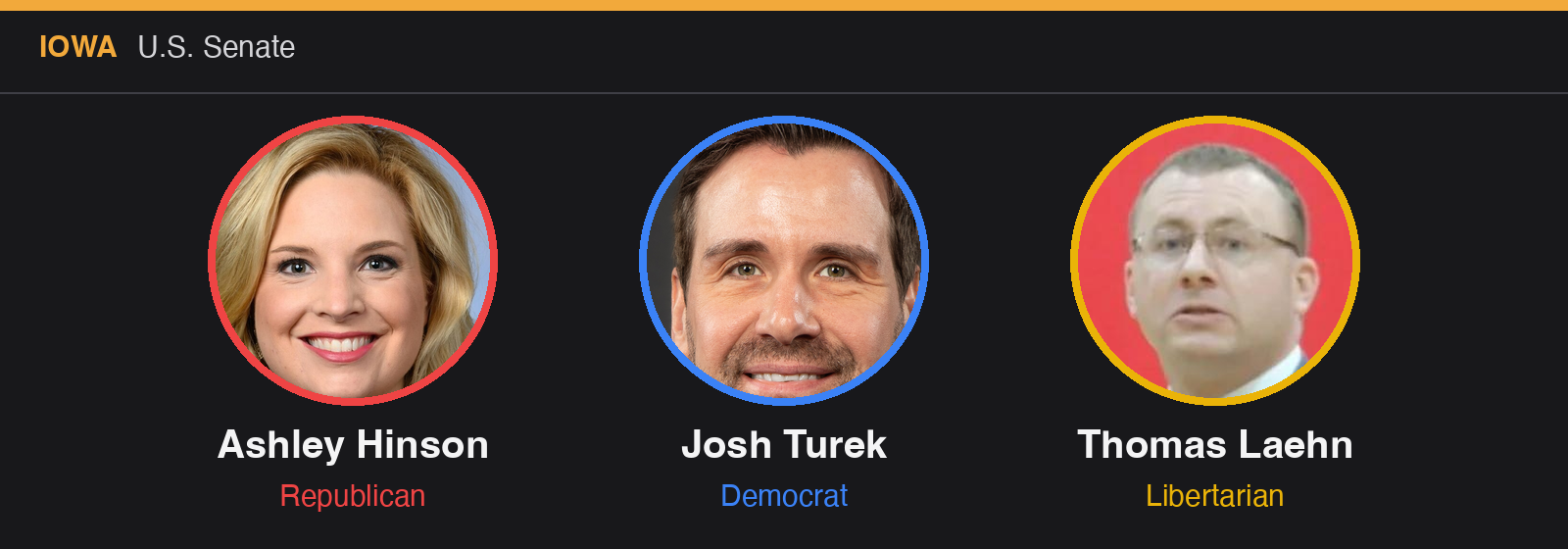 Photos: Ashley Hinson, Office of Congresswoman Ashley Hinson, public domain; Josh Turek, Iowa General Assembly, free use; Thomas Laehn, Laehn campaign.


Sen. Joni Ernst isn’t running again. Rep. Ashley Hinson, endorsed by Trump, Ernst, and Chuck Grassley, faces state Rep. Josh Turek of Council Bluffs, a Paralympic gold medalist in wheelchair basketball. The October polls run both ways: YouGov had Turek ahead 47 to 46, Suffolk had Turek ahead 48 to 44, and the New York Times and Siena had Hinson ahead 48 to 47. Democrats haven’t won a Senate race in Iowa since 2008.
The Libertarian is Thomas Laehn, Greene County Attorney, and he’s the only Libertarian ever elected to a partisan office in Iowa. He won the county job in 2018 and again in 2022, unopposed both times. Most pollsters leave him off; Suffolk’s polls that list him have had him between 2 and 4 percent. Republican campaign officials told the AP they worried less about Iowa than about Kansas because Libertarians aren’t a regular presence on the Iowa ballot, and the party did lose its major-party status in 2024, so its candidates now qualify by petition. Republicans challenged the paperwork of three other Libertarian candidates this summer. Laehn’s wasn’t challenged.
Laehn is a former professor of political theory and the Constitution at McNeese State in Louisiana. He told The Iowa Mercury in July that the United States is “more akin to an elective monarchy than a Republic,” dating the change to Truman sending troops to Korea in 1950 without a declaration of war, and he calls the war with Iran unconstitutional. He wants marijuana possession decriminalized and says that would be his first bill. He opposes the use of eminent domain for the Summit Carbon Solutions pipeline across Iowa farmland, “the biggest boondoggle in the history of our state.” He calls himself radically pro-life but says abortion belongs to the states. He says he’d caucus with whichever party doesn’t hold the White House, and that he could run as a Republican only if the party “was no longer a cult.”
That last point is the one the spoiler arithmetic misses. A voter who picks Laehn because the Republican Party has become the president’s isn’t a Republican vote misplaced. Laehn’s voters have said, in the one way a ballot lets them, that neither coalition is theirs.
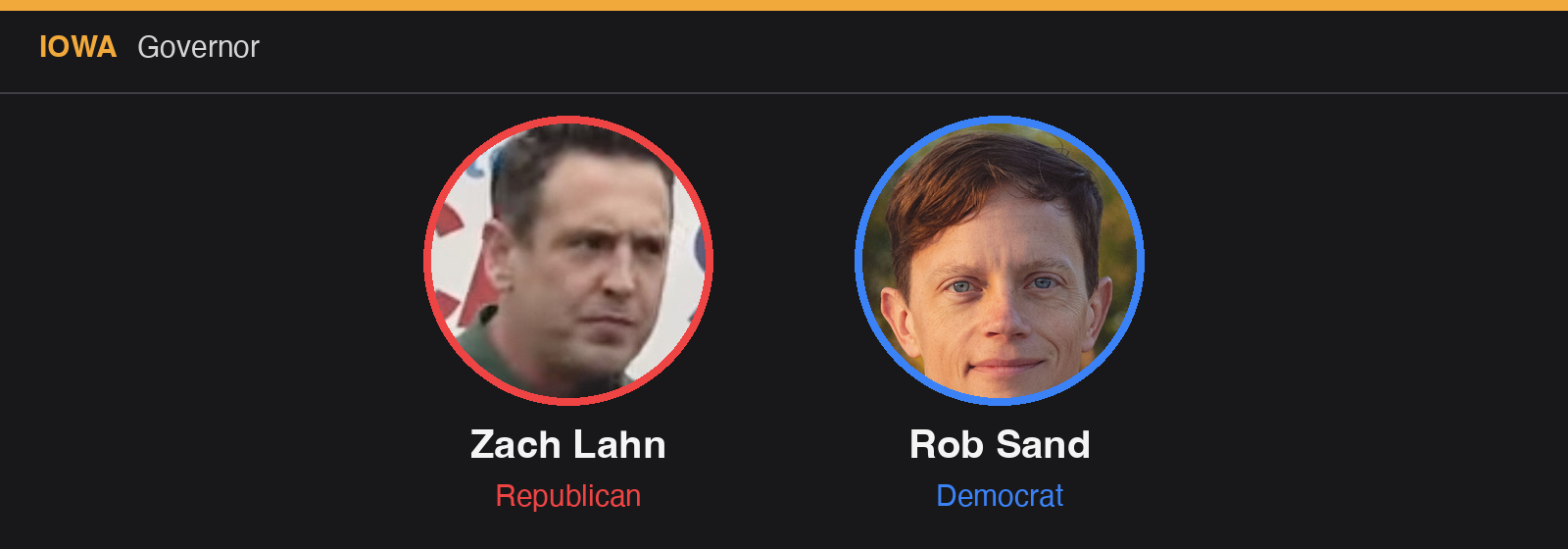 Photos: Zach Lahn, Aunger67, CC0; Rob Sand, Rob Sand for Governor, CC0.


Iowa’s governor’s race is less close. State Auditor Rob Sand, the only Democrat holding statewide office, leads Republican Zach Lahn by six to seven points in the averages, and both Cook and Sabato rate it Lean Democratic. If both leads hold, Iowa splits its ticket.
Nebraska: the protest line has a candidate
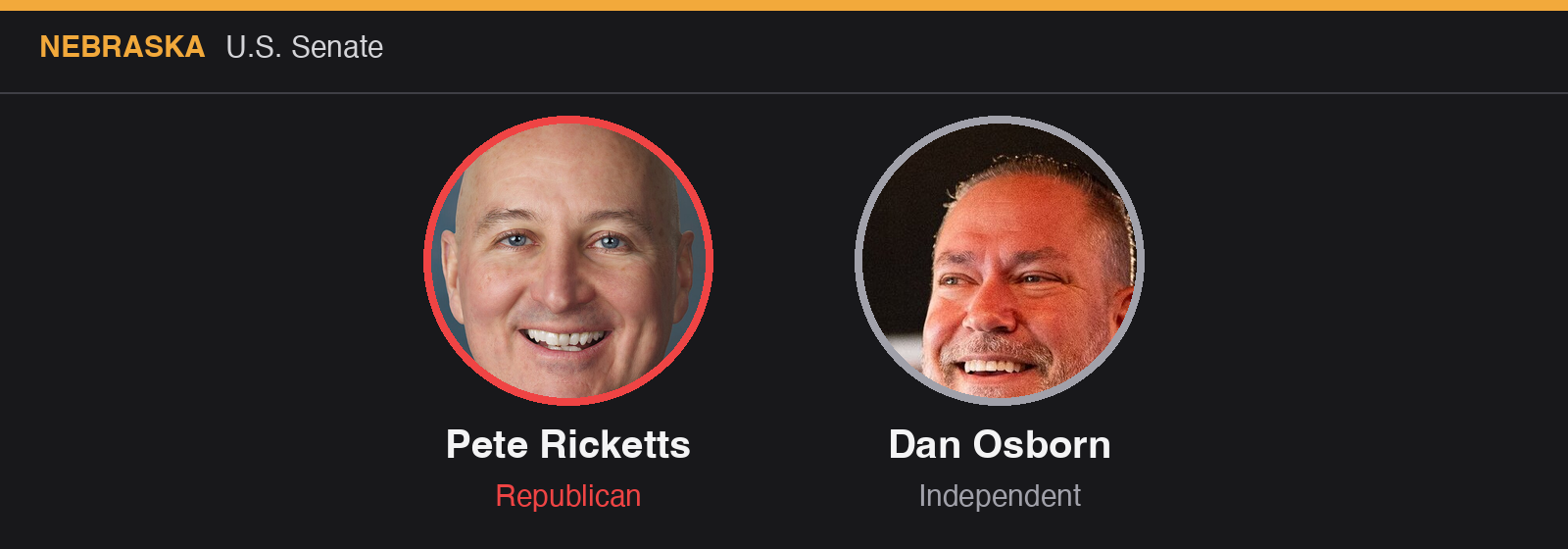 Photos: Pete Ricketts, United States Congress, public domain; Dan Osborn, Bill Clark RC, CC BY-SA 4.0.


Nebraska’s Senate race is the region’s clearest test of how many voters will leave both parties when the alternative is serious. Dan Osborn, a union steamfitter who led the 2021 strike at the Kellogg’s plant in Omaha, lost to Sen. Deb Fischer by less than seven points in 2024 as an independent. This year he’s running against Sen. Pete Ricketts, and he qualified for the ballot in July with more than six thousand valid signatures. A YouGov poll in early October had Osborn ahead 48 to 47. An NPA poll for Republicans a week later had Ricketts ahead 46 to 43. There’s no Libertarian in the race.
Kansas and Iowa ask whether three percent of voters will register a protest. Nebraska asks whether nearly half will, when the protest candidate can win. In 2024 Osborn said he’d caucus with neither party, and the question that hangs over Kansas and Iowa, whose votes the third line is taking, has no clean answer here, because his voters are drawn from both.
The governor’s race has its own third line. Gov. Jim Pillen faces former state Sen. Lynne Walz, and an April poll for the Walz campaign put Rick Beard of the Legal Marijuana NOW Party at 12 percent, with Brett Lindstrom running on an America First line as well. Nebraskans also vote on three citizen initiatives: two that together legalize online sports betting through the state’s racetracks, and one that makes permanent a 2025 law requiring school and college sports teams to be designated male, female, or coed.
Minnesota: an open seat, quietly
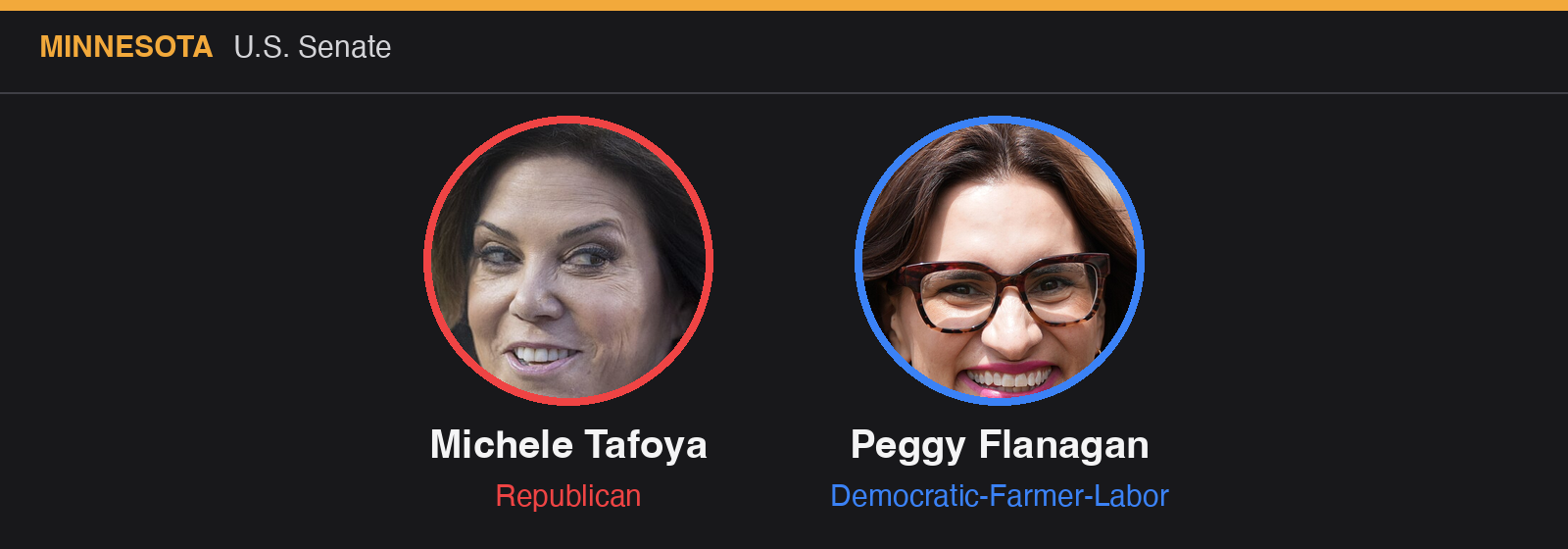 Photos: Michele Tafoya, Keith Allison from Hanover, MD, USA, CC BY-SA 2.0; Peggy Flanagan, Office of Governor Tim Walz & Lt. Governor Peggy Flanagan, public domain.


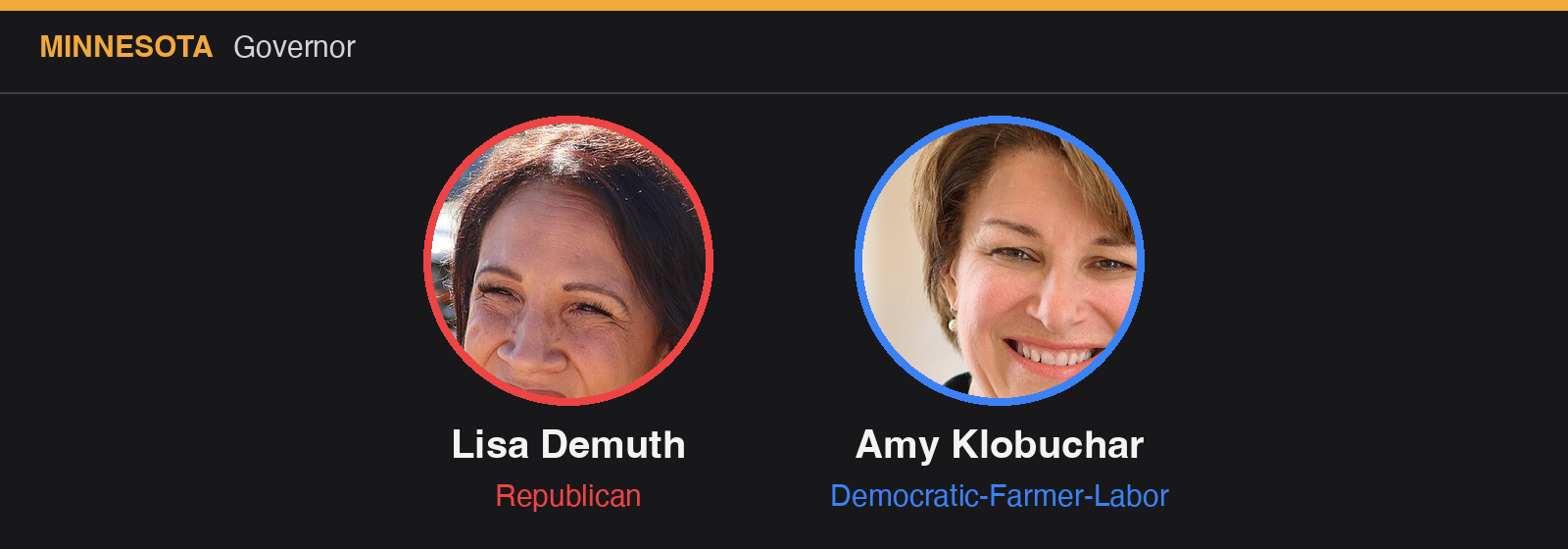 Photos: Lisa Demuth, Lisa Demuth for Governor, CC0; Amy Klobuchar, United States Senate, public domain.


Sen. Tina Smith is retiring, and Gov. Tim Walz isn’t seeking another term after a fraud scandal in state programs. In the Senate race, Lt. Gov. Peggy Flanagan leads Michele Tafoya, the former NBC sideline reporter, by between two and six points in three October polls. A Libertarian, Rebecca Whiting, and an independent, Marisa Simonetti, are also on the ballot, and neither was invited to the race’s one debate. Sen. Amy Klobuchar is running for governor and led Lisa Demuth 52 to 36 in August, with the Green Party’s Steven Young at 1. The state House, tied 67 to 67 through this whole session and governed by the power-sharing agreement What the Plains Decided Not to Change described, is up in full.
Missouri: who may amend the constitution
Missouri has no Senate race this year, and its ballot belongs to the constitution. Amendment 3 would repeal the abortion-rights amendment voters passed in 2024, replacing it with a ban that allows exceptions for rape and incest before twelve weeks and for medical emergencies, and it would add a constitutional ban on gender-transition care for minors. The legislature wrote both into a single question. A St. Louis University and YouGov poll in August had it at 43 percent yes and 44 percent no.
Amendment 6 points the other way. It would make the citizen initiative a “fundamental right” in the state constitution and require an 80 percent vote of the legislature to repeal or change anything voters have passed. It comes from a state where the legislature tried in August to make citizen amendments nearly impossible to pass, and voters refused. Amendment 7 would create the Show-Me Prosperity Fund, an endowment its supporters hope could one day replace state taxes, though the amendment puts no money in it. Amendment 8 writes the election and duties of county sheriffs into the constitution.
Proposition A is a referendum on the congressional map the legislature passed in a special session in 2025, at Trump’s urging, to turn the Kansas City district held by Rep. Emanuel Cleaver into a safely Republican one. Opponents gathered enough signatures to suspend the map until voters decide, so this year’s elections are running on the 2022 lines. The August poll had it at 35 percent yes, 32 no, and a third undecided. Missouri’s Libertarians are on the ballot for state auditor, where Dustin Coffell faces Republican Scott Fitzpatrick and Democrat Quentin Wilson.
The Dakotas: raising the bar
South Dakota’s Gov. Larry Rhoden, who took office when Kristi Noem left for Washington and then won the first runoff for governor in the state’s history, leads Democrat Dan Ahlers 56 to 36. North Dakota has no statewide race of consequence, but its legislature has put a question on the ballot that Missouri’s voters just turned down in another form. Constitutional Measure 1 would require 60 percent of the vote to amend the state constitution, for amendments proposed by citizens and by the legislature alike. A companion measure would bar any citizen-initiated amendment that covers more than one subject. Supporters say the constitution should be harder to amend. In 2024 North Dakotans voted down, by a wide margin, a citizen amendment to abolish property taxes on homes, which is the kind of measure a 60 percent bar would have left to fail more easily, and the kind its sponsors would have been less likely to try.
Spoiler or seat
The AP found Ted Brown, Texas’s Libertarian Senate candidate, running on about thirty thousand dollars against campaigns and allies that have spent roughly three hundred and ninety million. Asked about spoiling Ken Paxton’s chances, he said Republicans could avoid the problem by nominating a better candidate, and that he tells Democrats the same.
That answer leaves a harder question for libertarians themselves: whether a Senate campaign that can’t win is worth running at all, when the most it can do is decide which of two other people does.
The case for running starts with existence. A party that doesn’t appear on the ballot doesn’t exist for most voters, and the vote total is the only public count of how many people stand behind it. Ballot access itself hangs on that count. Iowa’s Libertarians lost their major-party status after 2024, when their candidates fell below the share the state requires, and now have to petition for every line. A three percent showing in a statewide race is the cheapest way a small party has to tell the major ones, and the press, that its voters are real and can be lost. The major parties do notice. A margin that decides a Senate seat is the one kind of message they are built to hear.
The case against has an old example on these questions. In 1844 the Liberty Party, the first antislavery party, ran James Birney for president. He took about fifteen thousand votes in New York, Henry Clay lost the state to James Polk by about five thousand, and with it the presidency. Clay had opposed annexing Texas. Polk took office on a mandate for expansion, Texas came in as a slave state, and the war with Mexico followed. The Liberty voters had registered their existence and helped elect the outcome they most opposed. Four years later the same voters folded into the Free Soil Party, which won no states, and six years after that into a new Republican Party that could win. A protest vote that decides an election hands someone a result, and the protesters don’t choose which one.
The third course is to run where winning is possible. Laehn is the only Libertarian ever elected to a partisan office in Iowa, and he got there by running for county attorney, not senator. County commissions, school boards, township offices, and the nonpartisan races that fill most of a local ballot can be won with a few thousand votes, and they’re where the decentralized government libertarians describe would actually sit. A party that holds a hundred such offices has standing a three percent Senate candidate never earns, and its officeholders don’t have to answer for anyone else’s majority.
The plains have also closed most of the routes that would let a small party register without spoiling. Kansas, Nebraska, and their neighbors outlawed fusion, the practice of two parties nominating the same candidate, in the 1890s and 1900s, largely to break the Populists, who had won statehouses here by fusing with Democrats. Fargo adopted approval voting in 2018, and the North Dakota legislature banned it statewide in 2025, two years after a first ban was vetoed. Missouri voters wrote a ban on ranked-choice voting into their constitution in 2024. Each of these would let a voter mark a Libertarian first without taking a vote from the candidate they’d accept second. Without them, the choice is the one the Liberty Party faced, between being counted and being careful.
On the plains, the width of the protest vote will show up in three forms. In Kansas, it’s a name without a campaign at three percent, which is more than the gap between the other two candidates. In Iowa, it’s a county attorney who’d caucus against whoever holds the White House. In Nebraska, it’s a steamfitter with nearly half the vote. Between them sit Missouri’s Amendment 6 and North Dakota’s Measure 1, one making it harder for a legislature to undo what voters decide, the other making it harder for voters to decide anything at all, on the same ballot in the same week, three hundred miles apart.
Sources: Associated Press, Libertarians could spoil Republicans’ chances in the fight for control of the US Senate (October 27, 2026); Wikipedia, 2026 United States Senate election in Kansas; Axios Kansas City, Your guide to Kansas’ close Senate race; Wikipedia, 2026 Kansas gubernatorial election; Fox Nebraska, Kansas voters reject constitutional amendment to elect Supreme Court justices; KCUR, Missouri and Kansas election guide 2026; Newsweek, Iowa Senate debate: Hinson and Turek polls; The Iowa Mercury, No spoiler here, says Libertarian U.S. Senate candidate in Iowa who has won local elections (July 2, 2026); Iowa Capital Dispatch, Three Iowa Libertarian candidates face challenges for place on 2026 general election ballot; Marist Poll, 2026 Midterm Elections in Iowa, October 2026; Nebraska Examiner, Nebraska nonpartisan US Senate candidate Dan Osborn qualifies for November ballot; Political Wire, Osborn edges Ricketts in Nebraska Senate race and Ricketts leads Osborn in Nebraska Senate race; Nebraska Public Media, Poll shows tight race for Nebraska governor; News From The States, Public hearings scheduled on Nebraska’s three 2026 voter-led ballot measures; KAXE, Senate: Flanagan, Tafoya, Whiting, Simonetti; Political Wire, Peggy Flanagan holds narrow lead in Minnesota; KSTP/SurveyUSA, August 2026 election poll; Missouri Independent, Latest Missouri poll finds another razor-thin margin ahead of November vote on abortion; Wikipedia, 2026 Missouri Amendment 3; Dakota News Now, Poll: Gov. Rhoden leads challenger Ahlers 56-36%; North Dakota Secretary of State, Constitutional Measure No. 1 ballot language; Peter H. Argersinger, “‘A Place on the Ballot’: Fusion Politics and Antifusion Laws,” American Historical Review 85, no. 2 (1980); Michael F. Holt, The Rise and Fall of the American Whig Party (1999), on the 1844 election in New York; Ballotpedia, North Dakota approval voting ban (2023) and Missouri Amendment 7 (2024); Prairie Public, North Dakota Legislature to put three ballot measures to voters in 2026.