 Social Liberty
Revolt of the Comuneros
In 1520 the cities of Castile rose against a foreign-raised king, formed their own congress, and tried to govern themselves. They lost within a year. What they built, and why it fell apart, still speaks to anyone who thinks liberty starts in the town.
Click to enlarge
There is a painting in the Prado's collection, hung for years in Spain's Congress of Deputies, that shows three men about to die. Antonio Gisbert painted it in 1860. Juan de Padilla stands at the center, calm, his hand on his chest. Juan Bravo has already been beheaded at his feet. Francisco Maldonado waits with a priest beside him. The date is 24 April 1521, the place is the village of Villalar, and the men are the captains of the comuneros, the citizens of the Castilian cities who had spent the previous year trying to govern themselves without their king.
This collection of essays posted that painting years ago with nothing to go with it. This is the essay it deserved.
A king from somewhere else
In late 1517 a seventeen-year-old arrived in Spain to claim the crown of Castile. Charles of Ghent had been raised in Flanders and spoke little Spanish. He brought his own court with him and gave its members the best offices in the kingdom. The most notorious appointment went to William de Croÿ, the twenty-year-old nephew of Charles's chief adviser, who was made Archbishop of Toledo, the richest see in Spain.
Then, in 1519, Charles was elected Holy Roman Emperor, and he needed money: for the election, for the journey north, and for an empire that had little to do with Castile. In the spring of 1520 he called the Cortes, the assembly of the cities, to Santiago and then to Corunna, and pressed its delegates to vote him a new subsidy. Many of them had come with instructions to refuse. Through bribes and pressure, he got his vote anyway, named a Flemish cardinal, Adrian of Utrecht, as regent, and sailed for Germany.
The delegates who had voted for the tax came home to angry cities. In Segovia, one of them was killed by a crowd.
The cities rise
Toledo had already moved. On 15 April 1520 its council formed the first comunidad, a community government that took the city's affairs into its own hands. Others followed through the heart of Castile: Segovia, Salamanca, Toro, Ávila, Valladolid, Burgos, and more. In June, Toledo set out what it wanted: cancel the new tax, restore the cities' right to raise their own taxes by agreement instead of through royal tax farmers, keep public offices for Castilians, stop sending the kingdom's money abroad, and name a Castilian regent.
That summer the cities sent delegates to Ávila to form a Santa Junta, a holy assembly of the communities. It was a congress of cities, not a parliament summoned by a king. In August the royal commander Antonio de Fonseca, trying to seize artillery, burned much of the market town of Medina del Campo. The fire did more for the rebels than any speech. Cities that had hesitated joined. At the end of August the Junta moved to Tordesillas, where Charles's mother, Queen Joanna, had been kept confined for years. She was still, in law, the queen, and the Junta tried to govern in her name.
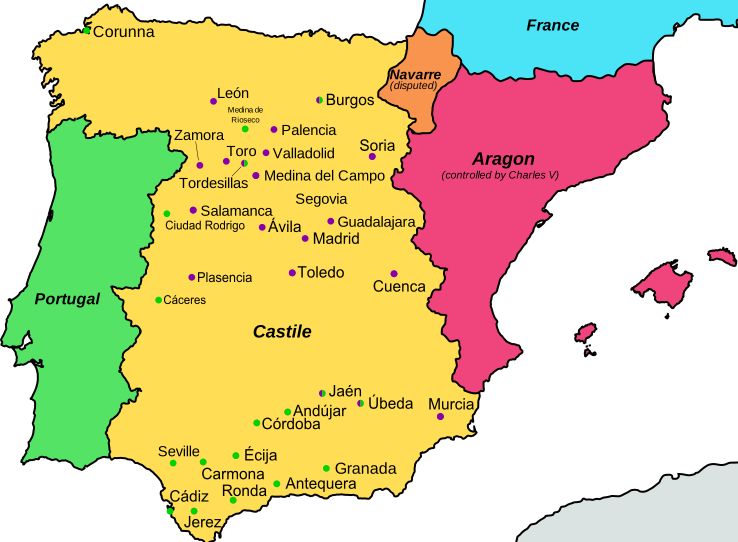
Where the cities stood. Purple: comunero cities. Green: royalist. Half and half: both sides present. The revolt held the old heart of Castile around Toledo, Valladolid, and Segovia; Andalusia and the far northwest stayed with the crown. Map: "Locations of the comunero movement" by AquitaneHungerForce, derived from Rastrojo's original, CC BY-SA 3.0.

What the comuneros were building had a shape. The libertarian writer Lawrence Reed, marking the revolt's five hundredth anniversary, described their most ambitious aim as a network of self-governed cities joined by a loose mutual-defense pact, something closer to the Italian city-republics than to a kingdom. Their program asked for the Cortes to meet regularly whether or not a king summoned it, for the cities to control their own taxes, and for public money to be spent at home. A federation of self-governing towns, with a common assembly and no master, is about as close to Bookchin's confederation of municipalities as the sixteenth century came.
Why it fell apart
The revolt lost because it split, and the split ran along the land.
As the cities rose, the countryside rose too, but against a different master. Much of rural Castile was held in señoríos, lordships in which a noble collected rents and also ruled: he named the judges, held the courts, and took the fees. Through the autumn of 1520, villages under these lords revolted, refusing their dues and claiming to answer to the crown or to the Junta instead of to the lord. The Junta hesitated. It denounced the rural risings and did little to stop them, and it never fully embraced them either.
That was enough to decide the nobles. Many great lords had kept their distance from the king at first, sharing some of the cities' resentment of the Flemish court. When the whole system of lordship came under threat, they chose the crown. Charles's regency added two Castilian grandees as co-regents, and the nobility brought its armies. In December 1520 royal forces took Tordesillas and the queen with it. On 23 April 1521, in heavy rain, they caught Padilla's army on the road near Villalar. The rain slowed his infantry and soaked the powder of his arquebusiers, and the royal cavalry broke them. Padilla, Bravo, and Maldonado were beheaded the next morning.
Toledo held out under Padilla's widow, María Pacheco, who ran the city from its fortress, collected its taxes, and kept its defenses until the city came to terms in October 1521. She later escaped to Portugal and died in exile. In November 1522 Charles issued a general pardon from Valladolid, with 293 names left out.
How it has been read
Every century has found its own comuneros. Spain's nineteenth-century liberals made them martyrs of liberty against despotism, which is the spirit of Gisbert's painting. Later historians pushed back: the comuneros, they argued, were defending old privileges, local oligarchies, and a suspicion of foreigners, against a modernizing monarchy. Others answered that the Junta's program, a standing assembly, consent to taxation, and power returned to the cities, made it one of the first modern revolutions. Since Castile and León became an autonomous region, 23 April, the day of Villalar, has been its official day, and the village is now called Villalar de los Comuneros.
Three claims about the comuneros
The arguments over them fit the three-claim form this collection uses for hard questions.
The comuneros were defending liberty. They resisted taxes imposed without real consent, money spent on a distant empire, and offices handed to a foreign court. They wanted their own assembly to meet by right.
The comuneros were defending privilege. Their cities were run by narrow councils of the well-placed. Some of their anger was simple hostility to foreigners. And when villagers rose against their own lords, the cities mostly looked away.
The comuneros were building self-government. The Junta was a real confederation of cities, governing for months without a king, collecting revenue, raising armies, and writing a program for how Castile should be ruled.
The first and third seem to be undercut by the second. If the liberty they defended was the liberty of city councils, then the confederation they built was a federation of oligarchies.
All three can hold together once it's clear where their liberty stopped. It stopped at the city walls. The comuneros understood self-government for towns and treated self-government for villages as a threat. The rural risings against the lords were, in their own way, the same claim the cities were making: that people should be governed by authority they consent to, not by someone who holds their land and their courts by inheritance. A movement that had taken up both claims would have been harder to defeat, and the nobles might not have found the crown so attractive. The comuneros chose the walls, and the lords chose the king.
What it says now
This collection has argued for municipal liberty because it's the scale at which people can actually govern themselves. The comuneros show the edge of that argument. A confederation of towns is only as free as the land around it. If the countryside belongs to lords who rule as well as own, the towns are islands, and the lords will eventually side with whoever protects their rents. That's why the land question has never been separate from the municipal one. Who holds the land, on what terms, and who collects its rent decides whether self-government can spread beyond the walls.
It's also a pattern. The Municipalist Current followed two modern experiments in confederated self-government, in northern Syria and in Barcelona, that were absorbed or outvoted by a larger power. The comuneros were the same story five centuries earlier: a federation of communities, governing itself for a year, ended by an emperor with more soldiers and allies who feared what self-government might do to their own holdings. The Municipality Against the State argued that the state is a kind of power a town meeting could never legitimately hold. Castile in 1521 shows what happens when the towns fail to make that argument on behalf of everyone, not just themselves.
The men in Gisbert's painting lost. Their program didn't vanish. Its central idea, that an assembly of the governed should meet by right and decide what it's willing to pay for, is the idea most free institutions since have rested on. The comuneros' mistake was to keep it for the towns.
A note on how this piece was written: the subject, the questions it asks, and the positions it takes are mine. Much of the research, the examples, and the sentences were drafted by an AI model working from that direction, and then edited by hand. I'd rather say that plainly than have a reader guess at it.