 Social Liberty
The Anti-Rent Ticket
Hudson Valley tenants in 1846 elected a Whig governor and a Democratic lieutenant governor on one ticket. In the Middle Atlantic this week, Republican House seats depend on voters who may be just as loose from their party alliances.
Click to enlarge
On Sunday, two days before the vote, the national numbers look like a switchover in progress. Emerson’s last October poll has Democrats ahead on the generic House ballot 52 to 42, up from 44 percent support fifteen months ago, with President Trump at 37 percent approval and 57 disapproval. A Washington Post-ABC News-Ipsos poll this month found that 34 percent of Republicans and Republican leaners now say he is using the presidency to enrich himself, up from 22 percent in September 2025. Cost of living is the top issue in Emerson’s poll at 34 percent, and fighting corruption is second at 28. Ending the Iran war is the top issue for only 6 percent, although the war runs through the other two, in gas prices and in the question of who decided what for whom.
Numbers like those measure a mood, and party alliances move slower than moods. Whether a voter’s anger reaches the other party’s line on the ballot is a separate question, and it gets answered in a few dozen districts. The House stands at 218 Republicans and 214 Democrats. NPR reported on October 29 that Cook has Democrats favored in 220 seats, with 17 toss-ups.
The Middle Atlantic is a good place to watch it. The Region That Already Ran the Experiment read New York, New Jersey, and Pennsylvania through their property tax fights in August, and Councils of the US 2026 placed them on the regional map. This week the region has no competitive Senate race and no close governor’s race. It has suburban and small-city House districts, nearly all of them Republican-held, where the incumbents won by getting Democrats and independents to split their tickets. Inroads here would show up as those voters ceasing to do it.
New York: the crossover shrinks
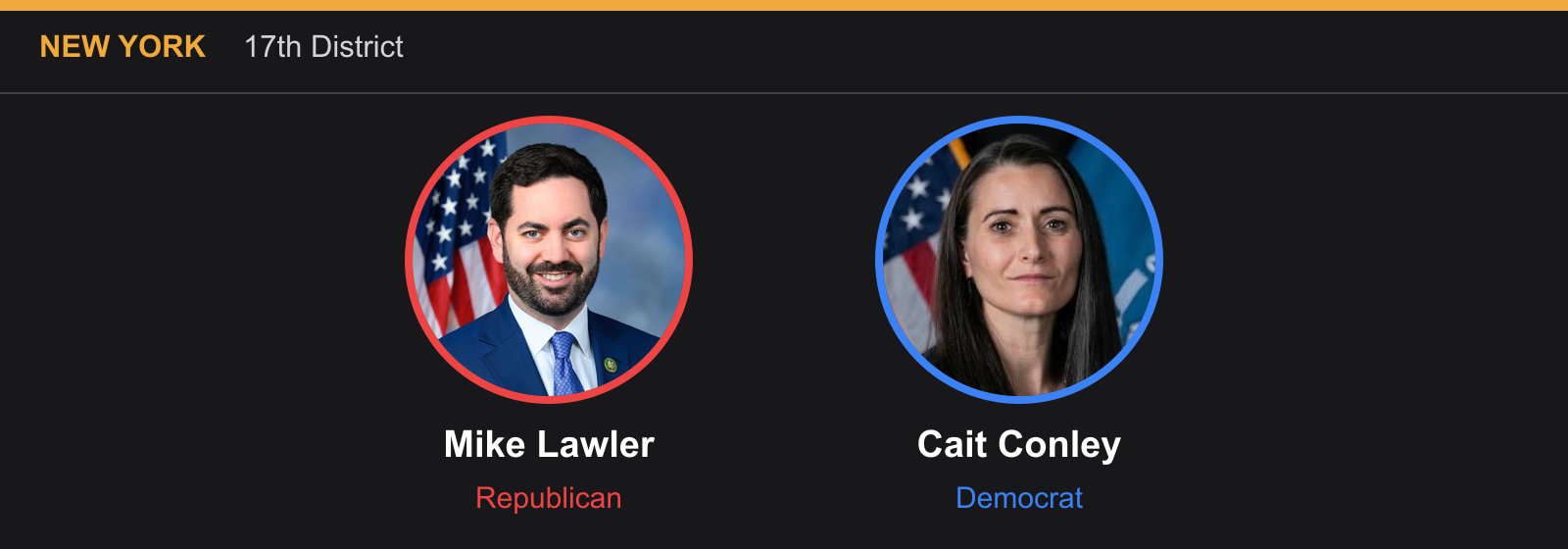 Photos: Mike Lawler, U.S. House of Representatives, public domain; Cait Conley, Cybersecurity and Infrastructure Security Agency, public domain.


Rep. Mike Lawler holds the kind of seat that party alliances alone would not give him. New York’s 17th takes in Rockland and Putnam counties and part of Westchester, and Kamala Harris carried it in 2024 while Lawler won reelection on the same ballot. Cook moved it from Lean Republican to Toss Up, and Inside Elections has it there too.
The Emerson College and PIX11 poll from late September is the most useful evidence, partly because of what sits under the topline. Cait Conley, an Army veteran, led 48 to 46 among 400 likely voters, a margin well inside its 4.9-point credibility interval. Lawler’s favorable rating fell from 52 to 45 percent since October 2024. Democrats who cross over for him fell eight points, to 12 percent, and Republicans crossing to Conley rose six points, to 10.
Those two crossover figures are the switchover in miniature, and they don’t all run one way. Lawler still takes one Democrat in eight, and one Republican in ten is leaving him. A House Majority PAC poll released by Conley’s campaign had her up 51 to 45. Another poll had Lawler up by five. City & State ran a piece in October asking whether Lawler is the only Republican who could hold the seat, and whether even he can, which fairly states the range.
The governor’s race at the top of the ticket isn’t close. Gov. Kathy Hochul leads Bruce Blakeman, the Nassau County executive, by double digits in every recent public poll: Siena at 54 to 40, Quinnipiac at 55 to 41, Marist at 53 to 42 among registered voters, Emerson at 52 to 40. Blakeman has called the polls “voter suppression tactics.” The statewide gap matters mostly as a coattail question, since a Republican House member in the Hudson Valley needs ticket-splitters and a blowout higher on the ballot makes those harder to find.
New Jersey: the firefighters switch
 Photos: Tom Kean Jr., Office of Congressman Tom Kean, public domain; no freely licensed photo of Rebecca Bennett was found.

New Jersey’s 7th runs across the state’s suburban and rural north and center, and Tom Kean Jr. held it in 2024 against a well-funded challenge. This year it has become one of the region’s clearest tests. Rebecca Bennett, the Democratic nominee, led narrowly in a poll reported in September, and the same report noted a firefighters’ union switching its endorsement. A poll from 314 Action, a Democratic-aligned group, had Bennett ahead 47 to 43. Ballotpedia lists Cook’s rating as Toss Up.
These are thin numbers. Most of the available polling comes from parties or allied groups, and there’s no late independent survey to check them against. The union is the more interesting detail. A public-safety union changing its endorsement is an institution changing its alliance, and institutions tend to move later and with more caution than individual voters do. One endorsement can’t carry a general claim, but this is what a switchover looks like when it happens below the level of polling.
Pennsylvania: the keystone seats
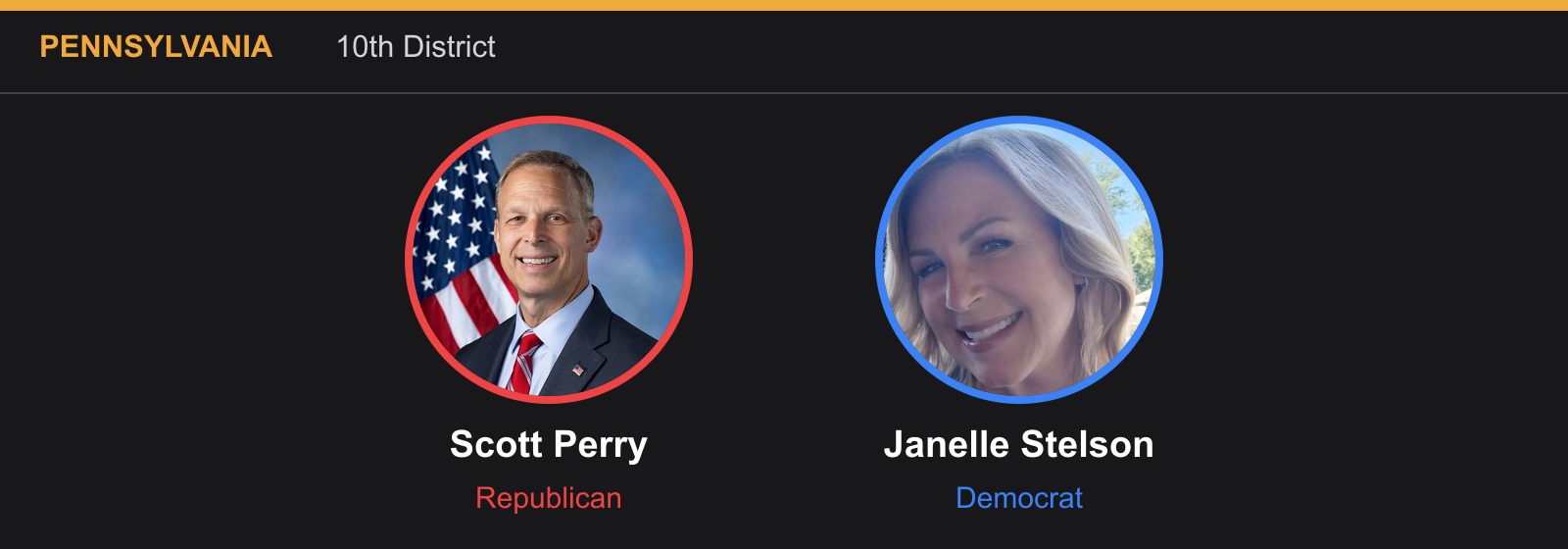 Photos: Scott Perry, House Creative Services, public domain; Janelle Stelson, James Newton / jnewt-maps on Bluesky, CC BY-SA 4.0.


Pennsylvania has four Republican-held districts at the center of what the Washington Examiner called a knife-fight campaign: Brian Fitzpatrick’s 1st in Bucks County, Ryan Mackenzie’s 7th in the Lehigh Valley, Rob Bresnahan’s 8th around Scranton and Wilkes-Barre, and Scott Perry’s 10th around Harrisburg and York.
They aren’t one kind of place, and they don’t make one kind of test. Bucks County is wealthy suburbia, and Fitzpatrick has spent years building a reputation for crossing his party. The Lehigh Valley is a former industrial region now full of warehouses. Northeastern Pennsylvania is the old Democratic union country that moved hard toward Trump, and Cook moved Bresnahan’s race to Toss Up back in April. Perry’s is a rematch: Janelle Stelson, a longtime Harrisburg television anchor who came close in 2024, led 47 to 44 in a September poll.
If Democrats take the 8th, it would be a return more than an inroad, and the party alliances of Scranton would be going home. If they take Bucks, it would be a new loyalty entirely. The same headline count would hide two different events, and it’s worth reading these seats one at a time when the returns come in.
 Photos: Josh Shapiro, Maryland GovPics, CC BY 2.0; Stacy Garrity, David H. McCormick, public domain.


Above all four sits Gov. Josh Shapiro. Quinnipiac had him at 59 to 34 over state Treasurer Stacy Garrity among likely voters in early October, a 25-point lead in a state Trump carried two years ago. A margin of that size means that a large number of Trump voters are planning to vote for a Democrat for governor. What they do further down the same ballot is the most useful thing Pennsylvania can tell the rest of the country on Tuesday. If Shapiro’s Republican voters go straight back to Perry and Bresnahan, then the popularity is his and the alliances haven’t moved at all.
A ticket with two parties on it
Up the Hudson from Lawler’s district, and west into the Catskills, tenants on the old manor estates spent the 1840s refusing to pay rent. They farmed under leases that ran for generations and owed the landlords wheat, fowls, and days of labor. The first mass meeting was on July 4, 1839, in the Helderberg hills at Berne. Within a few years, men in calico gowns and sheepskin masks were riding out to sheriff’s sales, summoned by tin dinner horns, in a costume that deliberately recalled the Boston Tea Party.
In August 1845 at a sale on Moses Earle’s farm in Andes, in the Catskills, Undersheriff Osman Steele was shot dead. Gov. Silas Wright, a Democrat of real national stature, moved against the movement, and courts sentenced two men to death for the killing. The sentences were commuted to life.
The tenants’ next step is the one worth remembering this week. The Anti-Renters had no interest in becoming a third party that would finish third. In 1846 they ran a ticket that picked from the two parties’ candidates, and it nominated John Young, the Whig, for governor and Addison Gardiner, the Democrat, for lieutenant governor. Both won. Young beat Wright 198,878 to 187,306, and Gardiner beat the Whig Hamilton Fish 200,970 to 187,613. On the same ballot, a bloc of voters unseated one party’s governor and the other party’s candidate for his deputy. Young pardoned the imprisoned leader Smith Boughton after taking office. That same year, a new state constitution abolished feudal tenures and outlawed agricultural leases longer than twelve years.
The tenants’ weapon was that nobody could count on them. The Whigs couldn’t treat them as Whigs, the Democrats couldn’t treat them as Democrats, and each party learned what it would have to offer in the next election. It also took organization, with committees, a newspaper, and a printed ticket. Today’s ticket-splitter has a private grievance and a screen full of ads, and there are no Anti-Rent conventions in Rockland County. The 2026 equivalents are a focus group in Georgia and a poll crosstab.
That difference limits how far the analogy goes. A voter who leaves a party over prices or a war, without any organization to bargain for them, can return as easily as they left. A switchover that lasts usually needs something to hold it. The Whig Party was gone within a decade, while the limit on leases stayed in the constitution.
What to read on Tuesday night
New York, New Jersey, and Pennsylvania all report on the evening of the third, and they report early enough to set the tone for the night. Pennsylvania’s count of mail ballots can run slowly, though, and a close seat there may not be settled by morning.
Bucks County will be an early clue. So will the difference between Shapiro’s margin and Perry’s in Dauphin and York counties, which is close to a direct measurement of how many voters split. In Rockland, watch whether Lawler keeps something near his 12 percent of Democrats. If the crossover he has lived on is gone, then a party alliance has moved. If he holds it and loses anyway, turnout did more of the work, and the tenants of 2026 stayed home instead of voting a new ticket.
Sources: Emerson College Polling, October 2026 National Poll and NY-17 2026 Poll; Anchorage Daily News/Washington Post, Poll finds jump in Republicans who say Trump is enriching himself; NPR, 2026 House map; City & State New York, Mike Lawler might be the only Republican who could win NY-17; Conley campaign, NY-17 poll; CBS New York, Hochul and Blakeman polls; Central Jersey, Poll shows Bennett narrowly ahead of Kean in NJ-7; New Jersey Globe, Pro-Shah group’s poll also found Bennett leading Kean; Ballotpedia, New Jersey’s 7th Congressional District election, 2026; Washington Examiner, Pennsylvania House battlegrounds; City & State Pennsylvania, Pennsylvania polls show Democrats leading; FOX 29, Shapiro holds 25-point lead over Garrity; Wikipedia, Anti-Rent War and 1846 New York state election.