 Social Liberty
What the Valley Lent
In 2024 South Texas handed Republicans the biggest Latino swing in decades. Polls now suggest some of that may have been a loan. Elsewhere in the region, a Louisiana House member's stock trades and an Oklahoma tie test how safe the rest is.
Click to enlarge
Texas’s 15th Congressional District runs from the eastern suburbs of San Antonio down to McAllen, and the Texas Tribune has called it Republicans’ greatest success story with Texas Latino voters. Monica De La Cruz won it by fourteen points in 2024, and Trump won it by eighteen. This fall a Tejano star named Bobby Pulido, who won his Democratic primary with two-thirds of the vote, was leading her 50 to 45 in a Texas Southern University poll.
Pew’s national figures give the scale of what’s being tested. Trump cut the Democratic margin among Latino voters to 3 points in 2024, down from 25 in 2020. No region showed that shift more dramatically than the Rio Grande Valley, where counties that hadn’t voted Republican for president in a century went over. It was the most striking change in party alliances of the Trump years, and people on both sides treated it as a realignment. Republicans drew a new congressional map in Texas last year on the assumption that it would hold.
Two days out, the question for the Texas Region (Texas, Oklahoma, Arkansas, and Louisiana) is whether that was a deed or a loan. Austin’s Long Recess read this state’s government in August, when its legislature wasn’t sitting. Tuesday, the voters get a turn. Democrats have spoken of inroads in Texas in almost every cycle since 2018, and they’ve mostly been wrong, so the burden of proof here runs high.
The Valley’s three seats
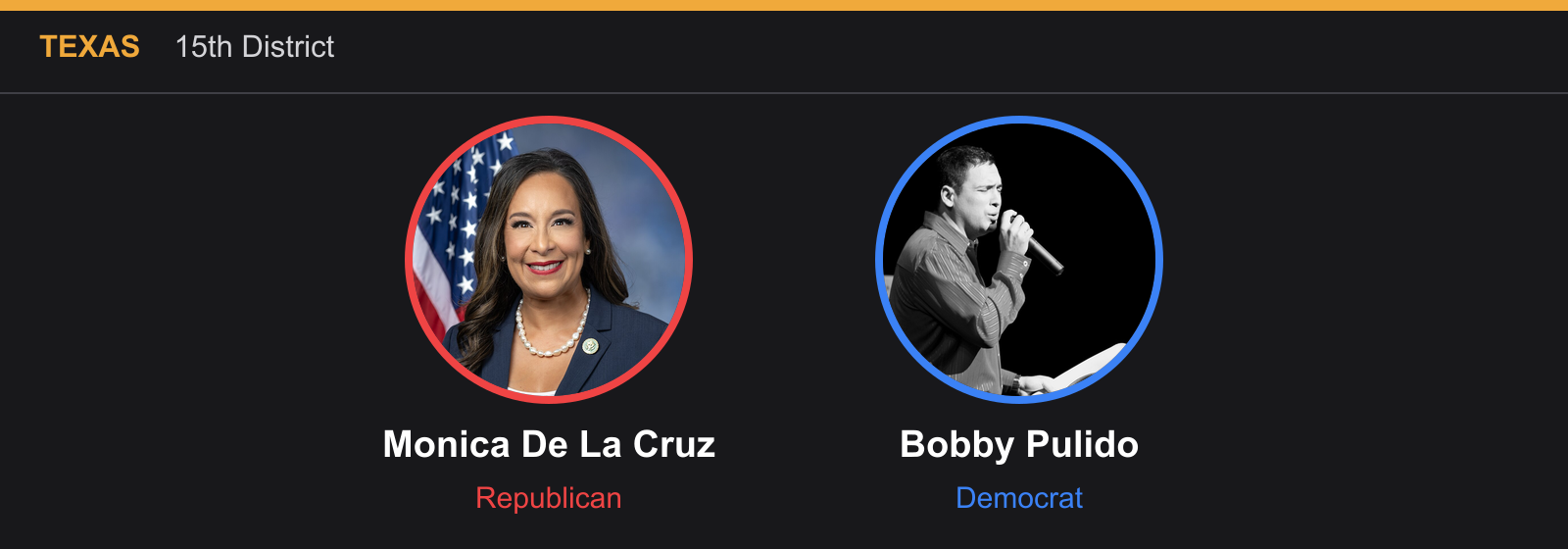 Photos: Monica De La Cruz, Nicktilson, CC BY-SA 4.0; Bobby Pulido, Kim-bodia, CC BY 4.0.


The Texas Southern poll, published in late August, is the fullest look at the three South Texas districts. The sample was 700 likely voters in the 15th and 34th and 600 in the 28th. In the 15th, Pulido led 50 to 45, with 8 percent of Republicans and 8 percent of 2024 Trump voters crossing over to him. His favorable rating was 45 to 34, and De La Cruz’s was underwater at 41 to 43.
In the 28th, Rep. Henry Cuellar, a Democrat whom Trump pardoned on federal bribery charges, led Republican Tano Tijerina 45 to 34, with 20 percent of Republicans and 23 percent of Trump voters backing him. That’s the largest crossover in the poll, and it comes from a long-established conservative Democrat rather than from any new enthusiasm for the party. In the 34th, Rep. Vicente Gonzalez led former Rep. Mayra Flores 45 to 42. Trump won both districts by ten points under the new lines.
A single poll two months old can’t settle anything, and as one Texas commentator pointed out, it’s one data point. A Daily Signal review in July counted two polls with De La Cruz ahead and one with Pulido ahead. A Public Policy Polling survey shared with the Tribune had De La Cruz up three. The Texas Southern poll also doesn’t report Latino voters as a separate group. A map drawn to give Republicans the Valley may yet do that.
The Senate race
 Photos: Ken Paxton, Gage Skidmore, CC BY-SA 4.0; James Talarico, Antonioaesparza, CC BY-SA 4.0.


Texas last elected a Democrat statewide in 1994. State Rep. James Talarico, a former middle-school teacher and seminarian, is running against Attorney General Ken Paxton, who beat Sen. John Cornyn in the Republican primary. Paxton carries his own history, including a 2023 impeachment by the Texas House and acquittal by the Senate, and he’s the sort of candidate on whom a corruption argument doesn’t need much setting up.
The polls disagree. Texas Public Opinion Research’s mid-October survey had Talarico up 51 to 47, in a tracking series that went from +6 to +5 to +4. ActiVote had him at 52 to 48 at the end of the month. The University of Texas/Texas Politics Project poll, with a longer record here, had Paxton up 50 to 47 in a survey taken from late September into October, and it called the level of competition historic. Libertarians also matter: the AP reported this week that Republicans fear losing a few points to third parties in Texas among other states, a dynamic explored in Once-Safe Ground.
The Latino figures are where this dispatch’s question meets the Senate race. The University of Houston’s Hobby School polled 500 Latino likely voters from October 10 to 14 and had Talarico up 52 to 41. The UT poll had him 54 to 41. Those are real Democratic leads, and they’re well short of what Democrats used to take for granted among Texas Latinos. Rural Latinos, in the same reporting, went the other way, 56 to 24 for Paxton. KERA reported that Talarico and Gina Hinojosa lead Latinos but fall short with rural voters. A Latino voter in San Antonio and one on a ranch in Duval County aren’t one bloc, and calling both of them a demographic has already caused a good many forecasting errors in this state.
In Texas Southern’s Valley numbers, Talarico led Paxton by eight in the 15th, ten in the 28th, and eleven in the 34th, three points better than Pulido did in the 15th. Hinojosa led Abbott in those districts by only three or four. It’s worth knowing how much of that gap is Talarico and how much is Paxton.
The governor’s race
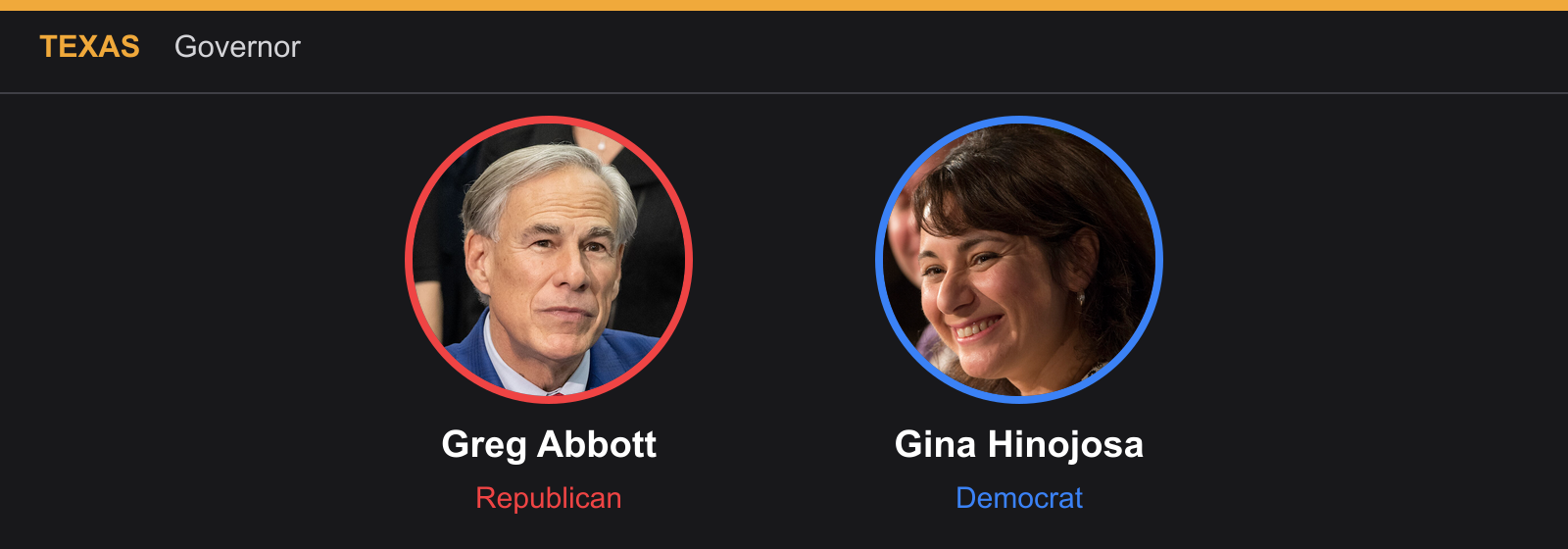 Photos: Greg Abbott, NASA Johnson Space Center / NASA-JSC/ROBERT MARKOWITZ, public domain; Gina Hinojosa, LBJ Library, public domain.


Gov. Greg Abbott, seeking a fourth term, should not be in any kind of race. His lead over state Rep. Gina Hinojosa has narrowed in Texas Public Opinion Research’s polling from seven points to four to three, 51 to 48 in the latest. The University of Houston had it 49 to 46, ReconMR 48 to 47, and a YouGov poll put Hinojosa ahead 48 to 47. The Libertarian, Pat Dixon, is drawing one or two percent.
Abbott’s own contribution to the Valley’s shift was substantial. He campaigned there for years, spent state money on the border, and in 2022 did better with Latino voters than Republicans had before. If Hinojosa runs within a few points, what’s being measured is the weight of national conditions on an otherwise secure incumbent: a war, the price of groceries, and a president whose approval sits near 37 percent in Emerson’s national poll. In that Emerson poll, 28 percent named fighting corruption as their top issue, second only to the cost of living.
The rest of the region
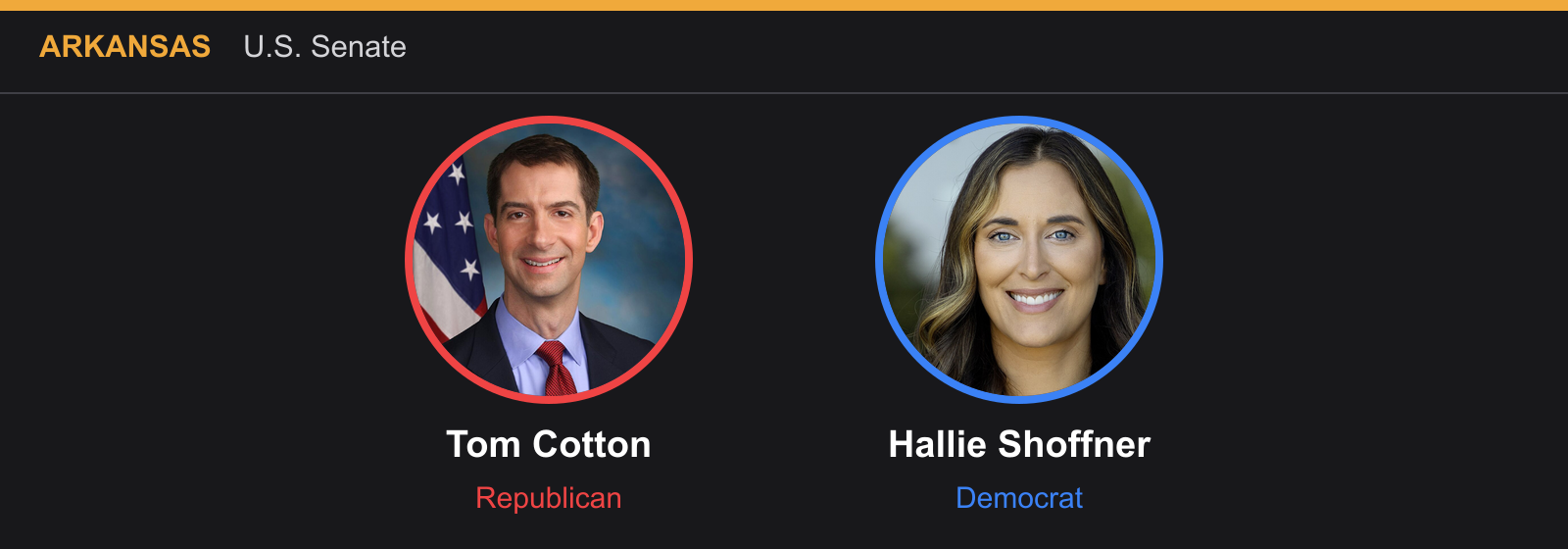 Photos: Tom Cotton, U.S. Senate Photo Office, public domain; Hallie Shoffner, Hallie Shoffner, CC0.


Elsewhere in the Texas Region, the alliance holds, though it creaked this year.
In Arkansas, a Hendrix College poll in August startled everyone by putting Hallie Shoffner, a rice farmer, ahead of Sen. Tom Cotton 47 to 44. By October the same poll had Cotton back up 50 to 41, with the Libertarian Jeff Wadlin at 5 percent, and an average put him about nine points ahead. Rural farm country facing tariffs and fertilizer costs is exactly where a defection might be expected. The August scare and the October correction are a fair warning about how far single state polls can swing.
In Louisiana, Rep. Julia Letlow, Trump’s choice, took the nomination after the Republican primary cost Sen. Bill Cassidy his seat. Her opponent, Jamie Davis, released a Public Policy Polling survey in July showing it at 41 to 37, with one in five undecided. That poll came from his side, and no independent October survey turned up in this research. Afterward, Gulf States Newsroom reported on her stock trades in Meta and a nondisclosure agreement with the company, and Letlow declined to attend an October forum. It’s a small instance of what Democrats are trying to do nationally with corruption, in a state where they’re unlikely to win.
Oklahoma has the odder story. Mike Mazzei beat Attorney General Gentner Drummond in an August runoff for the Republican nomination for governor, and a Cross Timbers poll in October found him in a statistical tie with Democratic state Rep. Cyndi Munson, with many voters undecided. The Munson campaign itself questioned that poll’s reliability while saying its own numbers also showed a close race, and betting markets gave Mazzei about nine chances in ten. So there is good reason to doubt it. That a tie is even being argued over is the news.
Six percent in 1972
South Texas has left a party alliance before, and it didn’t leave for the other party.
In 1963 five Mexican American candidates, backed by a Teamsters local and a new political organization, swept the city council of Crystal City, in Zavala County. By 1970 organizers there had founded La Raza Unida, a party of its own, on the argument that Texas Democrats had taken their votes for generations and given little back. Its strength was in the towns of the Winter Garden and the Valley, where Latino voters were majorities in counties run by others.
In 1972 the party ran a young Baylor-trained lawyer and former football player named Ramsey Muñiz for governor. The result was Dolph Briscoe, Democrat, 1,633,493, or 47.9 percent; Henry Grover, Republican, 1,533,986, or 45.0; Muñiz, 214,118, or 6.3. A Democrat elected governor of Texas with under half the vote, in an era when the Republican was supposed to be an afterthought, won by fewer votes than a brand-new party took from his traditional base.
Raza Unida didn’t last. Muñiz ran again in 1974 with less, then went to prison on drug charges, and the party had faded by the end of the decade. What it did was show Texas Democrats, in a language they could read, how much of their margin was on loan. The party responded over the following years with candidates, appointments, and attention, and the alliance came back stronger than it had been, and stayed for nearly fifty years.
That’s one way a loan gets repaid, and 2024 may turn out to be a similar notice served on the Democrats, with the Republicans as the temporary beneficiaries. The Valley’s voters went where the offer seemed better, on prices and work and being taken seriously. Polling on deportations suggests that some are reconsidering: a Pew finding says about 62 percent of Hispanic voters consider the current level of deportations excessive. The other reading is that the alliance really has changed and these polls are a midterm wobble. Nothing in the survey data can distinguish the two, and it may take until 2028 or 2030 to be able to.
What to read on Tuesday night
Texas polls close at 7 p.m. local time, 8 p.m. Eastern in most of the state and 9 p.m. in the far west. Hidalgo, Cameron, and Starr counties report early and tend to report fast.
Starr County is the single best number to find. It went for Trump in 2024 after more than a century of voting Democratic. Compare its margin to 2024. Then compare De La Cruz with Paxton in the 15th to see how much of the Republican vote is attached to the party and how much to a particular name. If the rural Latino number from the UH poll holds, and Duval and Jim Hogg and Zapata stay red while San Antonio moves, the alliance has divided by geography, and “Latino voters” will need a new sentence.
Sources: FOX 4, South Texas congressional poll gives Democrats edge in three key districts; AP via KSAT, Democrats look to Tejano music star Bobby Pulido; The Daily Signal, Redrawn districts set stage for high-stakes Texas House battles; NPR via KPBS, With an ad aimed at Trump, this Republican exposed GOP angst about Latino voters; Texas Public Opinion Research, October poll in Texas general election; ActiVote, Texas U.S. Senate polls; Texas Politics Project, Latest UT/Texas Politics poll; NewsNation, Latino voters emerge in Texas Senate race; Emerson College Polling, October 2026 National Poll; Talk Business & Politics, Poll: Tight race for US Senate between Cotton, Shoffner; Political Wire, Tom Cotton leads comfortably in Arkansas; PollCheck, Arkansas Senate; WWNO, Poll shows 4-point difference between Letlow and Davis; WAFB, Julia Letlow declines Senate debate; News 9, Oklahoma governor poll; Wikipedia, 2026 Oklahoma gubernatorial election, 1972 Texas gubernatorial election, and Raza Unida Party.