Emma Goldman The history of human growth and development is at the same time the history of the terrible struggle of every new idea heralding the approach of a brighter dawn. In its tenacious hold on tradition, the Old has never hesitated to make use of the foulest and cruelest means to stay the advent […]
Cass R. Sunstein, More is Less, in The New Republic, at 37 (May 18, 1998) A German psychologist named Dietrich Dorner has done some fascinating experiments designed to see whether people can engage in successful social engineering. The experiments are run by a computer. Participants are asked to solve problems faced by the inhabitants of […]
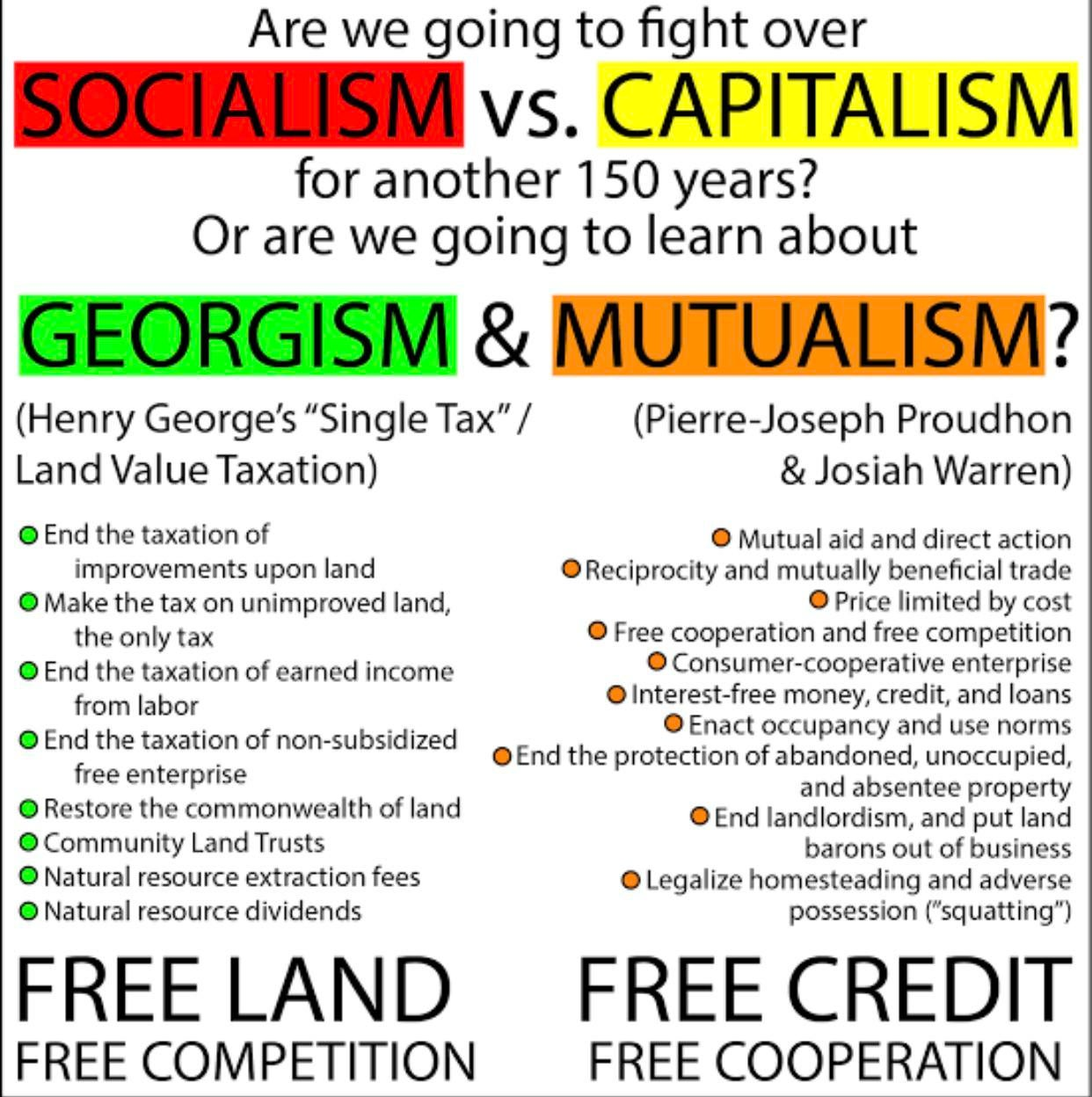
https://www.reddit.com/r/georgism/comments/qaf39r/how_would_geomutualism_work_in_practice_is_it/ I feel like this poster doesn’t understand what capitalism or socialism are. If by capitalism and socialism, it means neo-liberal capitalism and state socialism, then yes, mutualism and Georgism are two ideologies outside this paradigm. Capitalism is the control of capital by single people, who pay their workers wages, while keeping the […]
Marcel Wissenburg ABSTRACT Libertarians are not famed as friends of nature – but is that a matter of principle? I examine consequentialist, deontological and teleological versions of left- and right-libertarianism on three dimensions: their concepts of natural law, geo- and biological nature, and human nature – the latter subdivided into what characterizes humans and what […]
Implement the universal ethic into the constitution, so that there be no restriction or imposed cost on acts which do not coercively harm others. Replace existing taxes with public revenue from user fees, pollution charges, and land value. Replace mass democracy with cellular democracy: small-group voting with bottom-up multi-level governance.
Fred Folvary Introduction Conventional macroeconomics lacks a warranted explanation of the major business cycle, while the Austrian and geo-economic (Georgist) schools have incomplete theories. A geo-Austrian synthesis, in contrast, provides a potent theory consistent with historical cycles and with explanations about the root causes. The geo-economic and Austrian schools have had little interaction in the […]
Land value taxation is impeded by the same national sentiment that has reacted so strongly to the Supreme Court’s Kelo decision. That decision has sparked an intense national debate over the private property versus land use regulation and, ultimately, over the ability government to define a “public purpose.” State legislatures across the country are in […]
from John Ikerd, July 2008 In 1879, Henry George, a journalist and philosopher, proposed to abolish all taxation save that upon land values in his classic book, Progress and Poverty. He suggested that people were not poor because of any lack of productivity of either natural or human resources, but instead because of distribution of […]
Probably no agitation has ever attained the magnitude, either in the number of its recruits or the area of its influence, which has been attained by Modern Socialism, and at the same time been so little understood and so misunderstood, not only by the hostile and the indifferent, but by the friendly, and even by […]
Chapter I The Inquiry Narrowed to the Laws of Distribution—Necessary Relation of These Laws The preceding examination has, I think, conclusively shown that the explanation currently given, in the name of political economy, of the problem we are attempting to solve, is no explanation at all. That with material progress wages fail to increase, but […]
Chellis Glendinning Most students of European history dismiss the Luddites of 19th century England as “reckless machine-smashers” and “vandals” worthy of mention only for their daring tactics. Probing beyond this interpretation, though, we find a complex, thoughtful, and little-understood social movement whose roots lay in a clash between two world-views. The worldview that 19th century Luddites […]
In every psychic experience, even in the production of a work of art, there exists a nucleus that is impossible to transform. It resists any and every action against itself. We are used to dealing with these irreducible and radical othernesses by adapting them to our own way of knowing and our experience. In reality, […]
 Social Liberty