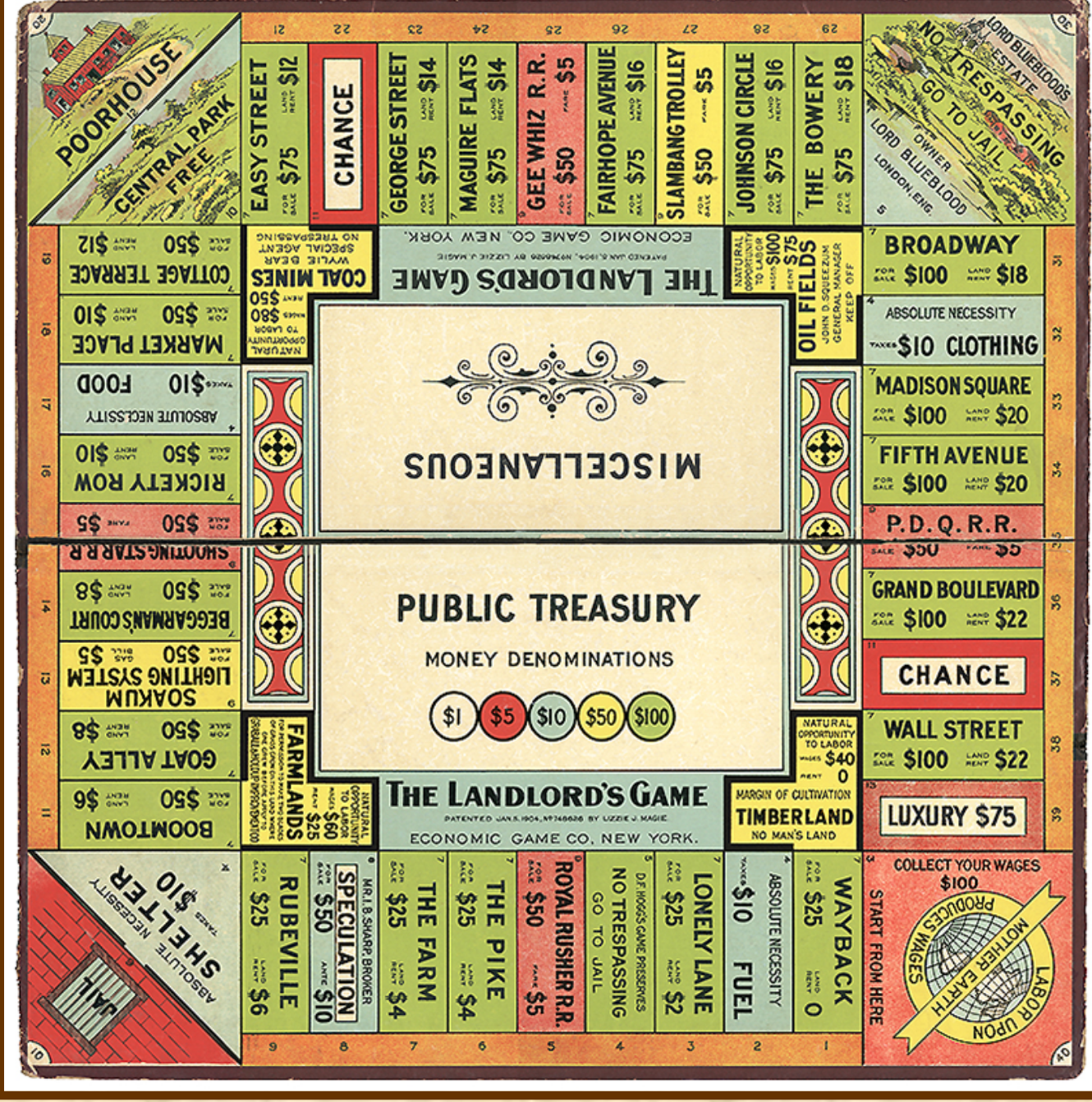
THE LANDLORD’S GAME The Landlord’s Game may be played by two or more. Each player selects one piece, and, if there are two players, each provides himself with $6oo; if three players, each $500; if four players, each $400. All money and implements not in use by the players should be put upon the […]
Open Economy The economy in Cizîre/Rojava is functioning on a survival basis. The other cantons, Afrin and Kobanê, depend on the wealth of Cizîre. Our economy is vital for the others. We are paying all costs for institutions of self-government and public services. We have no surplus to reinvest. We don’t have the means to […]
Edmund Burke You hope, sir, that I think the French deserving of liberty. I certainly do. I certainly think that all men who desire it, deserve it. It is not the reward of our merit, or the acquisition of our industry. It is our inheritance. It is the birthright of our species. We cannot forfeit […]
If many pragmatic people are blind to the importance of decentralism, many in the ecology movement tend to ignore very real problems with “localism” — problems no less troubling than the problems raised by a globalism that fosters a total interlocking of economic and political life on a worldwide basis. Without wholistic cultural and political […]
Above all, I have tried to show in my previous writings how confederation on a municipal basis has existed in sharp tension with the centralized state generally, and the nation-state of recent times. Confederalism, I have tried to emphasize, is not simply a unique societal, particularly civic or municipal, form of administration. It is a […]
Decentralism and self-sustainability must involve a much broader principle of social organization than mere localism. Together with decentralization, approximations to self-sufficiency, humanly scaled communities, ecotechnologies, and the like, there is a compelling need for democratic and truly communitarian forms of interdependence — in short, for libertarian forms of confederalism. I have detailed at length in […]
The assumption that what currently exists must necessarily exist is the acid that corrodes all visionary thinking (as witness the recent tendency of radicals to espouse “market socialism” rather than deal with the failings of the market economy as well as state socialism). Doubtless we will have to import coffee for those people who need […]
Murray Bookchin Few arguments have been used more effectively to challenge the case for face-to-face participatory democracy than the claim that we live in a “complex society.” Modern population centers, we are told, are too large and too concentrated to allow for direct decision-making at a grassroots level. And our economy is too “global,” presumably, […]
In a DAO Democracy, how do we propose a bill, and how does it get adopted? Initially, anyone can propose a bill. It can be submitted at any time. If the prediction market says it has a positive impact on the collective welfare, it is adopted. If not, it is not. If the bill is […]
If we grant that the final result is desirable, how might it be achieved? What are the paths from the world as it exists today to this future, better world where sound governance is the rule and not the exception? An existing organization might already be taking an annual poll of its members, and if […]
Anyone can propose a bill at any time. All proposals are reviewed equally, without bias. Proposals that improve the general welfare (according to the prediction market’s evaluation of the publicly known metric for the general welfare) will be adopted. The mechanism by which bills are reviewed is open to all. Anyone can investigate and present […]
While we have considered DAO’s as a base for a stable democracy, it is apparent that they can serve as a base for any computation. Further, given the persistence of a successful DAO (the DAO for Bitcoin has persisted since January 3rd, 2009), it seems inevitable that Darwinian selection will be applied quite vigorously to […]
A problem that might occur with prediction markets and governmental policies might be described as the End of the World problem. Suppose we are evaluating a policy that is very good, but has the small problem that is has a 20% probability of causing the end of the world. Normally, if a prediction market is […]
 Social Liberty