 Social Liberty
Readjusters
Republicans can lose three Senate seats. Two of their most endangered are in the South Atlantic, one in a state Trump won by eighteen points. In 1881 a Virginia debt revolt held the balance of a tied Senate.
Click to enlarge
In October, an NPR series on swing voters reported on two online focus groups of Georgians who had voted for Joe Biden in 2020 and Donald Trump in 2024. There were twelve of them. Eleven said they were disappointed in the president’s job performance, ten said they regretted their vote, and ten planned to vote for Democratic Sen. Jon Ossoff. Richard, a 56-year-old Republican who had been out of work for ten months, summed it up as “Food crisis, starting the war with Iran, inflation.” Karla, 49, said, “I’ve been so disappointed that I’m just going to go straight and just do Democrat.”
Twelve people aren’t a sample, and NPR said so. They’re a picture of what the numbers are trying to measure, in a region that holds a large part of the answer to whether a switchover from the traditional party alliances is under way. The Senate stands at 53 Republicans, 45 Democrats, and 2 independents who caucus with the Democrats. Republicans can lose three seats and keep control with the vice president’s vote. North Carolina and South Carolina could account for two of the three, and Georgia, a Democratic seat they once hoped to take, now looks out of reach.
The South Atlantic states run from Delaware and Maryland down to Florida, with Washington, D.C. among them. The View from Tallahassee read Florida’s legislature in August, and Councils of the US 2026 placed the region on the map. Nationally, Emerson’s late October poll gives Democrats a ten-point lead on the generic ballot, with the cost of living the top issue and fighting corruption second. In a Washington Post-ABC News-Ipsos poll, the share of Republicans and Republican leaners who say Trump is using the presidency to enrich himself rose from 22 to 34 percent in about a year.
North Carolina: the flip that’s nearly priced in
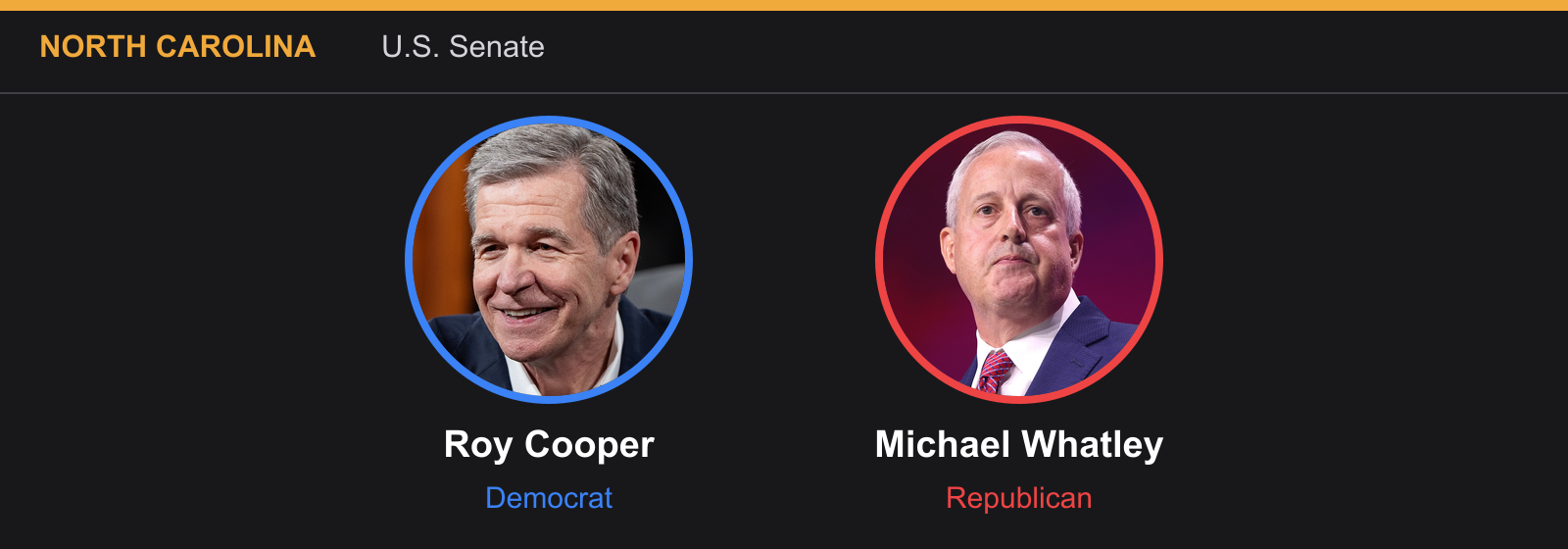 Photos: Roy Cooper, NetwonsBucket, CC BY-SA 4.0; Michael Whatley, Gage Skidmore, CC BY-SA 4.0.


Sen. Thom Tillis is retiring, and former Gov. Roy Cooper is running against Michael Whatley, who chaired the Republican National Committee. A High Point University poll had Cooper up 54 to 40, a very wide lead for a state that Democrats have won at the presidential level once since 1976. One poll isn’t an average, and North Carolina has a long habit of breaking late toward Republicans. Even so, this is the likeliest Democratic pickup in the country, and it’s mostly a story about Cooper, who won statewide twice as governor in years when Trump carried the state. If there’s an alliance moving here, it was already moving for him personally.
Georgia: an incumbent who stopped being the target
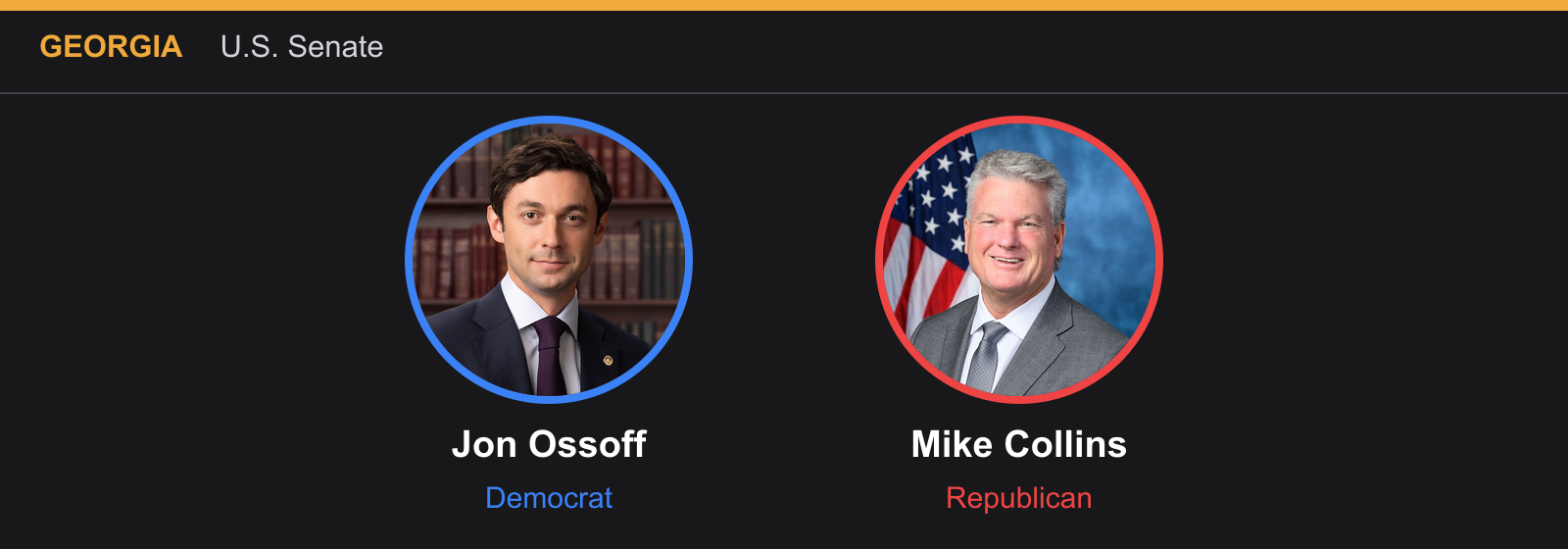 Photos: Jon Ossoff, U.S. Senate Photographic Studio, public domain; Mike Collins, United States Congress, public domain.


Ossoff was supposed to be the Republicans’ best chance at a pickup. A Quantus poll taken October 15 to 17 had him up by 6.9 points over Rep. Mike Collins, and AARP and YouGov polls had him up by 9 and 10. Republicans have gone from attacking this seat to defending elsewhere.
The governor’s race is much closer and shows the limit of the shift. Rick Jackson, the Republican who beat Lt. Gov. Burt Jones in the primary, leads former Atlanta Mayor Keisha Lance Bottoms by 1.6 points in the Quantus poll and 45 to 44 in YouGov’s, while AARP has Bottoms ahead 48 to 46. Barack Obama campaigned in metro Atlanta on October 28. A voter who splits Ossoff and Jackson has left a party’s alliance in one race and kept it in the other. Georgia’s numbers suggest there may be a good many of them, so a Democratic Senate win there shouldn’t be read as a blue Georgia.
South Carolina: the surprise
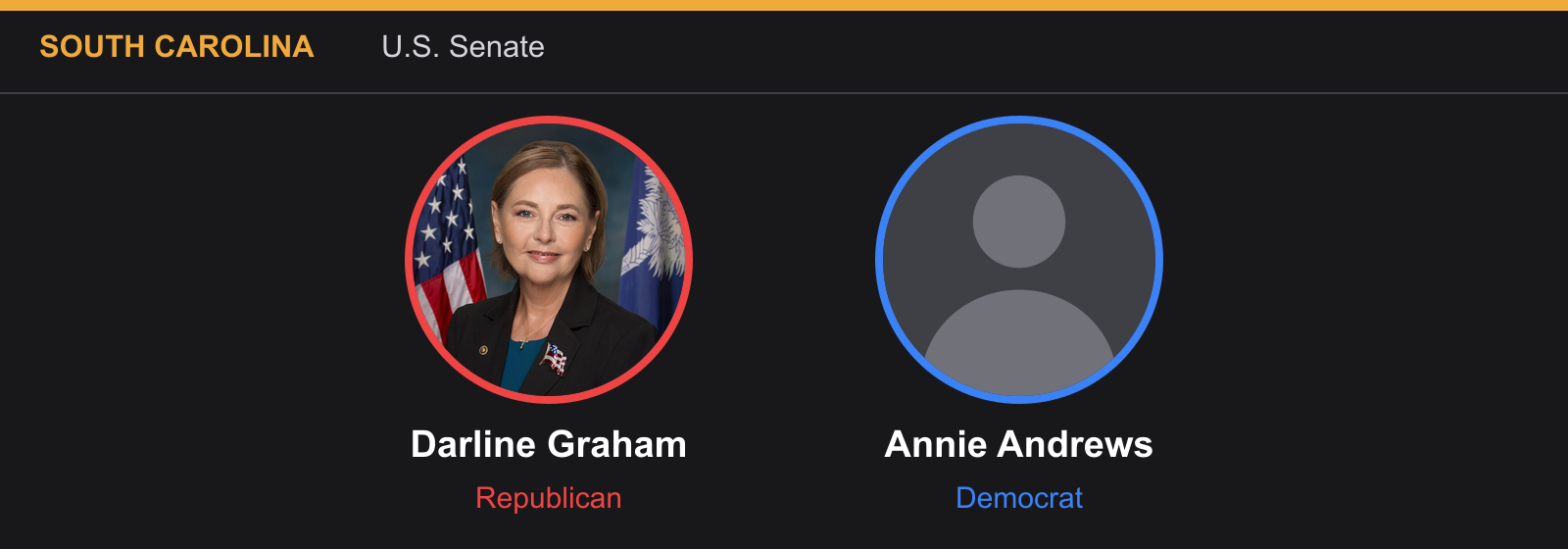 Photos: Darline Graham, Rosa Pineda, United States Senate, public domain; no freely licensed photo of Annie Andrews was found.

This one wasn’t on anyone’s list a year ago. Sen. Lindsey Graham died in office, and his sister, Darline Graham, was appointed to the seat and won the Republican nomination with Trump’s endorsement. She faces Annie Andrews, a Charleston pediatrician. The New York Times/Siena poll released October 28 had them tied at 48. Patinkin, a Democratic firm, had Andrews up 48 to 43 the next day. The Citadel had Graham up 43 to 39, with many undecided. The Senate Leadership Fund is spending $5 million there in the closing weeks, money that a party doesn’t send to a state Trump carried by almost eighteen points unless it is worried.
Analysts have a fair warning about reading too much into this. In 2020 multiple polls showed a tight race between Lindsey Graham and Jaime Harrison, and Graham won by more than ten points. South Carolina has embarrassed its pollsters before, and voters here may come home in the last days.
Something else is different this time. In the Siena poll, 51 percent said Darline Graham lacked the experience to be an effective senator, and voters barely knew her. This race may have less to do with a switchover than with a weak appointed candidate. Alan Wilson, the Republican candidate for governor, leads Jermaine Johnson 51 to 44 on the same poll, a real gap but a lot narrower than this state usually gives. If Andrews wins, she’ll have needed both things, the national climate and the circumstances of the appointment. Picking those apart will take a good deal longer than election night.
Florida: where the alliance has a name
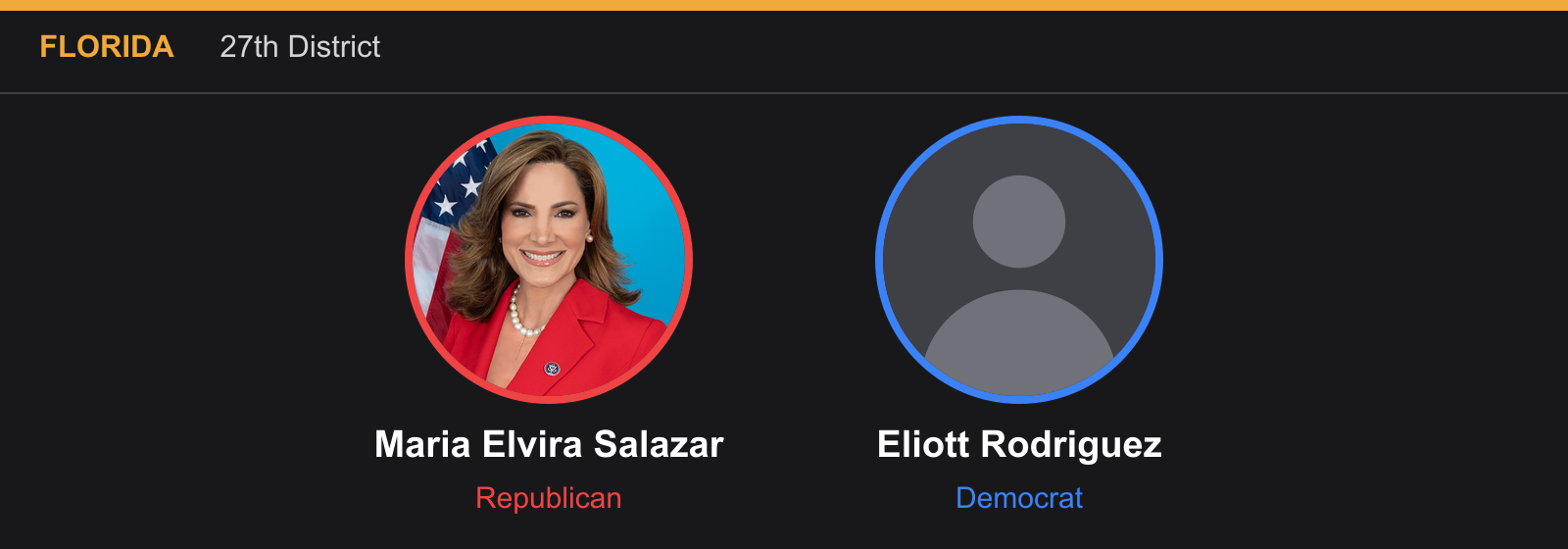 Photos: Maria Elvira Salazar, LogCabinRepublicanFL, public domain; no freely licensed photo of Eliott Rodriguez was found.

Florida saw some of the largest Latino movement of 2024, and it may be the best place to learn whether it holds. Pew found that Trump cut the Democratic margin among Latino voters nationally to 3 points in 2024, from 25 in 2020. An Equis Research survey this fall had Hispanic registered voters favoring Democrats for Congress 57 to 31.
In September Rep. María Elvira Salazar, a Cuban American Republican from a district that’s more than 70 percent Latino, filmed an ad in front of the White House. “The same Hispanics who helped you get to the White House in 2024 feel betrayed today,” she told the president, and said he had “gone too far” on immigration. Trump shared a post calling her a “back stabber.” Her opponent, Eliott Rodriguez, is a former broadcast journalist who also has Cuban roots. Cook rates the seat Lean Republican, and polls have been moving toward Democrats. Her neighbor Carlos Giménez has taken the opposite course in the 28th and stayed with the administration on enforcement. Those two choices run a small controlled test next door to each other.
The political scientist Eduardo Gamarra told NPR that the cost of living is the top issue, with deportations second. A Republican voter at Domino Park in Little Havana blamed Biden for the prices, a reminder that some of this alliance hasn’t moved. The new congressional map the legislature passed in the spring also aims at adding Republican seats, so a gain in votes may produce few seats.
Statewide, the Times/Siena poll had Sen. Ashley Moody up 50 to 44 over Angie Nixon in the Senate special election, and Byron Donalds up 48 to 44 over David Jolly, a former Republican congressman now running as a Democrat, for governor. Trump won Florida by thirteen points in 2024. Four-point and six-point Republican leads in the same state are a substantial narrowing, and also still leads.
Virginia: the map that wasn’t
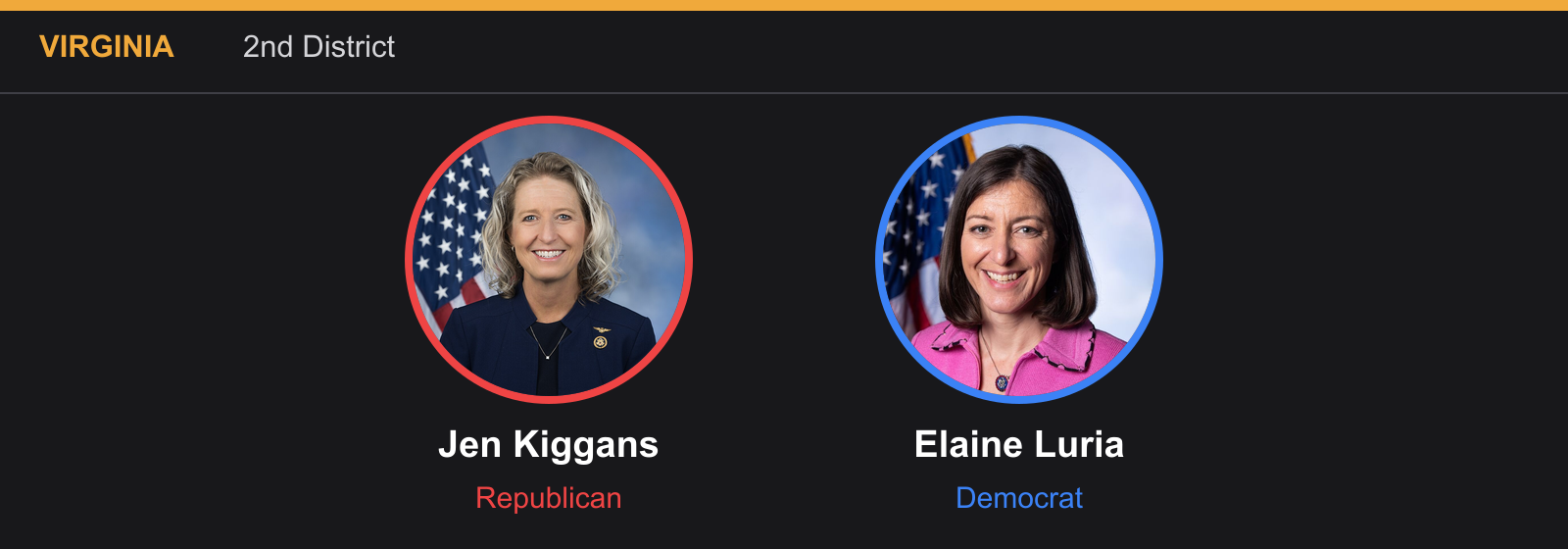 Photos: Jen Kiggans, House Creative Services, public domain; Elaine Luria, U.S. House of Representatives, public domain.


Virginia voters approved a Democratic redistricting amendment in April, 51.6 to 48.4, and in May the state Supreme Court blocked it on procedural grounds. So the map from 2021 stands. That makes the 2nd District around Hampton Roads an unusually clean measure, a rematch on old lines. A Christopher Newport University poll had Elaine Luria up on Rep. Jen Kiggans 46 to 43, inside the margin. Independents who have decided favored Luria 45 to 38, and 74 percent of them disapprove of Trump. Cardinal News observed that a wave would show up here first and then in the 1st.
The district is heavily military, and both candidates are veterans. The poll has nothing specific about the Iran war, but this is a place where that war is a family matter. Democrats in the district rank cost of living first and threats to democracy second. Republicans rank immigration first, with the cost of living far behind at 14 percent. The two alliances aren’t quite answering the same question.
The Readjusters
In the 1870s Virginia owed more than it could pay. The prewar debt, run up on canals and railroads and swollen by the loss of West Virginia, was eating the state’s revenue, and the Conservative government kept up payments to bondholders while schools closed. Under William Mahone, a former Confederate general and railroad man, a coalition broke from the Conservatives in 1877 and called itself the Readjusters. Its program was to reduce the debt, fund the schools, and repeal the poll tax. It won majorities in the legislature in 1879 and 1881 and elected William Cameron governor in 1881. Its coalition joined white farmers from the western counties with Black voters from the east, which was very nearly unthinkable a dozen years after the war. It cut the debt, raised school spending, and abolished the whipping post.
The legislature sent Mahone to the Senate, and he arrived in 1881 to find the chamber split, thirty-seven Republicans and thirty-seven Democrats, with himself and David Davis of Illinois outside both. A first-year senator from a state party nobody had heard of got to name a price. He took the chairmanship of the Agriculture Committee, control of Virginia’s federal patronage, and the right to choose the Senate’s secretary and sergeant at arms, and he organized with the Republicans, with Vice President Arthur available to break ties.
It didn’t last. The Readjusters lost the legislature in 1883 after the Danville Massacre, racial violence days before the vote that Democrats put at the center of their closing campaign, and Mahone lost his seat in 1886. The poll tax returned, and Virginia’s 1902 constitution finished the job.
Two things in that story apply this week. The first is that a party alliance that looked permanent in the South Atlantic has broken before, and money was at the center of the break. The second is the way it ended. Opponents didn’t have to win an argument about the debt. They had only to change the subject to who belonged with whom. Any coalition held together by prices is vulnerable to that move, and the 2024 switch and any 2026 switch back are both coalitions of that kind.
What to read on Tuesday night
Polls close early in this region, Georgia and Virginia at 7 p.m. Eastern, North Carolina at 7:30, and South Carolina at 7, with most of Florida at 7 and the Panhandle at 8. If Andrews is even at 9 p.m., the Senate is in real doubt. Georgia requires a majority, so a close race for governor could go to a December runoff.
Watch Miami-Dade for the difference between 2024 and 2026, and in particular Hialeah. Watch Hampton Roads for the first wave reading. And compare Ossoff to the Democrat for governor, county by county, since that gap is the most direct measure anywhere of how many voters left Trump without joining anybody.
Sources: NPR via KPBS, These swing voters regret voting for Trump and With an ad aimed at Trump, this Republican exposed GOP angst about Latino voters; Emerson College Polling, October 2026 National Poll; Anchorage Daily News/Washington Post, Poll finds jump in Republicans who say Trump is enriching himself; WTOC, New Georgia poll; Siena Research Institute, NYT/Siena poll of Florida, Minnesota and South Carolina; ABC News 4, New NYT/Siena poll shows SC Senate race tied and Candidates, experts react; Newsweek, Lindsey Graham’s longtime Republican-held Senate seat at risk; Florida Trib, As Miami-Dade votes, GOP incumbents walk tightrope; Ballotpedia News, New congressional maps in Florida, Tennessee; WGCU, Virginia voters OK a Democratic effort to redraw the map; Washington Examiner, Despite Virginia redistricting fiasco, Dems eye pair of GOP-held House seats; Cardinal News, CNU poll: Luria leads Kiggans by 3; Wikipedia, Readjuster Party, William Mahone, and 47th United States Congress.