 Social Liberty
Silver Walkout
In 1896 Henry Teller walked out of the Republican convention and the Mountain West followed, on fusion tickets that kept the opposition from splitting. In Montana this year an independent and a Democrat are both on the ballot.
Click to enlarge
Montana’s Senate seat wasn’t supposed to be open. On March 4, Sen. Steve Daines withdrew from his reelection race and endorsed Kurt Alme, the U.S. attorney for Montana, who then took 77 percent in the June primary. Seth Bodnar, the former president of the University of Montana and a former Army Special Forces officer, entered as an independent. The Democrats nominated Alani Bankhead anyway.
The polls since have told a simple story. A Quantus Insights poll on October 20 had Alme at 44, Bodnar at 28, and Bankhead at 21. A NonStop Local/American Pulse poll on October 5 had it 45, 26, and 19. A poll for Bodnar’s own campaign had him ahead 37 to 35, an outlier from an interested source. In the spring a Tavern Research poll tested the two-way versions: Alme and Bodnar tied at 50 in a head-to-head, and Alme over the Democrat by more. The arithmetic is plain. In the Quantus poll, Bodnar and Bankhead together take 49 percent to Alme’s 44.
That’s the Mountain region’s contribution to this year’s question, which is whether a switchover from the traditional party alliances is under way, and whether Democrats’ inroads in the West are real. The River Decides What Seven States Couldn’t read the eight Mountain states as a region in August, and Councils of the US 2026 placed them on the map. National conditions favor the challenge: Emerson’s late poll has Democrats up ten on the generic ballot and Trump at 37 percent, with the cost of living and corruption the top two issues. Here the region has a choice of how to turn that discontent into a seat, and it has made a hash of it in Montana.
Montana: three into two
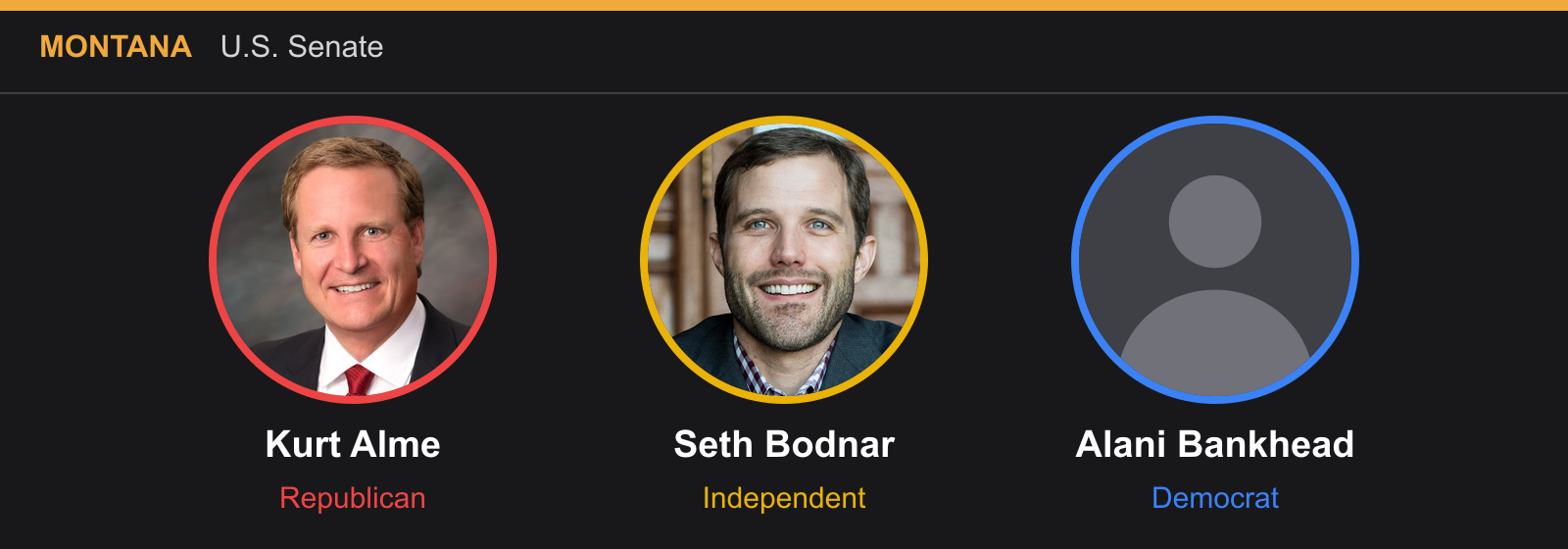 Photos: Kurt Alme, United States Department of Justice, public domain; Seth Bodnar, Todd Goodrich, CC BY-SA 4.0; no freely licensed photo of Alani Bankhead was found.


Bodnar’s campaign resembles Dan Osborn’s in Nebraska, covered in Once-Safe Ground, with the difference that a Democrat with a real base is on the same ballot. A Semafor-reported poll found Bodnar and Bankhead dividing Democratic voters 49 to 43. Bodnar has shown strength among independents, leading them 45 to 36 over Alme in the May Tavern poll, with Bankhead at a distant third. Inside Elections and most forecasters still rate this a Republican hold.
Whether Democrats should have stood down is a real argument. Bankhead’s voters are entitled to a candidate. Many of them have good reason to doubt an independent who owes their party nothing. The result of that choice, though, is that a voter who wants to leave the alliance has two exits and neither leads anywhere. Montana’s system gives a winner the seat with 44 percent.
Nevada: the economy’s own experiment
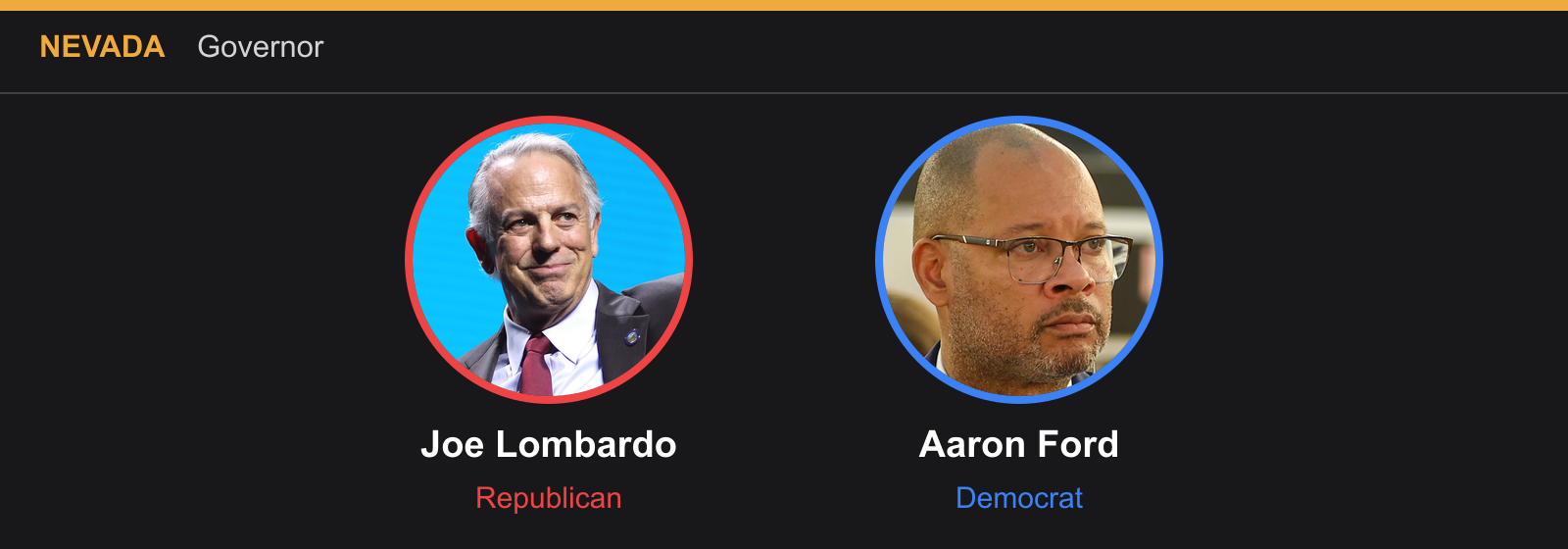 Photos: Joe Lombardo, Gage Skidmore, CC BY-SA 3.0; Aaron Ford, United States Mission to Geneva, United States Department of State, public domain.


Nevada went to Trump in 2024, by a little over three points, and its Hispanic voters, about 30 percent of the electorate, were a big part of it. Gov. Joe Lombardo, the region’s most vulnerable Republican incumbent, is locked in with Attorney General Aaron Ford. PollCheck’s average of sixteen polls had Ford at 44.5 and Lombardo at 43.8 on October 27. RedBox Research, polling October 20 to 23, had Ford up 46 to 43. A poll for Ford’s own campaign, oddly, had Lombardo up 48 to 47, and Noble Predictive Insights had Lombardo up 40 to 37. Multistate rated it Tilt Republican in mid-October, and prediction markets gave Ford the edge. The polls are within their margins, and nobody knows.
The Las Vegas economy is the context. Visitor traffic fell 7.5 percent in 2025, and Ford’s campaign is working to pin that on tariffs and immigration policy and on Lombardo by proxy. Polls of Latino voters here have shown Ford leading by 16 to 31 points depending on the wave, and those figures come in part from campaign framing and from small subsamples, so they deserve caution. Nevada’s economy depends on people’s willingness to travel and spend, and on foreign tourists’ willingness to come at all, and that makes it unusually exposed to a war and a tariff regime. Early voting closed Friday.
Lombardo’s position is an unusual one. He won in 2022 by running a little apart from Trump, and Trump endorsed him. The Las Vegas Sun described him walking a fine line in August. If he survives with Ford’s Latino lead intact, it would mean a lot of Nevadans split their ballots to keep a governor they didn’t mind.
Arizona: the Republican nominee as an argument
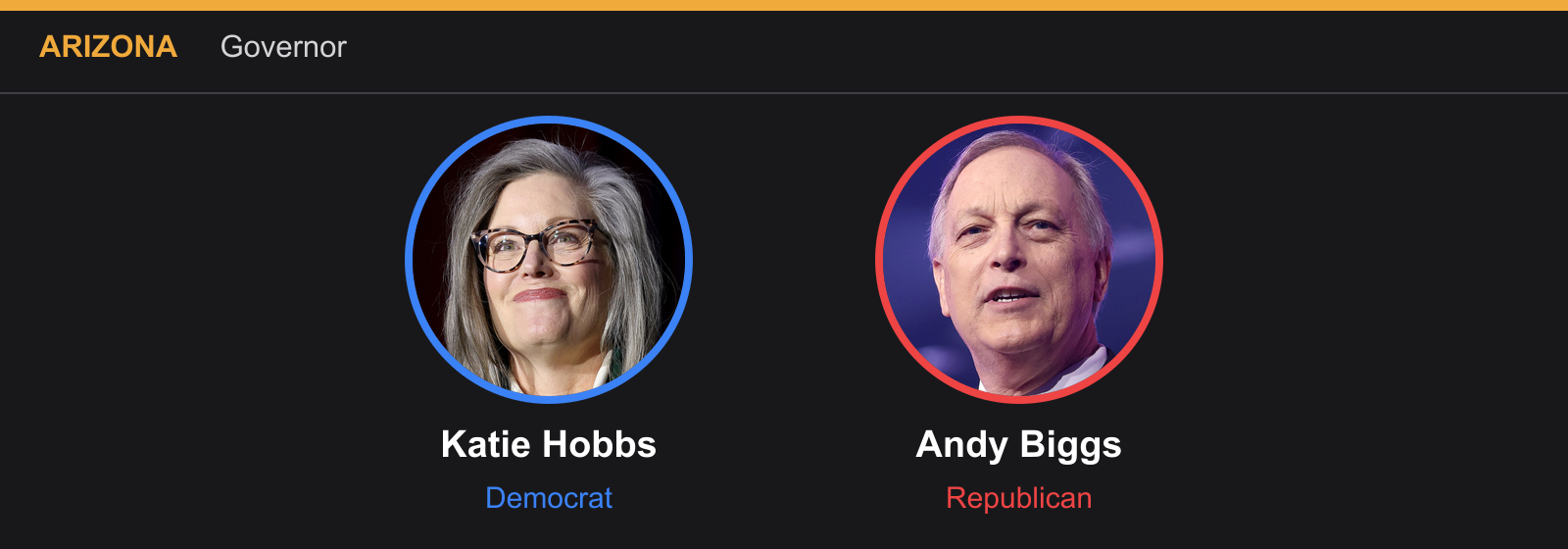 Photos: Katie Hobbs, Gage Skidmore, CC BY-SA 4.0; Andy Biggs, Gage Skidmore, CC BY-SA 4.0.


Arizona may say as much about a nominee as about a switchover. Gov. Katie Hobbs, who won by less than a point in 2022 and whom Republicans considered very beatable, leads Rep. Andy Biggs by nine points in the RealClearPolitics average, 50.2 to 41.0, with recent polls ranging from Hobbs +6 to +13. GrayHouse had a tighter 50 to 45 in late October. Biggs disputes the HighGround poll, and Hobbs skipped the October 6 debate, which would normally be considered a sign of weakness.
Trump carried Arizona by more than five points in 2024. The House races are the better test, and in the 6th District around Tucson, Rep. Juan Ciscomani faces JoAnna Mendoza, a Marine veteran. She led 47 to 45 in a House Majority PAC poll in June, a sponsored and very old number. It’s the sort of split-ticket seat where a nine-point gubernatorial margin might or might not carry down.
Utah and Colorado: lines and leftovers
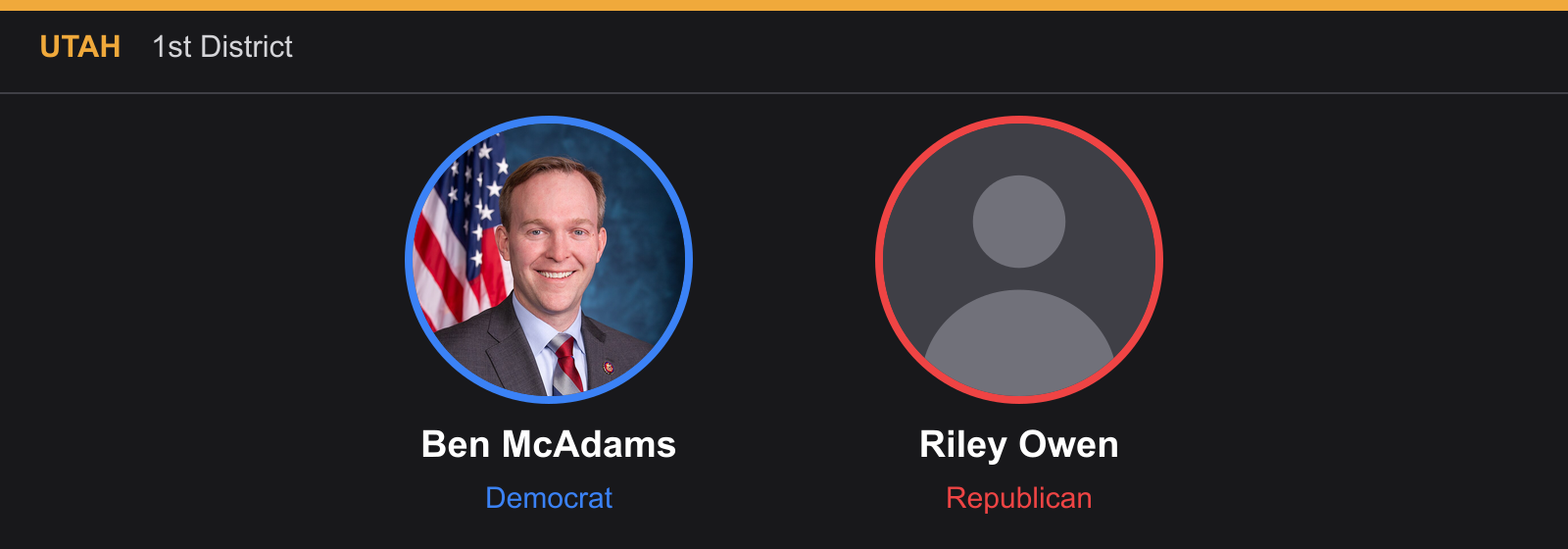 Photos: Ben McAdams, United States Congress, public domain; no freely licensed photo of Riley Owen was found.

The most certain Democratic gain in the region has little to do with voters’ moods. A Utah judge rejected the legislature’s congressional map last November and adopted one with a Salt Lake County district that leaned Democratic by 14 points over four cycles, and by 24 in the 2024 presidential race. Former Rep. Ben McAdams won the Democratic primary and faces Riley Owen, a 27-year-old Navy Reserve intelligence officer, along with a Libertarian, an unaffiliated candidate, and a write-in. Utah’s four-Republican delegation will very likely be three and one. That’s an inroad only in the sense that a court cut the road.
Colorado’s 8th, north of Denver, is the region’s truest toss-up. Republican Rep. Gabe Evans holds the even-leaning seat, and state Sen. Manny Rutinel won the Democratic primary 61 to 34. Most raters call it a toss-up, and no recent public poll turned up in this research.
Idaho and Wyoming aren’t close to anything, and an inroad that reached Boise would be a much larger event than anyone is predicting.
The walkout at St. Louis
In June 1896, Republicans meeting in St. Louis adopted a platform favoring the gold standard. The mountain states were silver country. Their mines, their towns, and their credit all rode on it, and their politics rested on the idea that a contracted money supply was squeezing debtors for the benefit of eastern bondholders. Sen. Henry Teller of Colorado, a former Secretary of the Interior and one of the party’s most senior men, led the opposition. When the gold plank passed, he and twenty-four others marched out of the hall.
Teller’s walkout was an institution changing sides in public. The Silver Republicans included Fred Dubois of Idaho, Frank Cannon of Utah, Lee Mantle of Montana, William Stewart of Nevada, and others, and they backed the Democrat William Jennings Bryan that fall over William McKinley. Bryan swept the mountain states. He carried Colorado with about 85 percent of the vote and Utah with over 80, in a region that had been Republican country a few years before.
It worked in part because the other parties gave way. Democrats took Bryan’s cause, Populists nominated him as well, and across the West the anti-gold forces ran fusion tickets and traded offices among three parties so that their voters weren’t split. Fusion had its critics, and it cost the Populists their party. But nobody had to choose among three silver candidates while the gold candidate took the seat with 44 percent.
Then the alliance mostly reverted. Silver became less urgent after new gold discoveries inflated the money supply and McKinley’s prosperity arrived. The Silver Republican organization dissolved in 1901, and most of its men went back home to the Republican Party after Theodore Roosevelt became president. Teller was one of the exceptions. He became a Democrat and sat in the Senate from Colorado until 1909. A region that had moved as a bloc on one question moved back when that question went away.
This week’s issues have some of that character. People are unhappy about prices and about a war. They’re unhappy about what looks to them like plain old corruption at the top of the government. The Post-ABC-Ipsos poll had 34 percent of Republicans saying the president is enriching himself, up twelve points in a year. Those are grievances, and they could dissolve if gas gets cheaper or the war ends. Bodnar’s voters and Teller’s had the same problem, which is what they’re attached to after the immediate crisis passes. Silver’s answer was that, for the great majority, they weren’t attached to anything, and they went home.
What to read on Tuesday night
Mountain polls close from 7 p.m. local in Arizona through 8 p.m. local in Montana, which means late evening on the East Coast. By then the Senate may already be decided, or may depend on Alaska and Montana alone.
In Montana add the Bodnar and Bankhead totals and compare them to Alme’s. If they sum to more than his, expect a long argument about fusion. In Nevada, Clark County’s mail vote is usually counted over several days, so a narrow election-night lead means little. In Arizona, compare Hobbs’s margin with Mendoza’s in Pima County. And in Colorado’s 8th, a Democratic win in Adams and Weld counties would be a stronger sign of a true shift in alliances than anything Utah’s new map can provide.
Sources: Political Wire, Kurt Alme leads three-way Senate race and Alme way ahead in three-way Montana Senate race; NBC Montana, Poll: 4-way U.S. Senate race benefits Alme; Semafor, Republican exploits divided field in Montana Senate race; Inside Elections, Montana Senate: New poll confirms GOP edge; Emerson College Polling, October 2026 National Poll; Anchorage Daily News/Washington Post, Poll finds jump in Republicans who say Trump is enriching himself; PollCheck, Nevada Governor; MultiState, Nevada governor race and Arizona governor race; Newsweek, Democrats’ chances of flipping GOP governor in swing state Nevada; Las Vegas Sun, With Trump in Las Vegas, Lombardo walks a fine line; Political Wire, Joe Lombardo barely leads in Nevada governor’s race; Ballotpedia, U.S. House battlegrounds, 2026; Associated Press via AJC, Judge adopts Utah congressional map; Salt Lake Tribune, Ben McAdams faces Riley Owen; Wikipedia, Henry M. Teller, Silver Republican Party, and 1896 United States presidential election.