 Social Liberty
Soil and Blood
The same decade that buried the streams under concrete channels also bulldozed the neighborhoods in its path. Both were sold as the same kind of progress, and both outlived the disasters used to justify them.
Click to enlarge
Two things happened to American cities in the same twenty-year stretch, using the same federal money, the same engineering confidence, and in more than one case the same construction crews. One got the streams. The other got the streets. Both are still standing — or, in the streams' case, still buried — many decades after the people who built them stopped being able to explain why on the merits.

The flood that never got to happen again
The doctrine has a birthday, the same way Fire Policy found one for total wildfire suppression. The Los Angeles River flooded catastrophically in March 1938, killing more than 100 people and destroying thousands of homes across a basin that had, by then, already filled in with development right up to the riverbank. The Army Corps of Engineers, newly empowered by the Flood Control Act of 1936 to treat flood control as a standing federal mission rather than an emergency response, drew the only lesson an agency built that way was equipped to draw: never again, at any cost.
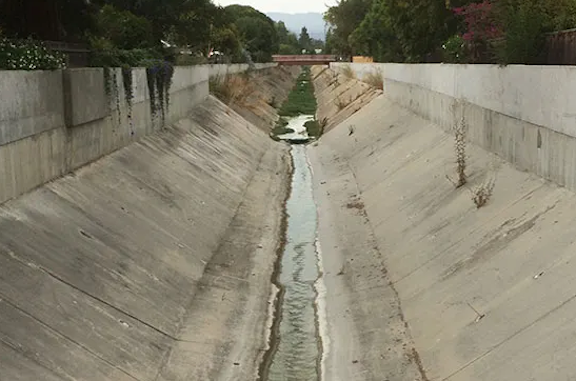
Over the following three decades the Corps lined 51 of the river's 58 miles in concrete — a trapezoidal channel engineered to move a flood through the city as fast as physically possible and out to the ocean before it could pool anywhere a person lived.
It worked, in the narrow sense that mattered to the agency that built it. Los Angeles hasn't had a flood on the scale of 1938 since. It's also true, and was true from the start, that a concrete channel doesn't stop water from falling — it just decides where the consequence of that water lands.
But a river encased in concrete can't recharge groundwater, can't slow a flood pulse by spreading across a floodplain, it can't support the riparian ecosystem a natural channel would carry incidentally.
All of that function didn't disappear when the concrete went in. It moved downstream and spread out in alluvial determinism, onto whichever community had less political capital to keep it from arriving at their doorstep instead — the same externality-shifting mechanism Who Pays? already named for ledger-keeping and Fire Policy named for a century of suppressed undergrowth: a cost that's real, continuous, and diffuse enough that no invoice for it ever gets cut.
The Los Angeles River wasn't unusual. It was the highest-profile instance of a fashion that ran through nearly every American city with a stream running through it. Small urban waterways got culverted wholesale between the 1920s and the 1960s — buried in pipe, paved over, and in most cases erased from the map entirely, not because each one had flooded catastrophically the way the LA River had, but because the concrete channel had become the unmarked default answer to "what do we do with water we don't have an immediate use for." New York City's Sunswick Creek, once a working watercourse through Queens, disappeared into storm sewer the same way Yonkers put the Saw Mill River under a parking lot in the 1920s and Berkeley put Strawberry Creek under a stretch of downtown. None of these were responses to their own 1938. Most of them were responses to nothing in particular — a stream in the way of a street grid, and a technology on hand that made not thinking about it any further the path of least resistance.
The other thing that got capped: the life of the soil
The same federal government building concrete river channels in this period was, simultaneously and often through the same city halls, clearing whole neighborhoods under the banner of urban renewal. The Housing Act of 1949 authorized federal funding for cities to designate areas as "blighted" and acquire them through eminent domain for redevelopment; the 1954 Act extended and accelerated the program. Between 1949 and the early 1970s, an estimated 2,000 urban renewal projects displaced more than a million people nationwide, and the displacement was not evenly distributed — Black and Latino neighborhoods were disproportionately the ones designated "blighted," disproportionately the ones bulldozed, and disproportionately the ones whose residents received the least in relocation assistance when the demolition crews arrived. James Baldwin gave the program's popular name to a national television audience in 1963: "urban renewal means Negro removal."
The Federal-Aid Highway Act of 1956 ran the same mechanism through a different federal line item. The Interstate System's urban segments were routed, in city after city, directly through the neighborhoods local planning departments had already marked for clearance — Overtown in Miami, the Fifth Ward in Houston, the Rondo neighborhood in St. Paul, Nashville's Jefferson Street corridor, Syracuse's Fifteenth Ward. Robert Moses ran the New York version of this playbook for decades, treating a highway route and a slum-clearance project as the same tool used twice.
The engineering literature of the period didn't hide the logic — a highway through a low-value, low-political-capital neighborhood was cheaper to build and easier to approve than the same highway through a neighborhood that could organize against it, and "blight" as a planning category had already done the work of making a neighborhood's residents easy to route around rather than negotiate with.
It's worth being precise about what's being claimed here, because it would be too easy and too glib to say the concrete river channel and the urban renewal bulldozer were literally the same program. They weren't; they ran through different federal agencies, different authorizing statutes, different local departments.
What they shared wasn't an org chart. It was an ideology, arriving at the same moment in the same cities: mid-twentieth century confidence that a sufficiently determined engineering project could simply clear away disorder — a river's tendency to flood, a neighborhood's resistance to clean redevelopment — and that the clearing itself was self-evidently progress, requiring no further argument once "blight" or "flood risk" had been invoked.
A river that flooded periodically and a neighborhood that hadn't been redeveloped were treated, in the planning language of the era, as the same category of problem: disorder in need of correction by whoever held the bulldozer.
The land in between got the same treatment
The fashion didn't stop at streams and demolished blocks. It ran through the ordinary green space sitting between them too, and the person most responsible for it in the country's largest city was the same one already named above for a different reason. Robert Moses ran New York's highway-clearance program from the Triborough Bridge Authority, but starting in 1934 he was simultaneously the city's Parks Commissioner, and inside his first years in that post he built or rebuilt 255 playgrounds — replacing Olmsted-era lawn, sand lots, and naturalistic parkland with a standardized municipal kit of chain-link fencing, steel equipment, and, overwhelmingly, poured asphalt. A generation of American children grew up playing on surfaces their grandparents' parks had never had, not because any one playground's asphalt won an argument on its own merits, but because it was maintainable at the scale a single citywide parks department needed to manage, and the same mid-century confidence about what "modern" public space should look like treated a stream running informally through a park exactly the way it treated a "blighted" block: something to be regularized before it could be enjoyed.
The Works Progress Administration ran the identical fashion at federal scale in the same years channelization and slum clearance were getting funded, pouring concrete bathhouses, pools, amphitheaters, and drainage systems into thousands of city and state parks nationwide between 1935 and 1943 — not because every park needed all of it, but because a public-works program built to employ people fast rewards whatever project is easiest to specify, inspect, and finish on schedule, and a poured concrete structure clears that bar in a way a restored meadow or a managed woodland edge never will. The industrialization wasn't limited to infrastructure the public was afraid of. It reached the place the public went specifically to get away from infrastructure, on the theory that a park, like a river or a neighborhood, was simply more disorder waiting for the same kind of correction.
None of this is only a historical artifact this site can file away as settled. An Industrial Park from a Bloated Government already found the identical mechanism running today, under bond money instead of WPA relief funds — a state contractor grading a city park flat under a resilience contract, scored on the same two variables, liability and maintainability, that decided what asphalt replaced grass with in 1934. The Park named the posture this produces "overvaluing": a park loved so anxiously that loving it consists mostly of restricting and paving it. The throughline from Robert Moses's playgrounds to a 2026 masticator crew clearing brush a groundskeeper would have recognized as a volunteer tomato patch is exactly that posture, run continuously for ninety years by whichever agency currently holds the budget to act on it without asking the people using the park first.
The sacred cow, fed and worshipped -- twice
A Meadow of Sacred Cows supplied the test worth applying to both halves of this at once: a nameable, concentrated beneficiary; a switching-cost story that mostly only the beneficiary has ever had to defend; and an arrangement that survives past the point anyone would still choose it fresh, wearing the borrowed legitimacy of the disaster that first justified it.
Both halves pass easily. The concrete-channel default persisted for decades after hydrologists had the evidence that channelization increases peak downstream flow, destroys groundwater recharge, and produces exactly the urban heat island effect a shaded, vegetated streambank would have mitigated — evidence that caught up with concrete drainage roughly on the same delayed schedule Fire Policy found for fire ecology catching up with total suppression.
The Army Corps of Engineers, the construction contractors it worked with, and the downtown property interests whose land a channelized river made insurable and developable all had a nameable, concrete reason to prefer the channel stay a channel. The neighborhoods losing groundwater recharge, shade, and the ordinary amenity of a visible stream had no comparable standing to organize, for the same public-choice reason A Meadow of Sacred Cows already gave for shipping subsidies: a large, diffuse cost never assembles the coalition a small, concentrated benefit gets for free.
Urban renewal ran the identical mechanism with a shorter half-life, mostly because its cost was never as invisible as a buried creek's. A demolished neighborhood is a visible, attributable harm in a way lost groundwater recharge isn't, and by the late 1960s the backlash — organized in real part by the very communities being displaced, and amplified by journalists and scholars willing to name the program's racial pattern plainly — had enough political weight to force real retreat.
The Housing and Community Development Act of 1974 formally ended the urban renewal program as such, folding federal redevelopment money into Community Development Block Grants with considerably more local and resident input built in. That's a faster correction than concrete channelization got, and it's worth crediting rather than flattening into the same story: not every sacred cow grazes on the same clock, and the one with a body count attached to a specific bulldozer on a specific street was always going to draw fire before the one whose damage showed up as a raised water table two towns downstream.
But formally ending a program is not the same as undoing what it built, the same gap Fire Policy found between the Forest Service retiring the 10 a.m. policy on paper in 1978 and actually changing what happened in the woods. The highways urban renewal cleared land for are still there, still carrying traffic through the middle of neighborhoods that in many cases were never rebuilt to anything like their prior density or cohesion. The concrete channels are still there too. Retiring the ideology that built both didn't retire the concrete itself, and concrete, once poured, doesn't require anyone to keep believing in it to keep doing exactly what it was built to do.
What reversing it actually looks like -- positive externalities
Neither half of this is purely a historical grievance with nothing left to do about it. Both have working counter-examples, and they're worth naming because they show the fix was never actually exotic — it just required someone willing to spend money undoing a default nobody had defended on the merits in decades.
Seoul removed an elevated highway built directly over its buried Cheonggyecheon stream in 2003 and restored 3.6 miles of the waterway as public open space, completing the project in 2005 — a reversal of the exact highway-over-buried-stream pattern American cities built simultaneously and never got around to undoing.
Yonkers daylighted a stretch of the Saw Mill River in 2011, pulling the same stream that had spent nearly ninety years under a parking lot back into the open as the centerpiece of a new downtown park, and reported measurable reductions in downstream flooding as a direct result — the flood-control case for daylighting turning out to run in the opposite direction from the channelization-era assumption that concrete was always the safer bet.
Los Angeles County adopted its own LA River Revitalization Master Plan in 2007, with pilot sections since restored to a soft, vegetated bank rather than the original trapezoidal concrete, explicitly reversing the 1938 doctrine on the same river that wrote it.
Highway removal has followed a parallel, if slower, track — Rochester filled in a sunken stretch of its Inner Loop in 2017, reconnecting street grid the original highway had severed, and several other cities, including New Orleans with the Claiborne Expressway, have active studies underway on doing the same to interstates built directly through the neighborhoods urban renewal cleared for them.
None of these projects required a new theory. They required a municipality willing to treat a decades-old default as a choice again, rather than a fact about how a city's infrastructure has to work — the same reopening A Meadow of Sacred Cows described as the whole difference between a locked-in convention and an exploitable one. A stream doesn't need a Corps of Engineers permit to know how to be a stream again once the concrete comes off it.
A street grid doesn't forget how to reconnect once the highway trench filling it is filled back in. What both actually needed was a generation of engineers and planners no longer required, by institutional muscle memory or contractor incentive, to treat 1938's answer as 2026's.
The generation raised inside the answer
None of the preceding sections explain why this default has been so slow to lose its grip on ordinary public opinion, as opposed to the specific beneficiaries who had a nameable reason to defend it. Land is powerful in the ways it influences us.
Fisheries science supplied the clearest name for this difficulty two decades before anyone applied it to a city. Daniel Pauly's 1995 paper on what he called "shifting baseline syndrome" described fisheries scientists who each took the fish stock they encountered at the start of their own career as the natural, healthy baseline against which to measure decline — never realizing that the stock they were calling healthy was already a fraction of what the previous generation's scientists had called healthy, and so on backward, until the actual pre-exploitation baseline had been forgotten by everyone still alive to study it.
Nobody in that chain was lying. Each generation was simply measuring against the only baseline it had ever personally seen.
The developmental psychologist Peter Kahn found the same mechanism running in people, not just professions, and running much faster. His research with children in Houston — a city with some of the country's worst industrial air quality at the time — found that kids who'd spent their whole lives breathing it described their environment as basically fine, not because they'd been told it was fine, but because they had no other atmosphere to compare it to; the smog was simply what air was.
Kahn called this "environmental generational amnesia," and it names something more specific than ignorance of history. A person can be taught the history of the Los Angeles River in an afternoon. What can't be taught nearly as easily is the felt sense that a concrete trapezoid is not what a river is supposed to be, because that sense has to be built from direct experience of the alternative, and most of the people alive in most of these cities today have never had that experience. They were born after the concrete, not before it.
That's the zeitgeist worth naming plainly, because it changes who this essay is actually arguing with. The concentrated beneficiaries A Meadow of Sacred Cows already named — the agency budget, the contractor backlog, the newly insurable downtown parcel — have an interest in the arrangement staying exactly as it is, and know it.
The much larger group of people who simply shrug at the idea that anything needs fixing aren't defending an interest at all. They're reporting their own honest baseline, calibrated from birth by the very artifact this essay is arguing should be revisited. That's a harder audience to move than a lobbyist, not because they're wrong to trust their own eyes, but because their eyes were trained on the deformity, not the harmony — a majority sincerely unable to see a scar as a scar, because it was already load-bearing infrastructure by the time they were born standing on it.
But not seeing a scar as a scar is a different failure than actually preferring it, and the two get conflated more often than the evidence supports. Shifting baseline syndrome operates on absence — it explains why nobody spontaneously objects to a river they've never known any other way, because the alternative was never in front of them to compare against.
It doesn't survive being asked the question directly. Put the choice in front of the same audience explicitly — should this park be graded flat and paved for a maintenance road, should this stream run in a concrete trapezoid or between planted banks — and the shrug tends to disappear, because now the person isn't being asked to notice something missing, they're being asked to choose between two things actually in front of them, and most people, asked that version of the question, say no to the industrialized one even inside the zeitgeist this essay has just spent several paragraphs describing.
That's the same asymmetry A Meadow of Sacred Cows already found in the arrangements it examined: the silence isn't consent, it's just that nobody with standing to ask the direct question has actually asked it, and a majority that would say no if asked isn't the same as a majority that agrees with the answers it inherited.
That zeitgeist is also not evenly distributed across the places it claims to describe, and the imbalance runs in the same direction twice. The baseline most people are actually measuring against — concrete-channel-as-normal in 1970, restoration-as-obvious-progress in 2026 — is disproportionately a high-population, high-density urban baseline, because that's where the money, the media coverage, and the case studies concentrate in both directions.
The Army Corps poured its biggest, most-photographed channels where the biggest, most federally fundable floods were: Los Angeles, not the small town two counties over with a modest creek and no comparable tax base to attract a mid-century reclamation project in the first place.
Every reversal this essay has named — Seoul, Yonkers, Los Angeles County, Rochester, New Orleans — is the same kind of place for the same reason: it takes a metro-scale budget and a metro-scale media apparatus to generate the case studies a national "zeitgeist" gets built from at all. A typical smaller town or suburb was rarely offered the 1938 bargain at the scale this essay has been describing, and it isn't obviously being offered — or asking for — the 2026 correction at that scale either.
Growing a Movement as a Design Problem already made the general version of this point about a different kind of uniformity: the right altitude for a decision is the altitude at which the people living with the outcome can actually make, test, and revise the argument themselves, not the altitude a national narrative happens to be pitched at because that's where the loudest examples live.
A suburb or town whose creek was piped into an ordinary storm drain decades ago on a modest, defensible engineering judgment, still serving that judgment adequately today, owes the metro zeitgeist neither the original shame nor the current fashion for undoing it. The mistake worth avoiding isn't only the one this essay has spent most of its length on — a big city treating 1938's answer as permanent. It's the mirror mistake of a small town importing either verdict, pro-concrete or anti-concrete, from a national conversation that was never actually describing its creek, its street grid, or its own budget to begin with.
Proceeding without becoming the thing being corrected
There is risk in handing that same overconfidence to the other side of the argument — swapping a fashion for concrete for an equally unexamined fashion for tearing it out, defended with the identical mid-century certainty that a sufficiently determined project can simply clear away whatever's there and call the clearing progress.
Daylight...or Die already named the discipline that has to apply here as much as anywhere else it's been invoked on this site: Elinor Ostrom's finding that the commons arrangements which actually survive pressure are the ones where the people bound by a rule can also participate in revising it, where sanctions and interventions escalate gradually rather than starting at maximum severity, and where the rule stays provisional rather than being replaced by a new dogma nobody's allowed to question either.
A reversal project run the way urban renewal was run — a planning department deciding unilaterally, on behalf of a neighborhood that finds out afterward — would be the same mechanism wearing a greener coat, and the communities who'd bear a new round of construction, detours, and disrupted access have exactly the standing to be in that room that their predecessors were denied the first time.
The reversals that have actually worked bear this out: Seoul, Yonkers, and Los Angeles County all moved in pilot sections rather than tearing out an entire system at once, which is what let each project generate its own evidence — measured flood outcomes, actual cost figures, a visible park where a parking lot used to be — instead of asking a skeptical public to trust a theory sight unseen.
That's the same A Meadow of Sacred Cows test, run forward this time instead of backward: before funding a reversal, ask whether there's a nameable beneficiary being served by the change beyond the diffuse public good, whether the switching cost being cited is real or just untested, and whether anyone defending the concrete channel or the highway trench has actually been asked to justify it on today's evidence rather than on 1938's. A pilot section that clears that bar earns the next one. A blanket mandate that skips the question isn't correcting the sacred cow. It's raising a new one, on land the old one just vacated.
What that leaves is a narrower, more patient project than either "tear it all out" or "leave it exactly as it is" — treat every channel and every highway trench as a specific, revisitable claim rather than a fixed feature of the landscape, price what it's actually costing the people downstream or displaced from it, and let the community currently living with the consequences decide, with real information instead of either generation's inherited certainty, whether this particular piece of 1938's answer still earns its keep in 2026.
Some of it will. A city that floods without a channel hasn't been served by tearing the channel out to make a point. Floods are part of what restores and makes the land healthy, sudden unexpected floods are not. The discipline isn't a verdict handed down in advance either direction. It's a willingness to ask the question again, in public, project by project, of a landscape that spent ninety years being told the question was already closed.
The tell, applied to both
Ask a hydrologist today whether burying every urban stream in concrete was good policy for the watershed it ran through, and the answer isn't a principled defense — it's the same shrug A Meadow of Sacred Cows found behind the naval-protection question and Fire Policy found behind ninety years of total suppression.
Ask an urban planner whether routing an interstate through a neighborhood chosen mainly for its inability to fight back was sound transportation policy, and you get the same shrug again, except this time attached to an admission that the neighborhood in question usually didn't get to be in the room when the routing decision was made at all.
Neither the concrete channel nor the urban renewal bulldozer was ever really a fight between progress and nostalgia, the frame each was sold under at the time. Both were a concentrated set of beneficiaries — an agency's budget, a contractor's backlog, a downtown property owner's newly insurable land — capturing a decision that a much larger, more diffuse group would go on paying for indefinitely, largely without ever being asked whether the arrangement was worth what it cost.
The stream didn't get a vote on whether it stayed buried. The neighborhood in the highway's path mostly didn't either, at the moment the vote that mattered was actually taken. Both were told, in the vocabulary the era had on hand, that the thing being cleared away was disorder, and that clearing it was simply what a serious city did. Six decades later, cities are spending real money finding out that a lot of what got cleared away wasn't disorder at all. It was just the thing that had been there before anyone with a budget got around to deciding it shouldn't be.
Sources: Los Angeles County Public Works, Los Angeles River Master Plan; Los Angeles Times and Army Corps of Engineers historical accounts of the March 1938 flood and subsequent channelization; National Weather Service, The Great Flood of 1938; Housing Act of 1949 and Housing Act of 1954, legislative history via the National Archives; James Baldwin, remarks on urban renewal, WGBH/PBS interview, 1963; U.S. Department of Transportation Federal Highway Administration, historical accounts of the 1956 Federal-Aid Highway Act's urban routing; Housing and Community Development Act of 1974; Seoul Metropolitan Government, Cheonggyecheon Restoration Project; City of Yonkers and Groundwork Hudson Valley, Saw Mill River daylighting project documentation; City of Rochester, Inner Loop East Transformation Project; Robert A. Caro, The Power Broker: Robert Moses and the Fall of New York (1974), on Moses's simultaneous tenure as New York City Parks Commissioner and his citywide playground-construction program; National Park Service, historical accounts of Works Progress Administration and Civilian Conservation Corps park construction, 1933–1943; An Industrial Park from a Bloated Government; The Park; Daniel Pauly, "Anecdotes and the Shifting Baseline Syndrome of Fisheries," Trends in Ecology & Evolution (1995); Peter H. Kahn and Batya Friesen, research on "environmental generational amnesia" including studies of children's environmental perception in Houston, Texas; Elinor Ostrom, Governing the Commons: The Evolution of Institutions for Collective Action (1990), cited previously in Daylight...or Die; A Meadow of Sacred Cows; Growing a Movement as a Design Problem.