 Social Liberty
What Is Winning
This month's news was the price of Nvidia, while by the Fed's survey the lowest-income families skipped meals at twice the national rate, and data centers rise where neighbors object. What is a party for, and what would it mean to win?
Click to enlarge
On 17 November the Associated Press ran a story headed “Another wipeout hits Wall Street as Nvidia, other jittery AI stocks swing lower.” It was one of dozens that week. The price of one company’s shares moved by single-digit percentages in a day, and nearly every business desk in the country put it on its front page, with a chart.
Six months before that, on 27 May, the Federal Reserve Bank of New York published a survey result that got far less room. Among lower-income families, more than 38 percent were receiving SNAP benefits, against about 22 percent six years earlier, and among families earning under $50,000 a year, nearly 20 percent had skipped meals or gone without. NPR’s account of it said more people in the United States were going hungry than during the depths of the pandemic.
The survey was taken in February and the figures are the latest of their kind we could find, so what the bottom looks like in November is one more thing the press hasn’t covered. The two stories sat in the same economy and only one made the front page.
That gap is what why politics. The index and the bottom are both economic news. Only one of them is reported as though it were the economy, and the other is left to the people who dwell in it.
A party that wants to say something different has to start by saying what a party is. What a Party Is For asked that of the Mises Caucus and its plan for the Libertarian Party, and this piece asks it again from the other side.
What winning is
The ordinary answer is that a party… the institution of the party… exists to win elections. It runs candidates, wins seats and holds offices, and scores itself by the count.
That answer is too thin to be right–a party can win every seat in a legislature and leave every condition it ran against exactly where it was–it can lose every election and see its program become law.
The Populists of the 1890s did the second. Their 1892 platform, written at Omaha, called for a graduated income tax and the direct election of senators, among much else. The party’s presidential vote peaked at about eight percent in 1892 and it was absorbed into the Democrats four years later, which any seat-counter would call a loss. The income tax became the Sixteenth Amendment in 1913 and the direct election of senators the Seventeenth in the same year. Nobody put the Populists’ name on either, but it hardly mattered.
Opportunity came at the same question the other way, a New Zealand party that took seven seats this month on a platform built around a land value tax. Whether that counts as winning depends on whether the tax gets passed, and a party is not the one that decides.
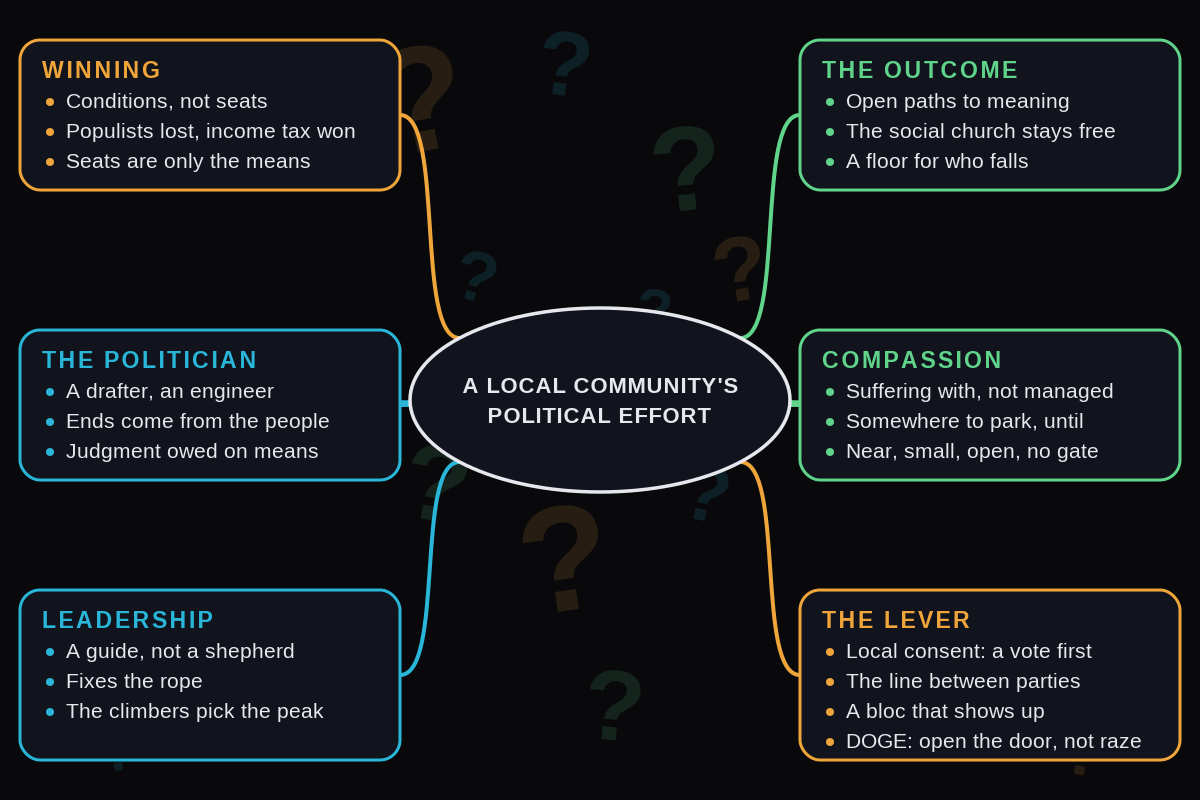
So a working definition: a party wins when what it stood for becomes a condition of the country, whichever name is on the door when it happens. It loses when it holds the office and the condition is unchanged. By that measure the offices are a means, a long way short of a score. That is a hard way to run a party, because the count is easy and the condition is hard to see, and it is why Rebranding a Borrowed Line and the other election pieces here spend as much time on what the ballot counts as on who is on it.
What a politician is, if the law comes from the people
Three Frames of Government ended on the claim that a government of the people has to be by them. Take that seriously and it changes what an elected person is for.
In the first frame the legislator is a ruler, with a program and the power to impose it. In the third frame the law comes from the people, in their meetings, associations and bylaws, by the way a neighbor persuades a neighbor. The legislator is then something closer to a drafter. The people say what is wanted. The politician works out how to write it so that it does what it says, costs what it can be afforded, and doesn’t break the law next to it. That is a technical job, and an honorable one, and it needs craft.
Edmund Burke told the electors of Bristol in 1774 that their representative owed them “not his industry only, but his judgment,” and that he betrayed them if he sacrificed it to their opinion. That is the other view, and it has a good deal of truth in it for a legislator facing a hundred bills. But Burke was describing a representative of a population, and the representative’s judgment was the point. In a frame where the people are the boss, judgment is still owed, but it is owed about means. The old word for such a person is an engineer, and That Queyntyly Engynours Made followed the word back to ingenium, wit, a faculty that belonged to everybody before it belonged to a license. A politician in the third frame has the same job. The ends come up from the people. The cleverness is in the building.
What leadership is
That leaves a gap, because someone has to say where a people is going, and a group of forty at a garden meeting does not say it for a country. This is what leadership is for. A leader does not rule, and a leader does not take dictation either. The work is to make a path visible and then to open it.
The image that comes to mind is the shepherd, and it is a trap. Tocqueville’s government that keeps its people as a flock of timid animals “of which the government is the shepherd” is the first frame described in one sentence. A better picture is a mountain guide. The climbers choose the peak. The guide knows the rope, the weather and where the ice is rotten, goes first, and fixes the line so that the ones behind can follow in their own time. A guide who decides the peak has stopped being a guide. A guide who has no opinion about the ice is no use.
Leadership in that sense has a future in it, a picture of where the line could go and why anyone should want to climb. It also has a particular relation to law, taxes and the other tools of a government. Those are the rope and the pitons. They don’t choose the peak. They are what a people uses to get up a hard pitch together that nobody could do alone.
The outcome
What outcome is the line headed for? Not a fixed state. A society that agreed on its destination would not be a free one. The outcome that seems right has two parts, and they are the two the Social Liberty position keeps coming back to.
The first is that every person has an open path to the things that give a life meaning: a family, friendships, work worth doing, a church or a garden or a band. This is what the Bill of Separations protects when it keeps the state out of those rooms, and what it means by the social church, the parts of life that deliver spiritual meaning to us.
The second is a floor. A person can’t walk a path while falling, and Thomas Paine, in Agrarian Justice in 1797, said it was “not charity but a right, not bounty but justice” that he pleaded for. The floor is how the first part becomes possible for someone with nothing under them. Liberty for Thee gives that floor a face in Ray, living on $1,400 a month with a savings cap that has not moved since 1989, who is not asking to be carried, only to be allowed to keep a little of what he is given.
Why compassion
Libertarianism of the individual has an answer to every question about what the state should leave alone, and the answer is clear and often right. It has no good answer to the person who is alone in the room that the state left. The difference between that and the Social Liberty view is the difference between leaving a person alone and leaving a person on their own.
Compassion comes from the Latin for suffering with. It is not a feeling, and it is not a program for a government to administer. It is a relation between people who are in the same place, and the first thing a government can do for it is stand out of the way. In many cities it is against the law to feed people in a park. In 2014 police in Fort Lauderdale cited a ninety-year-old man, Arnold Abbott, for handing out meals to the homeless. A benefit cliff is the opposite error: a rule built to help that takes the help away when a person earns a little more. Both put a barrier on a path that someone walking by would have taken without being told. Opening those paths comes first, and it is a larger task of law than it sounds.
A party that leads toward compassion therefore has a plain list of jobs. Remove the rule that makes helping a crime. Raise the cap that makes a saved dollar a reason to lose a home. Keep the rooms of the social church out of the state’s hands. Put a floor under the person who is falling, and do it in the form that lets them stand up. None of that is sentiment. It is the work of an engineer, in the sense above, for people who are not in the room.
And why now? Because it is what is being asked for. People at the bottom of the economy are skipping meals, and the press is looking at a share price. A politics that waits to be asked will go on waiting while the loudest voice sets the agenda, and that is a different thing from a politics that listens.
Until then, somewhere to park
The first service is a plain one. Until the federal government gets its spending and the creation of money under control, it has to provide campgrounds for the people who have no choice but to live in their cars.
The reasoning is the reasoning of the whole essay. A person who owns assets, a house or shares, comes through a rise in prices partly protected, since what they own tends to rise too. A person with a paycheck and a rent, and no house, has nothing that rises with it. Printed Money and Generational Phenomena followed how a generation’s whole sense of money depends on the years it came of age in. The people at the bottom now are the ones who carry the cost of printing and spending that was never put to them as a vote. A government that has created that condition owes a floor to those who fall through it, and the floor should be the cheapest, most immediate thing that works. For someone whose car is also their bedroom, that is a legal place to stop for the night, with water, a toilet, a bin, a lock on the gate and a number to call.
Some cities already do it. Santa Barbara has run a safe parking program since 2004, and others have followed, lots that are staffed or monitored by a church or a nonprofit, open at night and closed by day. The need has also become sharper in law. In Grants Pass v. Johnson in 2024 the Supreme Court held that a city may enforce its camping bans against people with nowhere else to sleep. A ban with nowhere to go is the first frame at its most complete, a rule that makes a condition a crime and offers no alternative. The sensible reply is not to repeal the ban. It is to open the place.
The word until matters. A campground is a patch on a hole, and it should be seen as one. The program is a stopgap that the money problem ought to make unnecessary, and a party that wants to win in the sense of the earlier section judges itself by how few people are using it, and how fast the number falls.
Compassion that survives a scam
Compassion has a trust problem, and it was earned. A person who has been defrauded does not go back to the same kind of giving. The pandemic relief programs lost tens of billions of dollars to fraud, and the Government Accountability Office put the unemployment insurance share alone between $100 billion and $135 billion. A Minnesota child-nutrition program, Feeding Our Future, was charged in 2022 with a scheme that prosecutors put at about $250 million, claiming meals for children who were not served. Every charity that sends an appeal and every scam that imitates one has drawn from the same well. People now ask a question before they give, and it is a fair one: how would I know?
A compassion that is going to be trusted after that has to answer the question in its structure, since the kind that asks to be believed has already been tried. Our philosophy gives six ways to do it, and each follows from the third frame and not the first.
- Near enough to check. The first frame’s compassion is administered from a distance, by an office that can’t be seen from the street where the money lands. The third frame’s is done by neighbors, and a neighbor can walk over and look. Elinor Ostrom found that the rule-keeping communities that lasted all had one trait in common, which was that the people who relied on the resource watched one another. Compassion at the scale of a street is compassion that can be audited by eye.
- Small enough to fail safely. A scheme of a quarter of a billion dollars has a lot of room to hide a theft. A fund of ten thousand dollars on a block does not, and when it is stolen the loss is small, the thief is a known person and the fund is easy to start again. The first frame’s remedy is to add a rule, and so a layer of the trellis commission. The third frame’s remedy is smaller units.
- Open books. From Time to Time went back to Madison’s clause that the accounts of the government be published. The same applies to a neighborhood fund or a church kitchen: where the money came from, where it went and who signed. A public ledger, whether it is a spreadsheet on a bulletin board or a block of a chain as in Why Cryptocurrency, lets any donor check and no one need be taken on faith.
- Help that the giver can see working. Money paid to a person who can say what it did for them is harder to counterfeit than a number in a report. A neighbor who got the first month’s rent, and is still in the apartment in March, is evidence.
- Free to leave and free to speak. A giver who can stop giving and say why has leverage, and a recipient who can say no thanks to a program that isn’t helping has the same. The first frame removes both, since it is funded by a tax and administered by a monopoly. In the third frame a failed compassion loses its supporters, and that is the discipline fraud never survives long.
- A floor that doesn’t need a gatekeeper. The more a benefit depends on an official’s finding that you deserve it, the more it invites both the lie and the suspicion. Paine’s phrase, “not charity but a right,” is also an anti-fraud principle. A plain floor, paid the same way to everyone below a line and without a cliff, has fewer forms to forge and less room for an inspector to be cruel.
None of this makes fraud impossible. A trustworthy compassion is one that is built so that a theft is visible, small and recoverable, and that people can leave. That is what a person who has been scammed is really asking for. It is also what an old-fashioned neighbor, who knew you and where you lived, always offered, and what the distance and size of the first frame took away.
The lever
A political effort has to deliver at least one lever of power. A lever is not an opinion, a following or a cause. It is something that makes a person who holds power do a different thing, because of what the effort can do to them or for them: unseat them, endorse them, block them, or hand them a vote they could not get without it. An effort with no lever is a discussion group, however correct. What a Party Is For put the same point in Heise’s terms, that power responds to leverage, and asked who in a given arrangement was captive and had nothing to trade.
The most recent lever pulled in this country was DOGE, and it is worth looking at because it was real. Elon Musk’s Department of Government Efficiency was an attempt to take apart a system that does not let anyone else in: a federal apparatus staffed for life, closed to outsiders, answerable to its own rules, which an elected president and his supporters found they could not steer from the Oval Office. Many voters shared the feeling behind it, that the government above them was run by people they had no say over. Heat of the Moment told what became of it. It promised two trillion dollars in savings and found a small fraction of that, much of it disputed, and by last November the director of the Office of Personnel Management was telling reporters it no longer existed as a unit.
DOGE shows both what a lever is and what kind not to pull. It moved things. Agencies were locked, jobs were cut and a closed house was made to feel what it was like to be opened from outside. But it took the building apart without letting anyone in. The people who gained access, in Lewis’s telling, were mostly young engineers who wanted to be near Musk, and the public who had felt shut out stayed shut out. Michael Lewis’s account of the civil servants who got in its way is a reminder that the staff inside included people working seventy-hour weeks for forty hours’ pay, the Priyas of the first frame, who were not the parasites of the story told against them. A lever applied from above to demolish a house that was already locked from the inside leaves the same locks in place and fewer people to turn the keys. The lever we want opens the door instead.
So what does ours do? The honest answer today is that the Social Liberty Caucus, at twelve seats on a chart, has not yet pulled one. Founders lays out the seats for the work, and two of them, Ballot and candidates, and the Municipal kit, are meant to produce a lever and not just talk. There are three candidates, and we would rather name them and choose than pretend to have all of them.
- Local consent. The lever closest to hand is the one that goes with a place: a town ordinance, or a citizen initiative where the town allows one, requiring that a large industrial building such as a data center, a warehouse district or a power line gets a vote of the residents it is built beside before it is permitted. It is a small and concrete power, and a place with no say over its grid or its land has the first frame’s problem in its purest form. A city council seat or a ballot measure that delivers it gives a neighborhood a way to say no that holds. It is also the lever where twelve people and a clear text can matter, because local elections are cheap, local turnout is low, and the other side usually does not bother to show up.
- The line between the parties. Cross-Filing, The Anti-Rent Ticket and Readjusters showed where a small group held a seat on a ticket or a ballot line and used it to trade, endorsing across parties in places where the rules let it. This is a larger lever and a rarer one, since only a handful of states allow fusion voting at all. Where it exists it belongs on the list.
- A bloc that shows up. A directory of members who turn out in a primary and vote together, wing leads co-signing the slate, is a lever in any race decided by a few hundred votes. It is also the one a movement can build in one election season, because it requires only that people vote the way they said they would.
Our first choice is the first of the three. Local consent is a lever people can feel in a place, it matches the argument of this essay that the third frame begins at the scale of a street, and it is winnable at the size we are. The test comes in measurable steps: an ordinance text, a town that takes it up, a vote, and a neighborhood that has used it to say no to something and been heard. If the Caucus cannot point to a first such step by the 2027 conference, then it is a discussion group and ought to say so.
We have no grasp on power
The pairing in the headline above, between a stock chart and a food line, has a third item that belongs with it. The price of Nvidia moves because of data centers, and data centers are being built in our communities whether or not the community wants them. Memory Farms in the Valley of Heart’s Delight looked at what the buildings take from the places that host them: land, water and a great deal of electricity. Where residents object, the usual reply is that the project is an economic necessity, a matter of the state’s competitiveness, a thing a city council or a county can approve over the neighbors’ heads. The people who live beside the building are the last to be asked.
The word for what is missing is power, in both senses, and the pun is the point. A community without a say in how the electricity grid grows has no grasp on power in the plainest, kilowatt sense, and it has none in the political one. It is the first frame in the form a person meets it: a government above the people that decides what is built in their street. The wall of separation in the second frame can’t fix it either, since the owner of the lot has a perfect right under it. Only the third does, with the people as the boss and a government that is called when they ask for it.
That is also what winning could be, put as a condition of the country. A party has won when a neighborhood can say no to a building and the answer holds, when a family on the edge can save a dollar without losing the roof, and when a person can feed a stranger without a citation. It has won when a person at the bottom can see the path and a person at the top has no more say over it than a neighbor does. At that point it needs fewer politicians, and the best thing it can do is let the ones it has go home.
A note on how this piece was written: the questions, the argument that a party is measured by conditions and not by seats, the engineer and mountain-guide pictures of the politician and the leader, and the link between compassion and open paths are ours. The sentences were drafted with AI assistance from that direction and then edited by hand. The Fed figures were checked against NPR’s account of the survey (27 May 2026) and the New York Fed’s Liberty Street Economics post of the same date, which measures food insecurity by a composite of four events and not by the USDA’s definition, and which covers February 2026, not November. The Populist vote, the dates of the Sixteenth and Seventeenth Amendments, the Burke and Paine quotations, the Tocqueville line and the Fort Lauderdale case, Grants Pass v. Johnson, the Santa Barbara safe parking program since 2004, the GAO’s fraud estimate and the Feeding Our Future figures are still to be checked against their sources, along with the DOGE details, which come from the Heat of the Moment essay and Lewis’s Daily Show interview and need checking against primary sources, the claim that only a handful of states allow fusion voting, and the claim about how data center sitings are approved over local objection.
Sources: Associated Press, “Another wipeout hits Wall Street as Nvidia, other jittery AI stocks swing lower,” 17 November 2026; Scott Horsley, “More people are going hungry now than at the height of the pandemic,” NPR, 27 May 2026; Gizem Kosar, Ishva Mehta and Wilbert van der Klaauw, “Food Insecurity and Consumer Pessimism,” Liberty Street Economics, Federal Reserve Bank of New York, 27 May 2026; the Omaha Platform of the People’s Party (1892); Edmund Burke, speech to the electors of Bristol (1774); Alexis de Tocqueville, Democracy in America, vol. 2 (1840); Thomas Paine, Agrarian Justice (1797); City of Grants Pass v. Johnson, 603 U.S. 520 (2024); City of Santa Barbara, Safe Parking Program; U.S. Government Accountability Office on pandemic unemployment insurance fraud (2023); U.S. Attorney’s Office, District of Minnesota, on Feeding Our Future (2022).